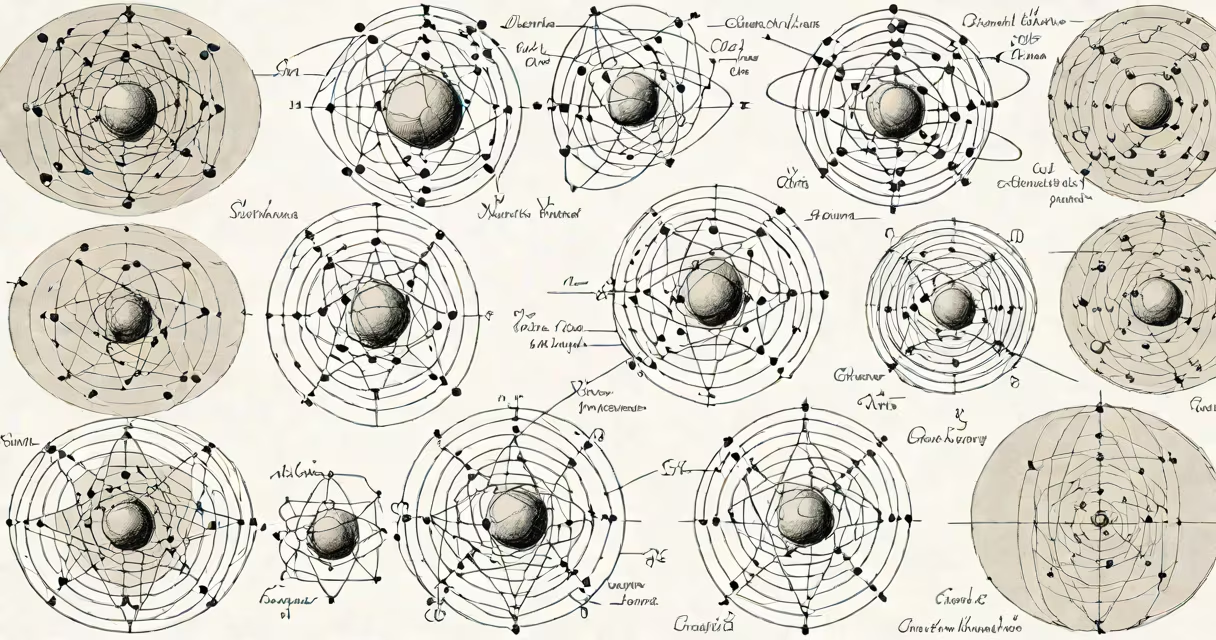
The 5 atomic model describes the five major stages in the development of atomic theory-from ancient philosophical ideas to the modern quantum mechanical model. Each stage introduced new evidence and corrected previous assumptions about the structure of matter.
Atomic theory began with the Greek philosopher Democritus, who proposed that all matter consists of indivisible particles called atoms. This idea had no experimental basis and remained speculative for over two millennia. The first scientific model emerged in 1803 when John Dalton formulated a system based on measurable properties: elements combine in fixed ratios, and atoms are indestructible units of matter. His model explained chemical reactions but could not account for subatomic particles.
In 1897, J.J. Thomson discovered the electron using cathode ray tubes. He proposed the plum pudding model: atoms are positively charged spheres with electrons embedded like plums in a pudding. This was the first model to acknowledge internal structure. However, it failed to explain results from Ernest Rutherford's gold foil experiment in 1909, which showed that most of an atom's mass is concentrated in a tiny, dense nucleus.
Rutherford's nuclear model replaced the plum pudding concept. He described atoms as mostly empty space, with electrons orbiting a central positive nucleus. This model correctly predicted that alpha particles would pass through thin metal foils with occasional large deflections. But it couldn't explain why electrons didn't spiral into the nucleus due to electromagnetic radiation-a problem resolved by Niels Bohr in 1913.
Bohr's model introduced quantized energy levels. Electrons occupy specific orbits around the nucleus and only emit or absorb energy when jumping between them. This explained hydrogen's emission spectrum precisely. However, it failed for multi-electron atoms and did not describe electron behavior accurately beyond hydrogen.
The final stage, the quantum mechanical model, emerged in the 1920s. Erwin Schrödinger's wave equation describes electrons not as particles in fixed orbits but as probability clouds. Electrons exist in orbitals-regions where they are likely to be found. This model underpins modern chemistry, materials science, and electronics.
| Model | Proposed By | Key Feature | Limitation |
|---|---|---|---|
| Indivisible Atom | Democritus (c. 400 BCE) | Atoms are solid, unbreakable units | No experimental support |
| Dalton's Billiard Ball | John Dalton (1803) | Atoms are unique to each element | Could not explain ions or isotopes |
| Plum Pudding | J.J. Thomson (1897) | Electrons embedded in positive matrix | Failed to predict scattering patterns |
| Nuclear Model | Ernest Rutherford (1911) | Central nucleus with orbiting electrons | Electrons should collapse into nucleus |
| Quantum Model | Erwin Schrödinger et al. (1926) | Electrons as probability distributions | Complex math required for predictions |
The 5 atomic model is not a single theory but a historical progression. Each step addressed gaps in the prior model. For example, Bohr's model solved the stability issue in Rutherford's design by restricting electron energy to discrete values. Yet even Bohr's model could not explain the fine structure of spectral lines, which required relativistic corrections and spin-features absent in early versions.
A common misconception is that the Bohr model is still accurate. It is not. While it explains hydrogen's spectrum well, it fails for helium and heavier elements. Modern textbooks use the quantum model exclusively. The Bohr model persists in education because it simplifies complex concepts for beginners-but it misrepresents reality.
Another misunderstanding involves the term "atomic model." Some assume it refers to a physical object. The 5 atomic model is not a machine or a diagram. It is a structure for describing how atoms behave. The models are mathematical constructs, not visual blueprints. They evolve as new data emerges.
Consider iron, an element with atomic number 26. Its electron configuration is 1s² 2s² 2p⁶ 3s² 3p⁶ 4s² 3d⁶. This arrangement determines iron's magnetic properties and reactivity. The quantum model explains why iron can form multiple oxidation states-something earlier models could not. Without this level of detail, technologies like MRI machines and semiconductors wouldn't function.
I once built a classroom model of the Bohr atom using colored beads and wire. Students placed electrons in orbits. The activity helped visualize energy levels. But when we discussed why electrons don't radiate energy while orbiting, the model broke down. That moment highlighted the gap between intuition and physics: a model can be useful for teaching, but it must not be mistaken for truth.
Understanding the 5 atomic model clarifies how science progresses. Each model corrects flaws in the last. The quantum model is not perfect-it cannot predict exact electron positions-but it is the most accurate description available. It enables technologies from solar cells to quantum computers.
The 5 atomic model represents humanity's evolving grasp of matter. From invisible particles to probabilistic clouds, each model reflects both the tools and the questions of its time. The process continues today, as researchers probe quark-gluon plasma and dark matter-new frontiers in atomic-scale understanding.