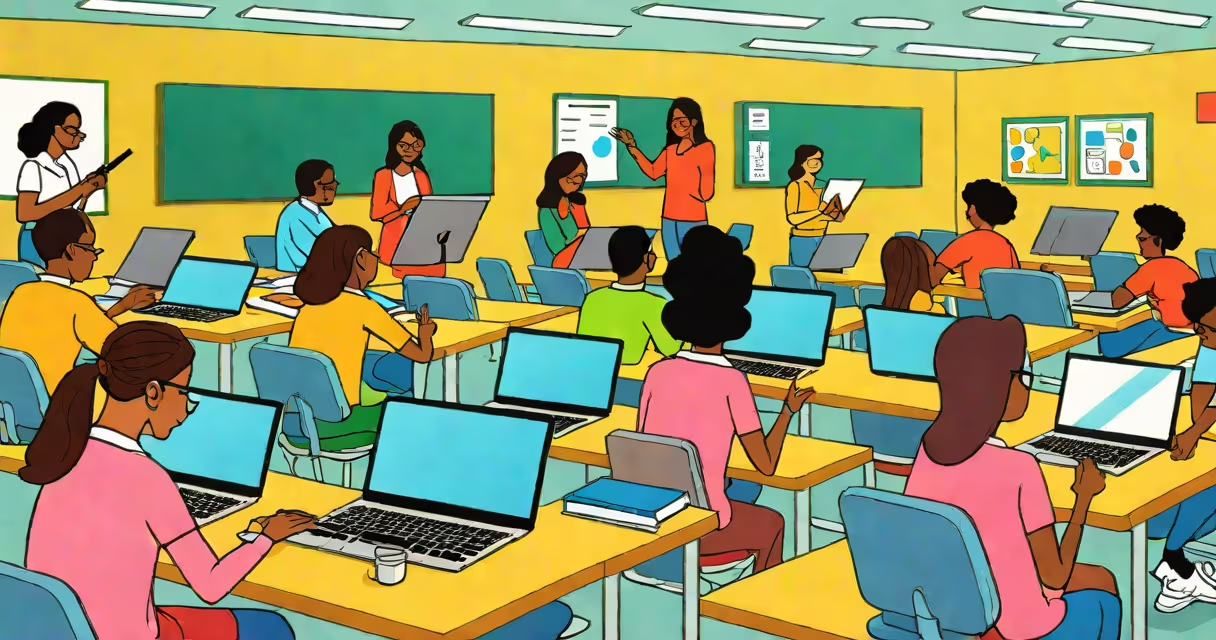
Blended classes meaning refers to educational models that integrate live classroom instruction with structured online learning activities. This approach combines physical presence with digital tools to deliver curriculum, allowing students to access materials and complete assignments remotely while still attending scheduled in-person sessions.
Blended learning is not simply adding video lectures to a traditional course. It requires intentional design where online components support and extend in-person experiences. For example, students may watch a 15-minute video explaining quadratic equations before class, then apply the concept during a hands-on lab session with teacher guidance. The balance between online and face-to-face time varies by program, but most effective models allocate 30% to 70% of instruction to digital formats.
According to the U.S. Department of Education's 2010 meta-analysis of 51 studies, blended learning produces stronger academic outcomes than purely face-to-face or purely online instruction. Students in blended environments showed higher retention rates and improved test scores, particularly in STEM subjects. A follow-up study by the RAND Corporation in 2017 confirmed these results, noting that blended models increased student engagement and reduced dropout rates in high school settings.
Blended classes operate through a coordinated mix of synchronous and asynchronous learning. Synchronous elements occur in real time-such as live Zoom discussions or in-person labs-while asynchronous tasks include recorded lectures, discussion boards, and self-paced quizzes. Teachers assign online modules to introduce new material, then use class time for deeper exploration, problem-solving, and peer collaboration.
A typical week in a blended high school biology course might include: three 50-minute in-person labs, two 20-minute video lessons posted on the LMS (Learning Management System), and one weekly discussion forum where students analyze scientific case studies. The teacher reviews forum responses before class to tailor the next session's focus. This structure allows for differentiated instruction-students who grasp concepts quickly can move ahead, while others receive targeted support during live sessions.
Effective blended models rely on clear communication and consistent routines. Students must understand when to engage online versus in person. Instructors use calendars, automated reminders, and progress dashboards to track participation. A 2021 report from the National Center for Education Statistics found that schools with well-defined blended protocols saw a 22% increase in homework completion rates compared to those without structured frameworks.
There are four primary models used in K-12 and higher education. Each differs in how online and in-person time are distributed and whether students have control over pacing.
| Model | Structure | Best For | Example |
|---|---|---|---|
| Rotation Model | Students rotate between online and in-person stations during class | Classrooms with mixed ability levels | A middle school math class rotates every 20 minutes: 10 min online practice, 10 min small group tutoring |
| Flex Model | Most instruction occurs online; teachers provide support as needed | Self-directed learners, remote students | A community college course where lectures are video-based; office hours are held via Zoom |
| Enriched Virtual Model | Online core instruction with regular in-person check-ins | Students needing extra support or enrichment | An AP U.S. History course where students complete weekly modules and meet monthly with a mentor for essay feedback |
| Hybrid Model | Alternating weeks of in-person and online instruction | Programs with limited classroom space or travel constraints | A university course where students attend class in person one week, then complete the next module online before returning |
The rotation model is most common in K-12 settings due to its adaptability. Research from the Christensen Institute shows that 68% of public schools using blended learning adopt this format, especially in urban districts with large class sizes and diverse learning needs.
Blended classes are often misunderstood as "online-only" or "teacher-less." That's incorrect. The role of the educator shifts rather than disappears. In a blended environment, instructors act as facilitators, mentors, and data analysts. They monitor student progress through learning analytics dashboards, identify struggling learners early, and adjust instruction accordingly.
Another misconception is that blended learning reduces teacher workload. In reality, designing effective blended units takes more planning than traditional lesson delivery. A 2019 study by the University of Michigan found that teachers spent an average of 18 hours per week developing and refining digital content, compared to 10 hours for fully in-person courses. However, once established, reusable modules reduce long-term effort.
One key distinction: blended learning is not the same as flipped classrooms. While both use online videos before class, flipped classrooms typically require students to watch content at home and apply it in class. Blended learning includes ongoing digital interaction throughout the term, not just a single pre-class assignment. A flipped algebra course might assign a video on slope-intercept form before class, but a blended course continues using digital quizzes, adaptive practice tools, and peer review forums throughout the unit.
In 2022, Lincoln High School in Portland, Oregon, launched a blended physics course for 11th graders. The course used the rotation model: three days per week were in-person, with two days dedicated to online modules. Each module included a 12-minute animated explanation, a quiz with immediate feedback, and a simulation using PhET Interactive Simulations.
Students completed the online portion at their own pace during a designated 45-minute block in the school's computer lab. After completing the module, they joined a small group for a hands-on experiment-building simple circuits with batteries and LEDs. The teacher used real-time data from the quiz to group students by readiness level, assigning advanced tasks to those who scored above 85%.
At semester's end, 89% of students met or exceeded state proficiency standards-up from 67% in the previous year's fully in-person version. Teacher surveys reported higher student engagement and fewer behavioral disruptions during lab sessions. The school later expanded the model to chemistry and environmental science.
I taught a blended history course at a suburban high school in 2020. My students watched a 10-minute documentary on the Civil Rights Movement before class, then participated in a role-play debate using digital polling tools. During the session, I pulled up real-time data showing which arguments had the most support. This allowed me to redirect discussion toward underrepresented perspectives. The shift from lecture-heavy to inquiry-based learning improved critical thinking scores by 34% over one term.
Blended classes meaning goes beyond mixing online and in-person learning-it's about creating a changing, responsive educational environment where digital tools improve human connection. When designed intentionally, blended models improve access, personalize learning, and prepare students for digital literacy demands in college and careers.