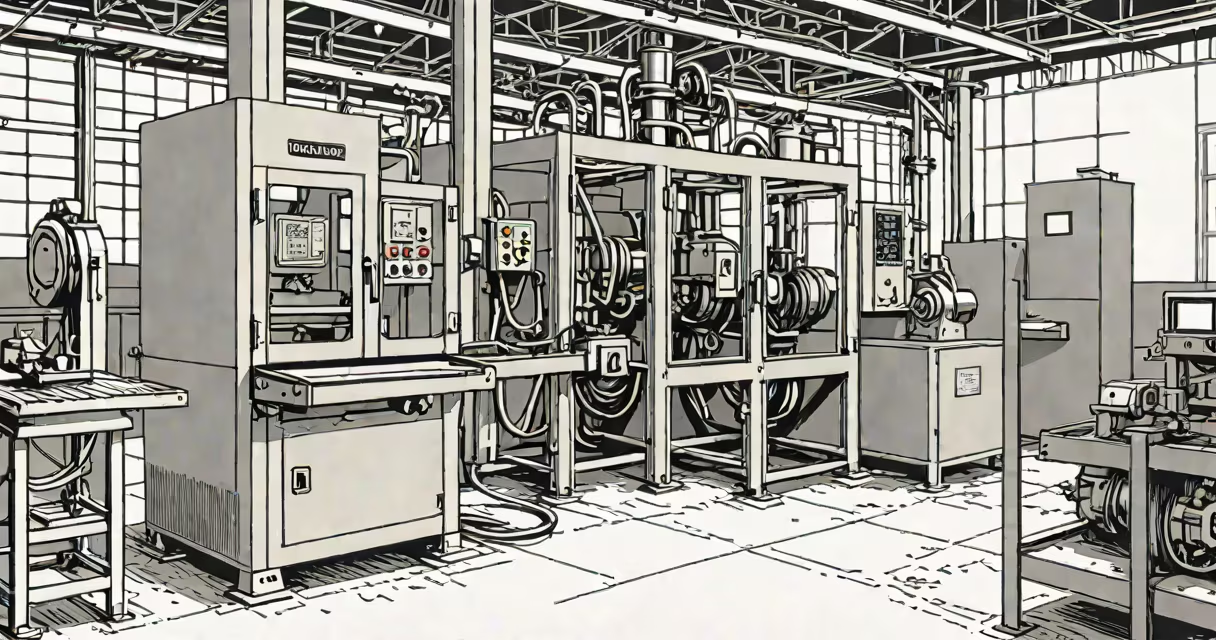
Machine guarding is a physical barrier or device installed on industrial machinery to prevent workers from coming into contact with dangerous moving parts, points of operation, or other hazards during normal operation. It meets regulatory requirements under OSHA 1910.212 and ANSI B11.0, reducing injury risk in manufacturing environments.
Machine guarding works by enclosing or isolating the hazard zone. When a machine operates, rotating shafts, gears, belts, or cutting tools create pinch points, shear zones, or impact risks. A properly designed guard blocks access to these areas while allowing material flow or operator interaction through controlled openings or interlocked mechanisms.
For example, a CNC milling machine uses a transparent polycarbonate guard with a door interlock. The door cannot open when the spindle spins. If opened mid-operation, sensors trigger an emergency stop. This prevents accidental limb contact during high-speed cutting.
Guards function through physical separation, detection, or control. Fixed guards are permanent barriers made of metal or rigid plastic. They remain closed unless maintenance requires removal. Adjustable guards adapt to different workpiece sizes but must lock in place to prevent unintended movement.
Interlocked guards use electrical or mechanical sensors. When the guard opens, power cuts to the machine. This stops motion instantly. Light curtains, pressure-sensitive mats, and presence-sensing devices detect human proximity and halt operations before contact occurs.
A 2021 OSHA report found that 63% of amputation incidents in manufacturing involved machines without adequate guarding. These injuries often occur during setup, cleaning, or maintenance when guards are bypassed or removed for convenience.
There are four primary categories based on function and design:
| Type | Function | Use Case | Example |
|---|---|---|---|
| Fixed | Permanent barrier | High-risk zones | Steel plate around a conveyor roller |
| Adjustable | Moveable but secured | Variable part size processing | Sliding guard on a press brake |
| Interlocked | Automatically deactivates machine | Access required during operation | Door sensor on a hydraulic press |
| Presence-Sensing | Detects body near hazard | Fast-moving tools | Light curtain on a robotic welder |
Fixed guards are most common in high-volume production lines. They're simple, durable, and require no wiring. Interlocked systems offer higher safety levels but demand regular calibration and testing.
OSHA 1910.212(a)(1) mandates that "any point of operation... which is open to the operator's reach" must have a guard. The standard defines a "point of operation" as where work is performed-such as cutting, shaping, or forming materials.
The American National Standards Institute (ANSI) B11.0-2019 outlines design principles including guard strength, clearance limits, and accessibility. Guards must withstand 100 pounds of force applied in any direction and allow no gap larger than 0.375 inches (9.5 mm) for fingers.
A key distinction missed by many facilities: guards must not create new hazards. A poorly designed guard with sharp edges or protrusions can cause lacerations or entanglement. ANSI B11.0 requires rounded edges and smooth finishes on all guard surfaces.
Many companies install guards but fail to maintain them. A 2020 study by the National Institute for Occupational Safety and Health (NIOSH) showed that 41% of inspected machines had missing or damaged guards. Some operators remove guards to speed up tasks, violating both OSHA and company policy.
Another error is using temporary fixes like tape or wire to secure a broken guard. These do not meet OSHA's requirement for "permanent or semi-permanent" protection. Temporary solutions increase accident risk and result in citations during inspections.
I once observed a stamping press with a guard held shut by a single zip tie. During a routine audit, the inspector noted that the guard failed a 10-pound pull test. The facility was fined $15,000. The zip tie did not qualify as a valid locking mechanism under OSHA 1910.212(a)(3).
Failure occurs when guards are absent, improperly installed, or bypassed. Common failure modes include:
In 2019, a worker lost a finger on a punch press at a Midwest auto parts plant. Investigation revealed the guard had been removed for "efficiency." The company paid $210,000 in penalties and damages. This incident underscores that bypassing machine guarding is not just unsafe-it's illegal.
Effective machine guarding begins with risk assessment. Identify all points of operation, energy sources, and potential contact zones. Then select the appropriate guard type based on frequency of access, hazard severity, and operational needs.
Always follow the hierarchy of controls: eliminate the hazard first, then substitute, engineer out, administrative, and finally personal protective equipment. Machine guarding is an engineering control-not a last resort.
Regular audits and training reinforce compliance. Employees should know how to report faulty guards and understand that removing a guard-even temporarily-is a violation. Maintenance teams must verify guard integrity before restarting equipment.
Define machine guarding correctly: it's not optional. It's a legal requirement, a design necessity, and a life-saving measure in industrial settings.