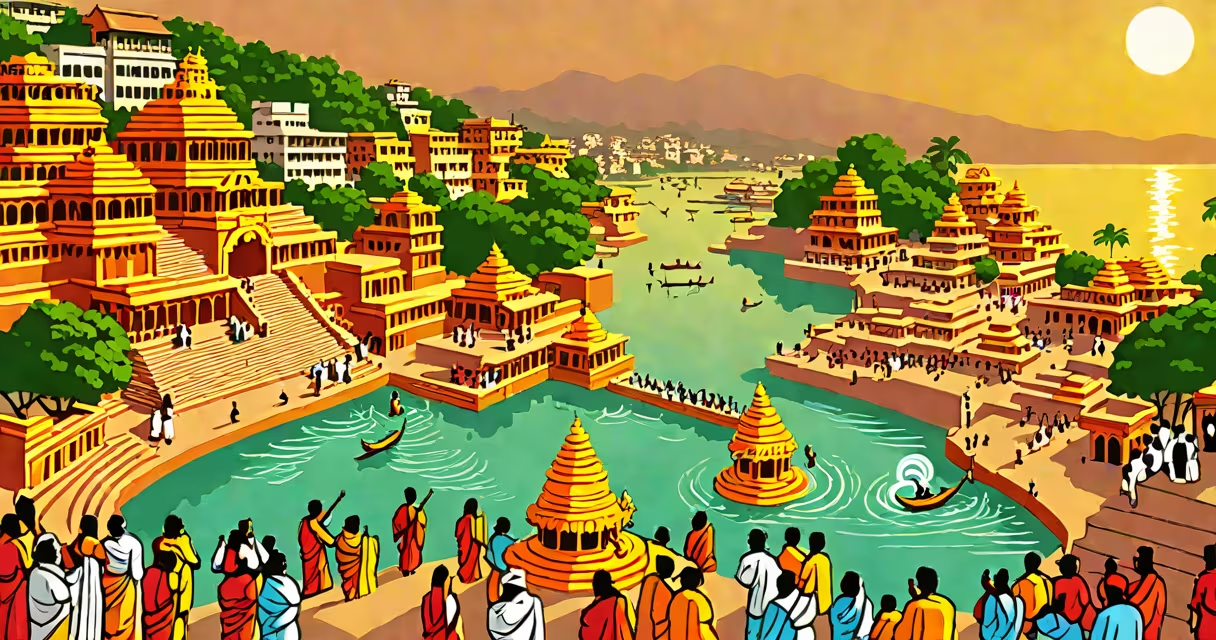
Har Ki Pauri is a prominent religious bathing stepwell on the banks of the Ganges River in Varanasi, Uttar Pradesh, India. It serves as a central site for ritual purification, daily worship, and major Hindu festivals. The name translates literally to "the footprints of God," referencing the divine presence believed to reside in the river's waters.
Located on the eastern bank of the Ganges, Har Ki Pauri is part of a series of 88 ghats-steps leading down to the river-that form the spiritual spine of Varanasi. Unlike many other ghats, which serve local communities or seasonal events, Har Ki Pauri is designed for continuous public access and large-scale ceremonial activity. Its location near the city's oldest temples, including Kashi Vishwanath, makes it a focal point for both daily rituals and major religious gatherings.
The ghat's structure follows traditional North Indian temple architecture. It consists of a wide, stepped platform descending into the river, flanked by stone railings and small shrines. The steps are made of sandstone and are worn smooth by centuries of feet. During morning hours, the ghat fills with people washing, offering prayers, and lighting incense. At dusk, the evening Ganga Aarti ceremony draws thousands of visitors who gather to witness the synchronized waving of lamps and chants.
At dawn, priests begin chanting mantras from the edge of the steps. Devotees bathe in the river, believing the water purifies sins and aids liberation (moksha). This practice is rooted in ancient texts like the Puranas, which describe the Ganges as a goddess capable of cleansing even the heaviest karmic burdens.
Each day, hundreds of pilgrims arrive at Har Ki Pauri. Some come for a single dip; others stay for days to meditate, attend lectures, or participate in community meals. The ghat operates 24/7 during peak seasons, with staff managing crowd flow and safety. Firewood is burned in designated areas to create smoke for ritual offerings, and marigold garlands are laid on the water's surface.
A key feature is the timing of the Ganga Aarti. Performed nightly at 7:30 PM, it involves 52 priests standing on the steps, holding flaming torches while singing hymns. The event lasts about 45 minutes and is accompanied by music from cymbals, drums, and bells. Visitors report feeling a deep sense of calm during the ritual, though the space becomes extremely crowded-up to 5,000 people may gather on weekends.
While all Varanasi ghats share core features-steps, shrines, and river access-each has distinct functions. Har Ki Pauri stands out due to its scale, visibility, and role in mass ceremonies.
| Ghat Type | Primary Function | Example Location |
|---|---|---|
| Temple-adjacent | Ritual bathing linked to specific deities | Manikarnika Ghat (for cremation) |
| Community-use | Daily washing, cooking, and social gathering | Dasashwamedh Ghat (popular with tourists) |
| Mass-ceremony | Large-scale rituals, festivals, and processions | Har Ki Pauri (main site for Ganga Aarti) |
Har Ki Pauri is classified as a mass-ceremony ghat. Its design prioritizes visibility and accessibility. The steps are wider than average-about 1.5 meters across-to accommodate large groups. The central platform includes a raised shrine housing a statue of Lord Shiva, which is bathed daily in milk and water.
Unlike Manikarnika Ghat, which is reserved for funeral rites and remains closed to non-deceased-related activities, Har Ki Pauri welcomes all visitors regardless of caste, religion, or nationality. Foreign tourists often visit during sunrise, when the light reflects off the river and casts golden hues on the stone steps.
Many assume Har Ki Pauri is the only major ghat in Varanasi. In reality, it is one of several hundred. The city's ghats span nearly 2 kilometers along the riverbank, with each serving different purposes. Har Ki Pauri is not the oldest-Benares' oldest ghat is Panchganga, dating to the 12th century-but it is among the most visited.
Another misconception is that the name "Har Ki Pauri" refers to physical footprints. While the term "Har" means "Lord" (typically Shiva), and "Pauri" means "footstep," the name is symbolic. There are no actual footprints preserved at the site. The name evokes the idea of divine presence rather than a literal relic.
Some travelers believe they must bathe in the Ganges to gain spiritual benefit. While immersion is encouraged, scholars at the University of Delhi note that the psychological and communal aspects of the ritual are equally significant. A 2019 study published in the Journal of Religion and Health found that participants who engaged in group bathing reported higher levels of perceived well-being than those who did not.
I visited Har Ki Pauri at 5:15 AM during Diwali week. The air was cool, and the sound of distant bells mixed with low chants. I joined a group of pilgrims at the lower steps, where water reached my waist. As I dipped my hands into the river, a priest placed a tilak (vermilion mark) on my forehead and recited a verse from the Bhagavad Gita: "Yada yada hi dharmasya..." (Whenever dharma declines...).
Afterward, I walked to the upper platform and watched the Aarti begin. The flames from the oil lamps danced in the breeze. A woman nearby wept silently. Later, I learned she had come from Kolkata to fulfill a vow made after her mother's recovery from illness. Her story was not unique-many visitors cite personal transformation tied to their time at the ghat.
Har Ki Pauri is a living center of Hindu devotion, where ancient rituals meet modern pilgrimage. It is not merely a tourist attraction but a functioning spiritual space where belief, ritual, and community converge. The site exemplifies how sacred geography shapes religious experience in India. For millions, it remains a place where the divine feels close enough to touch.