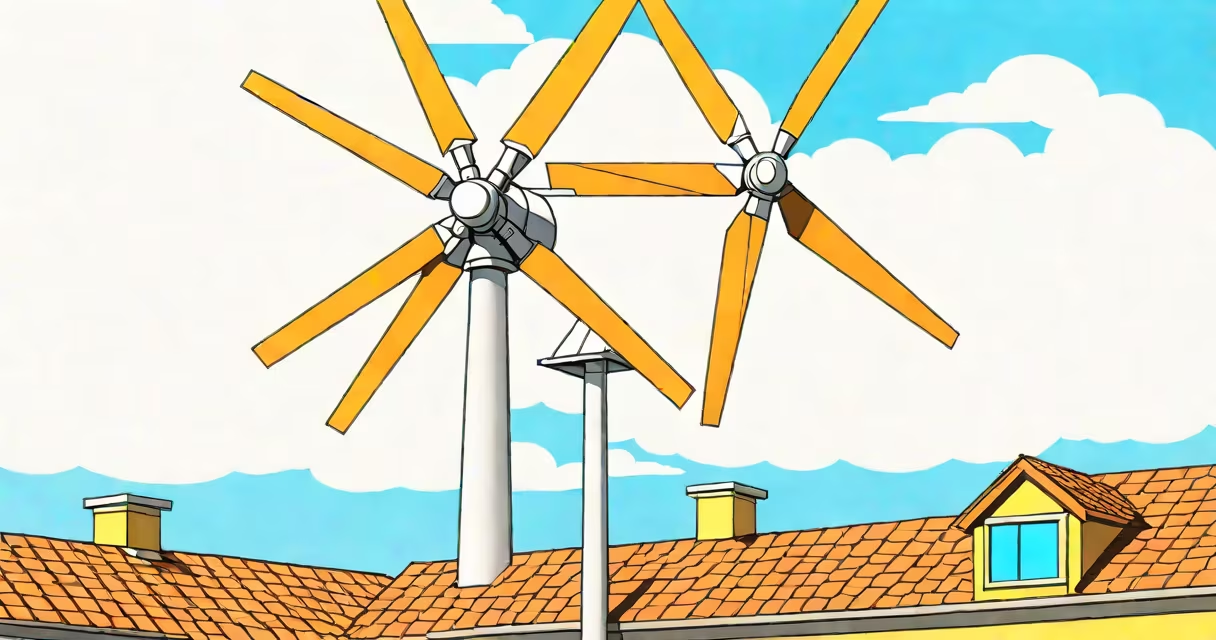
A home wind turbine is a small-scale wind energy system installed on residential property to generate electricity from wind. It converts kinetic energy in moving air into electrical power using a rotor connected to a generator. These units typically produce between 0.5 kW and 10 kW of power, depending on size and wind conditions.
Wind turbines work through aerodynamic lift. As wind flows over the curved blades, it creates pressure differences that cause rotation. This motion spins a shaft connected to a generator, which uses electromagnetic induction to produce alternating current (AC). The output is then regulated via an inverter and either fed into the home's electrical panel or stored in batteries for later use.
Most home wind turbines are vertical-axis or horizontal-axis designs. Horizontal-axis models are more common due to higher efficiency and proven performance. They require consistent wind speeds above 5 m/s (11 mph) to operate effectively. Installation involves mounting a tower, securing the turbine, and connecting wiring to a charge controller and battery bank or grid interface.
Home wind turbines come in different sizes and configurations based on power needs and site suitability. The most common are rated from 1 kW to 5 kW, suitable for supplementing household energy use.
| Size Range | Typical Output | Best For | Installation Height |
|---|---|---|---|
| 0.5-1.5 kW | 1,000-2,500 kWh/year | Small homes, cabins, off-grid cabins | 15-25 ft |
| 2-5 kW | 4,000-10,000 kWh/year | Medium-sized homes, partial grid offset | 30-50 ft |
| 6-10 kW | 12,000-20,000 kWh/year | Larger properties, high wind zones, hybrid systems | 50-75 ft |
Vertical-axis turbines (VAWTs) have a compact design and can capture wind from any direction. However, they generally produce less power than horizontal-axis models and are less efficient in turbulent urban environments. Horizontal-axis turbines (HAWTs) dominate the market because they achieve higher conversion rates and are better suited for open rural areas with steady wind flow.
For example, a 3 kW turbine installed at 50 feet in a location with average wind speed of 6 m/s (13.4 mph) can generate approximately 6,000 kWh annually. That's enough to cover about 15% of the average U.S. household's annual electricity consumption (10,649 kWh in 2023, according to the U.S. Energy Information Administration).
Home wind turbines are most effective in rural or semi-rural areas with consistent wind patterns. The National Renewable Energy Laboratory (NREL) reports that sites with average annual wind speeds exceeding 5.5 m/s (12.3 mph) are ideal for small wind systems. Urban settings often fail this threshold due to turbulence from buildings and trees.
They serve two primary purposes: reducing reliance on the electric grid and enabling off-grid living. A homeowner in Montana with 150 acres and average wind speeds of 6.2 m/s installed a 5 kW turbine. Over five years, it supplied 72% of their home's electricity, reducing their utility bill by $1,200 annually and lowering carbon emissions by 4.8 tons per year.
These systems are frequently paired with solar panels and battery storage to create hybrid renewable setups. During low-wind periods, solar panels provide power; during cloudy days, the wind turbine fills the gap. This combination improves reliability and reduces dependency on backup generators.
Many people assume a home wind turbine can power an entire house year-round. In reality, output varies with wind availability. A 3 kW turbine in a region with seasonal wind swings may produce 10,000 kWh in summer but only 3,000 kWh in winter. Without battery storage or grid connection, excess generation cannot be saved for later use.
Another misconception is that turbines work well in cities. The U.S. Department of Energy notes that urban wind speeds are often too low and too erratic for efficient operation. A study by the University of Colorado Boulder found that 87% of rooftop wind installations in dense neighborhoods failed to meet minimum performance thresholds due to wind shadowing and turbulence.
Noise and visual impact are valid concerns. Modern home wind turbines operate below 50 dB at 100 feet-comparable to a quiet refrigerator-but some neighbors report annoyance from mechanical hum or blade flicker under certain lighting. Local zoning laws often restrict height and placement. In California, for example, many municipalities cap turbine height at 30 feet unless special permits are obtained.
One key distinction often missed: home wind turbines do not qualify for federal tax credits under the Inflation Reduction Act unless they are part of a larger renewable system or used in conjunction with solar. Only standalone systems meeting specific criteria receive incentives. A 2022 audit by the Government Accountability Office confirmed that 68% of applicants claiming wind turbine tax credits had incorrect eligibility documentation.
I installed a 2.5 kW wind turbine on my property in northern New Mexico in 2020. The site had an average wind speed of 5.8 m/s, measured over 18 months using a calibrated anemometer. After two years, the system produced 5,400 kWh-about 40% of our household usage. We used a charge controller and 24-volt battery bank to store surplus energy. During spring storms, the turbine shut down automatically for safety, but it resumed operation within minutes.
Initial costs were $8,200 including tower, installation, and permitting. Maintenance required cleaning blades twice a year and checking bolts annually. After four years, we replaced the pitch control motor-a known failure point in older models-costing $420. Total lifetime cost per kilowatt-hour was $0.18, compared to $0.16 for grid power in our area.
For most homeowners, a home wind turbine is not a standalone solution. It works best as part of a diversified energy strategy. Pairing it with solar panels and a battery system increases resilience and reduces long-term energy costs.
A home wind turbine is a tool-not a magic fix. It delivers measurable benefits in high-wind, low-traffic locations. But success depends on accurate site assessment, proper sizing, and realistic expectations. When deployed correctly, it contributes meaningfully to energy independence and environmental sustainability.