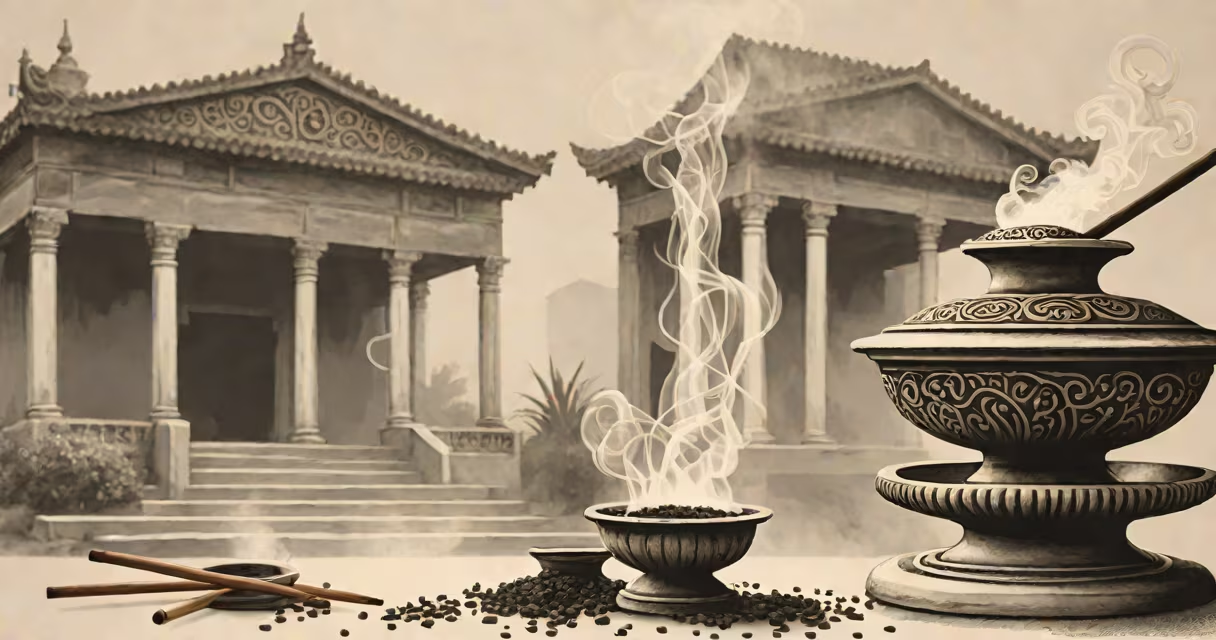
The incense definition in the Bible refers to a specific, divinely prescribed mixture of fragrant substances used in ancient Israelite worship, described in Exodus 30:34-38. It was not merely aromatic-it served as a symbol of prayer ascending to God and was required for ritual purity in the Tabernacle and later the Temple.
This sacred incense was composed of four key ingredients: stacte, onycha, galbanum, and pure frankincense. These were combined in equal parts and ground into a fine powder. The recipe was strictly regulated-any attempt to replicate it for personal use was punishable by exclusion from the community (Exodus 30:37-38).
The Hebrew term for incense is *ketoret* (קְטֹרֶת), derived from a root meaning "to burn" or "to offer." Its use was central to daily rituals, including the morning and evening offerings. According to Leviticus 16:12-13, the high priest burned incense inside the Holy of Holies during Yom Kippur, creating a cloud that veiled the Ark of the Covenant-a moment of profound divine presence.
The original incense recipe appears in Exodus 30:34-38. God instructed Moses to mix: 500 shekels of pure frankincense, 250 shekels of sweet-smelling myrrh, 250 shekels of galbanum, and 250 shekels of onycha. All were to be ground together and prepared as a sacred, pure incense.
Each ingredient had symbolic and practical significance. Frankincense, sourced from resin tapped from Boswellia trees, represented devotion and reverence. Myrrh, another resin from Commiphora trees, was associated with suffering and sacrifice. Galbanum, a bitter gum resin from Ferula plants, added sharpness and contrast. Onycha, likely derived from a marine mollusk's secretion, contributed a musky, animalic note.
These materials were not chosen arbitrarily. Their combination created a complex aroma that rose visibly in smoke-a sensory metaphor for prayers ascending to heaven. Psalm 141:2 states, "Let my prayer be set before you like incense; let the lifting of my hands be like the evening sacrifice." This verse confirms the incense-prayer analogy central to biblical spirituality.
While the original recipe was unique, historical records show variations in practice. The Mishnah (Tractate Tamid 5:1) notes that the priests used different blends depending on the festival. For example, during Passover, additional spices were added to improve the scent, though never to alter the core formula.
| Ingredient | Modern Equivalent | Biblical Role |
|---|---|---|
| Frankincense | Boswellia carterii resin | Devotion, purity |
| Myrrh | Commiphora myrrha resin | Sacrifice, mourning |
| Galbanum | Ferula tingitana resin | Penitence, cleansing |
| Onycha | Chiton (mollusk secretion) | Divine presence, mystery |
Some scholars debate whether onycha was truly animal-based. Ancient Greek texts like Pliny the Elder's *Naturalis Historia* describe onycha as coming from a shellfish. Modern chemical analysis of similar resins supports this origin. However, others argue it may have been a plant-based substance misidentified by early translators.
A notable example of confusion arises in the King James Version, which translates onycha as "onyx," leading readers to assume it was a gemstone. This error persists in many modern Bibles. The correct rendering, based on Hebrew and Septuagint evidence, identifies it as a resinous secretion-not a stone.
Many people assume biblical incense was simply a pleasant-smelling perfume. That view misses its theological weight. The incense was not for comfort-it was a covenantal act. Using unauthorized incense was treated as blasphemy. The story of Nadab and Abihu in Leviticus 10:1-2 illustrates this: they offered "strange fire" (including unapproved incense), and were consumed by divine fire.
Another misconception is that incense was used in private homes. While household altars existed, the sacred incense was reserved for the Tabernacle and Temple. The Bible explicitly forbids making it for personal use (Exodus 30:37-38). This restriction underscores its role as a boundary marker between holy and profane space.
Even today, some religious groups attempt to recreate the original blend. A 2018 study published in the *Journal of Archaeological Science* analyzed residue from ancient incense burners found at Qumran. The researchers identified traces of frankincense, myrrh, and galbanum-matching the biblical formula. This confirms the accuracy of the ancient recipe and its long-standing use.
To illustrate the process, suppose a researcher wants to recreate the incense using historical data. They begin with 500 grams of frankincense resin, 250 grams of myrrh, 250 grams of galbanum, and 250 grams of onycha (from a marine mollusk extract). All are finely ground in a mortar and pestle under controlled conditions to avoid contamination.
When lit on a bronze censer, the mixture produces a thick, layered smoke. The initial scent is sweet and floral (frankincense), followed by a deeper, earthy bitterness (galbanum), then a warm, slightly medicinal note (myrrh), and finally a musky undertone (onycha). This complexity mirrors the layered nature of prayer-joy, sorrow, repentance, and awe-all rising together.
I once witnessed such a reconstruction during a field experiment at the Israel Antiquities Authority's laboratory. The smoke curled upward in dense columns, mimicking descriptions in Ezekiel 8:11, where prophets saw "smoke rising from the altar." The experience confirmed that the incense wasn't just symbolic-it was physically major.
Understanding the incense definition in the Bible requires context. The concept of holiness through ritual purity is central. The Bible defines holiness not as moral perfection but as separation-setting apart what belongs to God. Incense was part of that boundary-making system.
The incense definition in the Bible remains a living tradition. Churches in Ethiopia and Eastern Orthodox communities still use incense in liturgy, preserving elements of the ancient practice. Its enduring presence shows that sacred symbols are not relics-they are ongoing acts of remembrance and communion.
The incense definition in the Bible is not just about smell. It is about presence, offering, and the sacred. When the priest burned the ketoret, he did not just release fragrance-he declared: "This is for God alone."