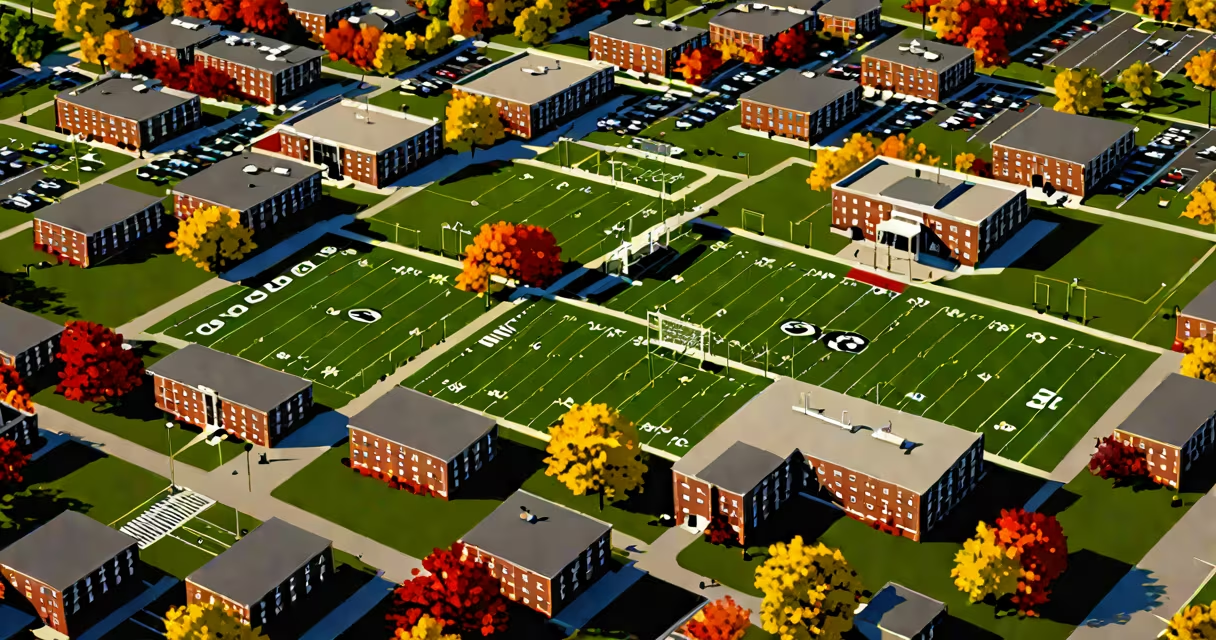
Richmond Community Schools is a public school district headquartered in Richmond, Michigan, serving approximately 1,250 students across kindergarten through grade 12 in Wayne County. The district operates three schools: Richmond High School, Richmond Middle School, and Richmond Elementary School, providing instruction in core academic subjects, career and technical education, and extracurricular programs.
The district was established in 1950, consolidating several rural school districts in the area. It currently administers state-mandated assessments, including the Michigan Student Test of Educational Progress (M-STEP), and reports annual performance data through the Michigan Department of Education's Public School District Information System.
Richmond Community Schools maintains a focus on college and career readiness, offering dual-enrollment opportunities with Henry Ford College and a full set of Advanced Placement courses. The district's mission emphasizes equity, achievement, and community engagement, with regular updates shared via its official website and social media channels.
Richmond Community Schools functions under a locally elected board of education, which sets policy, approves budgets, and oversees district leadership. The superintendent manages daily operations, including staffing, curriculum implementation, and facility maintenance.
Instruction follows the Michigan Academic Standards, with teachers required to hold valid state certifications. All schools participate in the National School Lunch Program, with free and reduced-price meals available based on household income. Transportation is provided for students living more than 1.5 miles from their assigned school.
Each school holds weekly staff meetings and quarterly parent-teacher conferences. The district uses PowerSchool for attendance tracking, grading, and communication between families and educators. Digital learning tools such as Google Classroom and Canvas are integrated into classroom instruction during hybrid and remote learning periods.
Richmond Community Schools includes three distinct educational levels:
| School Type | Grades Served | Enrollment (2023-2024) | Special Programs |
|---|---|---|---|
| Elementary | K-5 | 460 | Reading intervention, gifted education, special education support |
| Middle School | 6-8 | 320 | STEM lab, band, robotics club |
| High School | 9-12 | 470 | AP courses, CTE pathways, athletics, debate team |
Students in grades 9-12 may enroll in career and technical education (CTE) programs in automotive technology, health sciences, and business administration. These programs partner with local employers and offer industry certifications upon completion.
Special education services are delivered through individualized education plans (IEPs) developed by teams including parents, teachers, and specialists. The district contracts with the Wayne County Intermediate School District for additional support services.
Richmond Community Schools is often mistaken for a charter or private institution due to its consistent academic performance. It is a traditional public district funded primarily through property taxes and state aid, not tuition or private donations.
A common error is assuming the district includes all schools in the surrounding area. Richmond Community Schools serves only the township of Richmond and adjacent unincorporated areas. Nearby districts such as Montrose Community Schools and Pinckney Community Schools operate independently with separate governance and funding structures.
Another misconception is that all schools within the district follow the same calendar. While they share the same academic year, start dates and holiday breaks vary slightly by school level to accommodate staff development and student transitions.
In the 2023-2024 M-STEP results, 62% of Richmond High School students met or exceeded standards in English Language Arts, compared to the state average of 54%. Math proficiency stood at 58%, above the state average of 51%.
Graduation rates reached 92% in 2023, up from 87% in 2019. Of graduates, 68% enrolled in postsecondary education within six months, according to the district's annual report. The district also achieved a 94% attendance rate across all levels, exceeding the state benchmark of 90%.
These results were validated by the Michigan Department of Education's 2024 School Accountability Report Card, which rated Richmond Community Schools as "Excelling" in student achievement and "Meeting" in school climate and safety.
I visited Richmond High School during a career fair in October 2023. Over 30 local businesses and colleges set up booths. Students in the health sciences CTE program demonstrated patient care simulations using mannequins. A group of seniors presented a robotics project designed for a regional competition.
Teachers reported increased student engagement since the district adopted a new literacy initiative in 2022. Reading scores in middle school rose by 11 percentage points over two years. The district also implemented a peer tutoring program that reduced disciplinary incidents by 18% in the 2022-2023 school year.
Richmond Community Schools shares geographic proximity with other districts in southeastern Michigan. Montrose Community Schools, located about 12 miles west, serves a similar population size but has a higher proportion of students eligible for free lunch. Pinckney Community Schools, situated 20 miles northeast, has a larger high school enrollment and offers a wider range of AP courses.
Adams-Central Community Schools, while farther north in the state, shares a comparable demographic profile and graduation rate. However, Adams-Central has a higher percentage of students receiving special education services, indicating differences in local needs and resource allocation.
For comparison, Richmond Community Schools spends $12,800 per pupil annually, slightly below the state average of $13,200. This reflects lower administrative costs and efficient use of state and federal grants.
Richmond Community Schools remains focused on continuous improvement. The district updated its strategic plan in 2023, prioritizing literacy, mental health support, and teacher retention. Leadership has committed to increasing access to advanced coursework for historically underserved student groups.