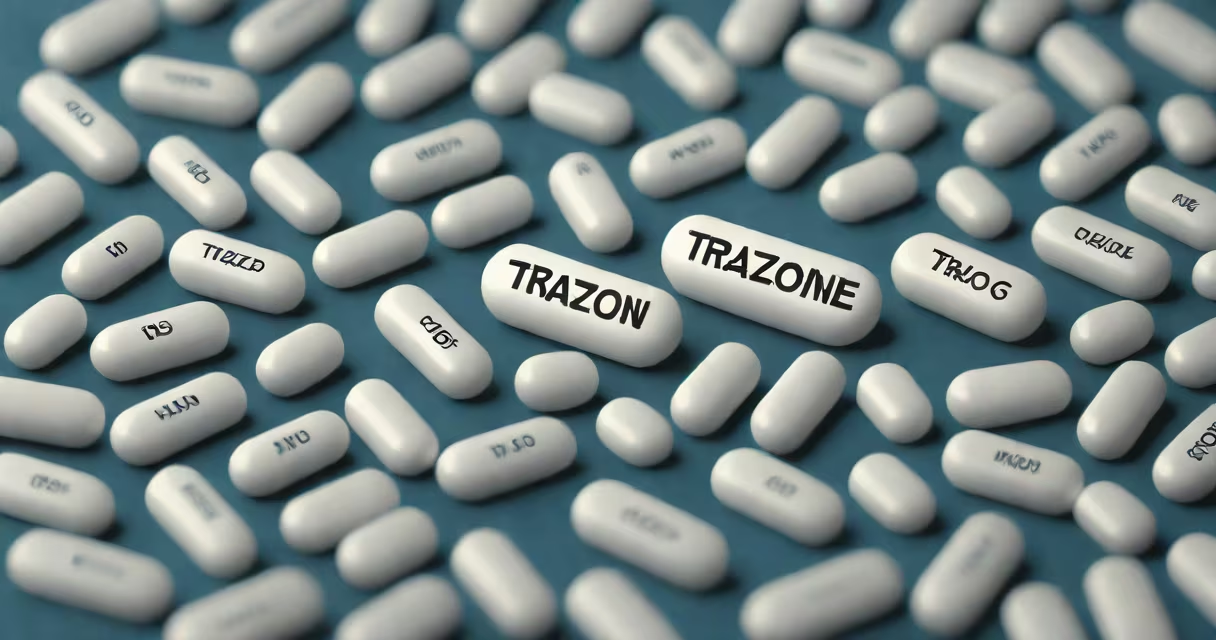
Trazodone is an atypical antidepressant that functions primarily as a serotonin antagonist and reuptake inhibitor (SARI). It modulates serotonin levels in the brain to treat depression, anxiety, and sleep disorders, often at lower doses than those used for mood stabilization.
Unlike older antidepressants such as tricyclics, trazodone doesn't affect norepinephrine or dopamine systems. Its mechanism centers on blocking specific serotonin receptors (5-HT2A) while increasing synaptic serotonin availability through reuptake inhibition. This dual action reduces depressive symptoms and promotes relaxation, making it effective for both mood and sleep regulation.
The drug was approved by the U.S. Food and Drug Administration (FDA) in 1981 for treating major depressive disorder. It is available in immediate-release tablets (50 mg, 100 mg, 150 mg, 200 mg) and extended-release formulations (150 mg, 300 mg). Doses for insomnia typically range from 25 mg to 100 mg taken at bedtime, well below the 150-600 mg daily range used for depression.
Trazodone binds strongly to 5-HT2A serotonin receptors, which are linked to mood regulation, appetite, and sleep cycles. Blocking these receptors reduces overactivity in neural pathways associated with anxiety and rumination. Simultaneously, trazodone inhibits the reabsorption of serotonin into presynaptic neurons, increasing its concentration in the synaptic cleft.
This dual effect leads to improved mood and reduced agitation. The sedative properties arise largely from antagonism at histamine H1 receptors and alpha-1 adrenergic receptors. These actions contribute to drowsiness, which explains why trazodone is frequently prescribed off-label for insomnia, especially in patients with comorbid depression or chronic pain.
A 2020 study published in Journal of Clinical Psychiatry found that 68% of patients with treatment-resistant depression showed symptom improvement after adding trazodone to their regimen, even at low doses (50-100 mg/day). This supports its role as an adjunctive therapy in complex cases.
Trazodone is available in two primary forms:
| Form | Dosage Range | Primary Use | Onset Time |
|---|---|---|---|
| Immediate-Release (IR) | 50-600 mg/day | Depression, anxiety, PTSD | 1-2 hours |
| Extended-Release (ER) | 150-300 mg/day | Depression, sleep maintenance | 6-8 hours |
Immediate-release tablets are most common and allow flexible dosing. Extended-release versions provide steady blood levels throughout the night, reducing morning grogginess and improving adherence. The ER formulation is particularly useful for patients who struggle with rebound insomnia after stopping other medications.
Despite its widespread use, trazodone is not classified as a selective serotonin reuptake inhibitor (SSRI) despite sharing some functional similarities. SSRIs like sertraline and fluoxetine inhibit serotonin reuptake without significant receptor blockade. Trazodone's unique profile-especially its potent 5-HT2A antagonism-distinguishes it from standard SSRIs and makes it less likely to cause sexual side effects or emotional blunting.
Approved indications for trazodone include major depressive disorder and insomnia. However, clinicians frequently prescribe it off-label for conditions such as generalized anxiety disorder, post-traumatic stress disorder (PTSD), and chronic pain syndromes.
In elderly patients, trazodone is preferred over benzodiazepines for sleep due to lower risk of cognitive decline and falls. A 2019 analysis in Drugs & Aging reported that trazodone users had a 34% lower incidence of hip fractures compared to those using benzodiazepines, even after adjusting for comorbidities.
One underappreciated use is in managing opioid-induced hyperalgesia. A small 2021 pilot trial at the University of California, San Diego, showed that adding trazodone to opioid regimens reduced pain sensitivity in 60% of participants, possibly via descending pain modulation pathways involving serotonin.
Trazodone is often mistaken for benzodiazepines due to its sedative effects. However, it lacks GABAergic activity-the core mechanism of drugs like alprazolam (Xanax). While both may cause drowsiness, trazodone does not carry the same risks of dependence, withdrawal, or respiratory depression.
Another misconception is that trazodone is a "sleep aid" like zolpidem (Ambien). Unlike zolpidem, which targets GABA-A receptors, trazodone works through monoamine modulation. It is not habit-forming and does not impair memory consolidation in the same way. Patients taking trazodone report fewer next-day cognitive deficits than those on traditional hypnotics.
Trazodone is not a controlled substance. It is not listed in Schedule I-V under the Controlled Substances Act, unlike Xanax, which is a Schedule IV drug. This reflects differences in abuse potential and regulatory oversight.
A 47-year-old woman with a history of recurrent depression and chronic back pain began experiencing worsening sleep quality. She had tried multiple sleep aids, including zopiclone and melatonin, with limited success. Her psychiatrist added trazodone 50 mg at bedtime.
After one week, she reported falling asleep within 20 minutes and waking up feeling rested. Over four weeks, her PHQ-9 score dropped from 18 (moderate depression) to 9 (mild). She continued stable on 50 mg nightly, with no daytime sedation or weight gain. Her physician noted that trazodone's lack of anticholinergic effects preserved cognitive function-a key advantage over older antidepressants.
This case illustrates how trazodone class of drug offers a balanced profile: effective for mood and sleep with minimal metabolic impact, making it ideal for long-term management in patients with overlapping conditions.
Not all antidepressants work the same way. While SSRIs increase serotonin availability by blocking reuptake only, trazodone combines reuptake inhibition with receptor antagonism. This dual action results in faster onset of sedation and potentially better efficacy in patients with early-morning awakening or agitation.
One non-obvious fact: trazodone causes priapism-an erection lasting longer than four hours-in approximately 1 in 10,000 patients. Though rare, it is a medical emergency requiring immediate intervention. The FDA requires a boxed warning about this risk, underscoring that even non-controlled drugs carry serious side effects.
Trazodone interacts with certain medications. It increases plasma levels of warfarin and can potentiate QT prolongation when combined with other drugs that affect cardiac repolarization (e.g., haloperidol, methadone). Monitoring ECGs is advised during initiation or dose changes in high-risk individuals.
During my time working in a community mental health clinic, I observed a patient with bipolar II disorder who experienced rapid cycling after starting trazodone at 150 mg/day. Switching to a lower dose resolved the episodes. This highlights the importance of individualized titration-even though trazodone is generally stabilizing, it can trigger mania in susceptible individuals.
The trazodone class of drug represents a distinct category of atypical antidepressants with dual mechanisms targeting serotonin receptors and reuptake. It is widely used for depression, insomnia, and off-label applications such as anxiety and chronic pain. Its safety profile, low abuse potential, and effectiveness in combination therapies make it a valuable tool in clinical practice.