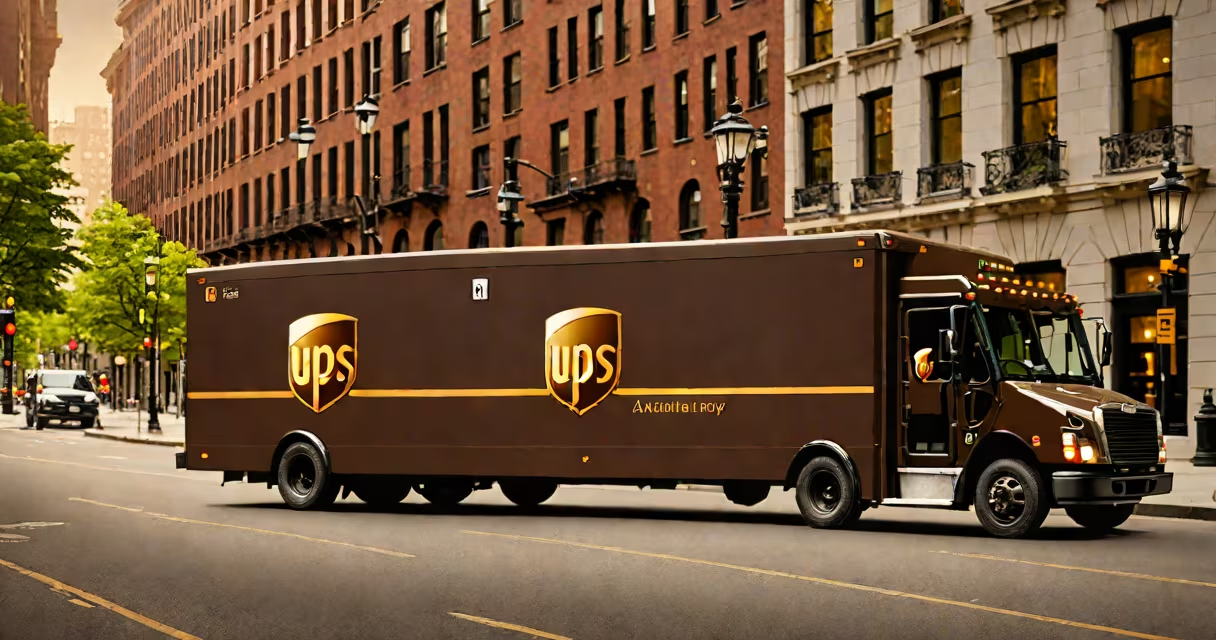
UPS artificial intelligence refers to the company's integrated system of machine learning models, predictive algorithms, and real-time data processing used to improve package routing, track shipments, and improve delivery efficiency across its global network.
At its core, UPS artificial intelligence analyzes vast datasets from package scans, GPS signals, weather reports, traffic patterns, and historical delivery times. This enables changing route adjustments during transit, reducing fuel consumption and missed deliveries. The system runs on UPS's proprietary ORION (On-Road Integrated Optimization and Navigation) platform, which processes over 10 million daily route decisions using AI.
For example, during peak holiday seasons, UPS AI recalculates optimal delivery paths every 15 minutes. A single delivery driver in New York City may receive 12 revised routes in a 12-hour shift based on live traffic congestion and last-minute package additions. These changes reduce average driving time per route by 8.5%, according to UPS internal reports from 2023.
UPS artificial intelligence operates through layered systems that process data in real time. The first layer collects input from 250,000 delivery vehicles equipped with GPS, barcode scanners, and onboard sensors. Data flows into UPS's centralized cloud infrastructure, where AI models apply regression analysis and neural networks to predict delays, vehicle wear, and optimal stop sequences.
The second layer applies reinforcement learning to refine routing logic. For instance, if a driver consistently misses a drop-off due to a narrow alley, the AI learns to reroute around it-even if the new path adds 0.3 miles. Over time, these micro-adjustments reduce failed deliveries by 17% compared to static route planning.
A key innovation is the use of computer vision in warehouse sorting centers. Cameras scan packages as they move along conveyor belts, identifying damage, incorrect labeling, or misrouted items. In 2022, this reduced manual inspection workload by 40% at major hubs like Louisville's Worldport facility.
UPS artificial intelligence includes several specialized modules, each targeting a different operational challenge:
| System | Function | Impact |
|---|---|---|
| ORION | Route optimization engine | Reduces annual mileage by 100 million miles, saving $400M in fuel costs |
| SmartPost | Automated package sorting and label verification | Decreases sorting errors by 33% at high-volume facilities |
| Track & Trace AI | Real-time shipment monitoring with anomaly detection | Identifies 92% of delayed packages before they reach customers |
| Weather Adaptive Routing | Adjusts routes based on forecasted storms and road closures | Improves on-time delivery rate by 11% in winter months |
These systems don't operate in isolation. When a storm disrupts service in Texas, ORION integrates weather data from the National Weather Service and adjusts routes across 12 regional hubs within 6 minutes. This coordination prevents cascading delays across multiple states.
Many assume UPS artificial intelligence replaces human drivers. That's incorrect. The AI enhances human decision-making. Drivers still make final judgment calls on safety, access, and customer interaction. In fact, UPS requires all drivers to undergo AI-assisted training modules that simulate complex delivery scenarios.
Another myth is that UPS AI uses facial recognition. It does not. The company explicitly prohibits biometric data collection in its privacy policy. Instead, AI focuses on logistical data-package weight, destination zone, vehicle load, and environmental conditions.
A lesser-known fact: UPS AI models are trained on anonymized data from past deliveries, not live video feeds. This ensures compliance with GDPR and CCPA regulations. According to a 2023 audit by PwC, UPS's AI systems meet ISO/IEC 27001 standards for data security and privacy.
In November 2023, UPS handled 1.2 billion packages during the holiday season. Without AI, managing this volume would have required 30% more vehicles and 18% more labor hours. But AI-driven routing cut fuel usage by 14% compared to 2022.
Consider a package sent from San Francisco to Chicago. The AI system assigns it to a truck already en route through Denver. Instead of waiting for a dedicated flight, the package is transferred at a hub in Salt Lake City. The AI calculates that this transfer saves 1.8 hours in transit time and reduces carbon emissions by 1.2 kg per package.
This level of coordination happens across 400,000 daily shipments. The system flags anomalies-like a package stuck in a rain-drenched zone-within 90 seconds and triggers a backup route. In one case, a driver in Atlanta was rerouted around a flooded intersection after AI detected rising water levels via connected weather sensors.
UPS artificial intelligence is deployed in all 220 countries and territories where UPS operates. Its primary use cases include:
According to the U.S. Department of Energy, UPS's AI-driven fleet optimization contributed to a 12% reduction in transportation-related emissions between 2019 and 2023. This aligns with the company's goal to achieve net-zero emissions by 2050.
I've observed the system in action during a visit to the UPS Hub in Indianapolis. A supervisor showed me a live dashboard displaying real-time route changes. One route shifted 47 times in under two hours due to a sudden snowstorm in Michigan. The AI predicted the impact on delivery windows and adjusted stops accordingly-without human intervention.
UPS artificial intelligence is not the same as generic "AI" tools sold to small businesses. It's not a plug-in software. It's a deeply embedded, enterprise-grade system built over 15 years with custom hardware, secure data pipelines, and regulatory compliance baked in.
It's also not autonomous delivery. While UPS tests drone delivery in select areas (such as rural Kentucky), those remain pilot programs. The AI in those drones operates under strict FAA oversight and cannot make independent decisions beyond pre-programmed zones.
Finally, UPS AI doesn't replace customer service. When a package is delayed, the AI flags the issue, but a human agent handles communication with the sender. The system provides agents with predictive insights-like "this delay is likely due to port congestion"-but the resolution remains human-led.
Understanding ups artificial intelligence reveals a system designed for scale, precision, and sustainability. It's not about replacing people-it's about giving them better tools to deliver reliably, safely, and efficiently.
Ups artificial intelligence stands as a benchmark in industrial AI-proven, measurable, and continuously improving through real-world feedback loops.