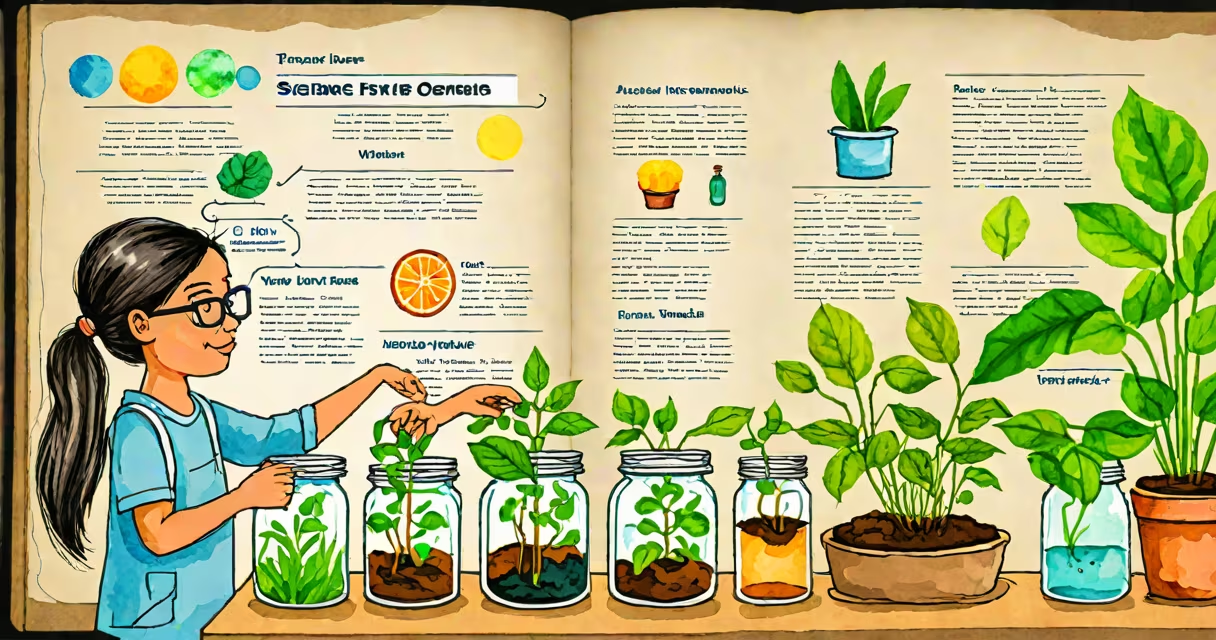
Science fair ideas are testable questions that explore cause-and-effect relationships through hands-on experimentation, often centered on biology, chemistry, physics, or engineering. These projects follow the scientific method: form a hypothesis, conduct controlled tests, collect data, and draw conclusions. They're designed to teach inquiry, critical thinking, and communication skills.
For example, testing whether plants grow faster under red or blue LED lights leads to measurable results. The experiment controls variables like soil type, water amount, and room temperature while changing only the light color. After two weeks, students measure plant height and leaf count, then compare averages. This structure applies to all science fair ideas, regardless of complexity.
Projects must be safe, ethical, and feasible within time and material constraints. A well-designed idea avoids vague goals like "see what happens" and instead asks specific questions: "Does sugar concentration affect yeast fermentation rate?" or "How does surface texture impact friction on a ramp?" These are testable, observable, and reproducible.
Science fair ideas fall into four main categories based on their focus and methodology:
| Type | Focus | Example | Best For |
|---|---|---|---|
| Observation | Describing natural phenomena | Tracking daily cloud types and weather patterns | Elementary to middle school |
| Experimentation | Testing cause-and-effect | Measuring how pH affects eggshell dissolution | Middle to high school |
| Engineering Design | Building and improving solutions | Designing a low-cost water filter using sand and charcoal | High school and beyond |
| Research-Based | Reviewing existing data | Analyzing NASA satellite data on Arctic ice loss since 1980 | High school and advanced learners |
Experimentation and engineering design are most common in fairs. The former tests variables; the latter solves problems through iterative design. A project that builds a solar-powered car, for instance, involves prototyping, testing speed on different surfaces, and refining the design based on results.
Some ideas fail because they lack control. A student once tried to prove that music improves plant growth but used different soil types and varying light exposure. Results were unreliable. The fix: standardize all conditions except the variable being tested-music genre in this case.
Effective science fair ideas solve real problems. One winning project in 2022 tested biodegradable packaging made from potato starch. The student measured decomposition rates in compost and compared them to plastic bags. The result showed the starch-based material broke down completely in 45 days, while plastic took over 500 years. This project won regional awards and was later cited in a local waste reduction initiative.
A common mistake is choosing overly broad topics. "How do animals adapt?" lacks focus. A better version: "Do crickets exposed to higher temperatures develop larger wings?" This allows measurement of wing size across multiple individuals under controlled heat settings.
Another error is skipping the control group. In a study on fertilizer effectiveness, one group gets fertilizer, another doesn't. Without the control, you can't tell if growth differences come from the treatment or other factors like sunlight variation.
These science fair ideas have been successfully used by students from grades 6 to 12, with adjustments for depth and complexity:
Each project uses accessible materials, follows the scientific method, and produces quantifiable results. For instance, the static electricity experiment involved 15 trials per hair type, with average counts reported. Graphs show differences.
I once helped a middle schooler test which brand of laundry detergent removed grass stains best. She used identical fabric swatches, same wash cycle, and measured stain coverage with a digital camera and image analysis software. Her presentation included side-by-side photos and a bar chart. She placed second at her state fair.
Many assume science fair ideas must be complex or involve expensive equipment. That's false. The National Science Teaching Association (NSTA) emphasizes that "the best projects are driven by curiosity, not cost." A 2021 NSTA survey found 78% of winning projects used materials under $10.
Another misconception is that all projects require a hypothesis. While the scientific method typically begins with one, research-based projects may start with a question. For example, "How has climate change affected migration timing in monarch butterflies?" uses historical data rather than live experimentation.
Finally, some think the goal is to "prove" a theory. But science fair projects aim to test and report findings objectively. A negative result-like "no difference in germination rates between warm and cold water"-is valid and valuable. It shows that temperature didn't affect the outcome, which still advances understanding.
When selecting a science fair idea, prioritize clarity, feasibility, and alignment with your interests. Avoid topics already widely covered unless you add a new variable. For example, instead of "how sugar affects tooth decay," try "does the frequency of sugar intake matter more than total amount?"
Science fair ideas are not about finding the "right" answer. They're about asking a good question, designing a fair test, and communicating results honestly. With clear planning and attention to detail, even simple experiments yield meaningful insights.