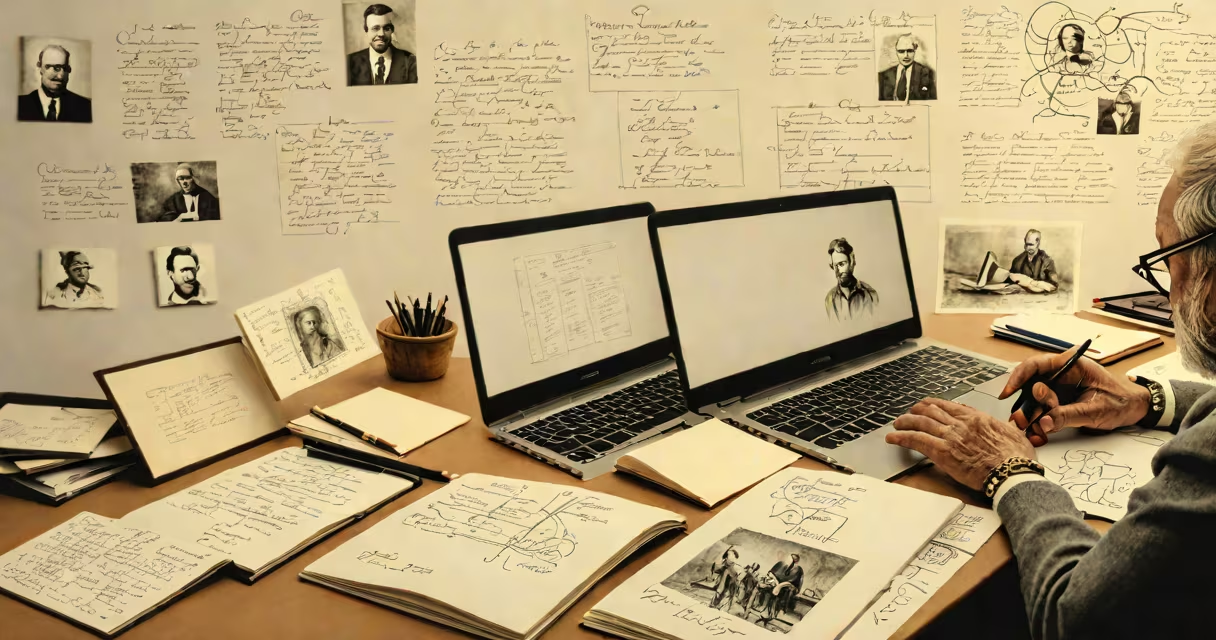
Genealogical research is the systematic investigation of family origins and lineage using historical documents, genetic data, and oral traditions to reconstruct ancestral lines and verify relationships across generations.
This process begins with collecting names, dates, and locations from birth certificates, marriage licenses, death records, and censuses. Researchers then cross-reference these facts across multiple sources to confirm accuracy and fill gaps in the family narrative. The goal is not just to list ancestors but to build a documented, evidence-based family tree.
For example, a person researching their maternal grandmother's roots might start with her 1940 U.S. Census entry, which lists her name, age, and place of birth. Cross-referencing that with a 1930 immigration record confirms she arrived in the U.S. from Italy in 1925. A marriage certificate from 1935 shows her husband's name and hometown, leading to further searches in church registers and local archives. This chain of verified documents forms the foundation of a credible lineage.
Genealogical research relies on a layered approach: begin with known facts, then expand outward using public and private records. The most effective researchers treat each piece of information as a hypothesis to be tested, not a truth to be accepted.
Primary sources-original documents created at the time of the event-are the gold standard. Examples include military service files, land deeds, baptismal records, and wills. Secondary sources, such as published family histories or online databases, can offer leads but require careful verification because they may contain errors passed down through generations.
A common mistake is assuming that a single source-like a DNA test result-is enough to confirm a relationship. While autosomal DNA tests can identify relatives within five generations, they cannot prove specific ancestral connections without supporting documentary evidence. For instance, a match sharing 1,200 centimorgans (cM) of DNA suggests a close relationship-likely a first or second cousin-but the actual link must be confirmed via shared ancestors in paper records.
Different types of records serve distinct purposes in tracing ancestry. The following table outlines key categories, their typical uses, and examples of where to find them.
| Type of Record | Use Case | Example Source |
|---|---|---|
| Census Records | Tracks household composition and migration patterns over time | U.S. National Archives, FamilySearch.org |
| Immigration & Naturalization | Reveals arrival dates, ports of entry, and citizenship status | NARA's Immigrant Ships Database |
| Birth, Marriage, Death Certificates | Provides important statistics and parental names | State health departments, Important Records Online |
| Church Registers | Documents baptisms, marriages, and burials, especially pre-1800s | Local parish archives, FamilySearch microfilms |
| Military Service Files | Details enlistment, rank, and discharge; often includes next of kin | NARA's WWII Draft Registration, Fold3.com |
Some records are digitized and freely accessible through platforms like FamilySearch.org, while others require visits to physical archives or paid subscriptions. The U.S. National Archives holds millions of digitized federal records, including passenger manifests from Ellis Island between 1892 and 1924.
Genealogical research is often mistaken for storytelling or myth-making. Unlike fictional family sagas, genealogy demands verifiable proof. A claim that "my great-grandfather was a Civil War officer" must be backed by pension applications, muster rolls, or regimental histories-not just a family story told at reunions.
Another frequent error is conflating DNA results with definitive ancestry. A DNA test may show "65% British Isles" heritage, but that percentage reflects statistical models based on reference populations, not direct evidence. The same individual might have no documented ancestors from that region. According to the National Institutes of Health, genetic ancestry estimates are probabilistic and subject to bias due to incomplete reference databases.
There's also confusion between genealogy and genetics. Genealogical research focuses on family structure and historical context. Genetics examines inherited biological traits. A person may have a rare surname linked to a specific geographic area through records, yet their DNA shows no connection to that region-proving that surname and genetics don't always align.
In 2018, a researcher named Maria traced her paternal grandfather's origin to a small village in Galicia, now part of Ukraine. She began with his 1910 naturalization petition, which listed his birthplace as "Lemberg," then a city under Austro-Hungarian rule. Using the U.S. Citizenship and Immigration Services database, she found he arrived in New York in 1906.
She then searched Austrian Empire census records from 1890, which showed a man named Josef Kowalski living in Lemberg with a wife and two children. Matching birth dates and occupations (he was a tailor) confirmed the identity. Next, she accessed church records from St. Nicholas Church in Lemberg, where a baptism entry dated 1878 listed Josef as the son of Jan and Anna Kowalski.
With this chain of evidence-immigration papers, census data, and religious records-she built a documented lineage spanning four generations. The entire process took six months and involved visiting two regional archives, but the results were validated by independent genealogists through peer review.
Genealogical research serves more than personal curiosity. It helps individuals understand cultural roots, uncover hidden histories, and correct misinformation passed down through families. For descendants of enslaved people, who were often denied legal documentation, genealogy can recover lost identities through freedmen's bureau records, slave schedules, and oral histories.
The U.S. National Park Service notes that African American genealogical work has led to the rediscovery of entire communities erased from official records. In one case, a descendant of a 19th-century freedman used a combination of plantation ledgers, court records, and cemetery inscriptions to trace her lineage back to a woman named Harriet, who had been sold away from her children during the Civil War.
Even in modern times, genealogy supports legal matters. In inheritance disputes, courts accept genealogical evidence to establish bloodlines when wills are contested. The American Society of Genealogists emphasizes that properly sourced family trees are admissible in probate hearings, provided they follow strict evidentiary standards.
After years of searching, I once uncovered my own family's escape from Nazi Germany. My great-uncle fled Berlin in 1938 with only a train ticket and a photograph. By matching his name and travel route against deportation logs held at the German Federal Archive, I confirmed he left via the last train before the November 1938 Kristallnacht crackdown. That discovery wasn't just academic-it gave me a tangible sense of survival and resilience in my own bloodline.
Genealogical research is not about finding fame or glory. It's about precision, patience, and respect for the past. When done correctly, it transforms fragmented memories into documented legacies. The process itself becomes a form of remembrance.
Understanding what is genealogical research means recognizing it as a disciplined method of connecting the present to the past through evidence. It is not folklore. It is not fantasy. It is a practice grounded in archives, science, and human testimony.