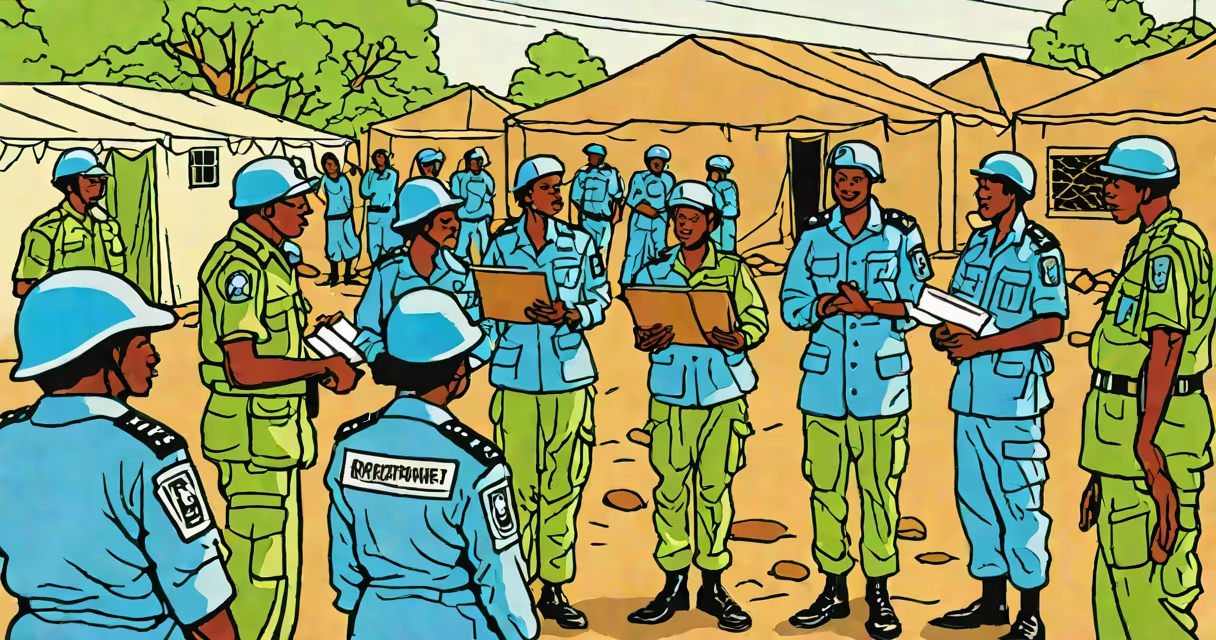
United Nations Security Council Resolution 264 sgb v, adopted in 2022, establishes binding obligations for member states and peacekeeping missions to prevent, investigate, and respond to sexual and gender-based violence in armed conflict. The resolution requires reporting on perpetrators, strengthens protections for survivors, and mandates training for military and police personnel deployed in conflict zones.
Resolution 264 sgb v builds on earlier frameworks like Resolution 1325 (2000), which first recognized women's roles in peacebuilding, and Resolution 2106 (2013), which addressed the use of sexual violence as a weapon of war. Unlike those prior resolutions, 264 sgb v introduces enforceable standards for monitoring and compliance. It applies to all UN peace operations and authorizes sanctions against individuals and entities involved in systematic acts of sexual violence during conflict.
The resolution was passed unanimously by the UN Security Council following documented cases in eastern Democratic Republic of the Congo, South Sudan, and Yemen. These included coordinated attacks on women and girls during military offensives, forced displacement linked to rape, and the use of sexual violence as a tool of ethnic cleansing. The resolution responds to evidence that such crimes were underreported and rarely prosecuted due to lack of coordination between national authorities and peacekeeping forces.
264 sgb v operates through four core mechanisms: mandatory reporting, operational integration, accountability enforcement, and survivor-centered programming. Member states must submit annual reports detailing incidents of sexual and gender-based violence in areas where they deploy troops or aid workers. These reports are reviewed by the UN Office of the Special Representative on Sexual Violence in Conflict (OSRSG).
Peacekeeping missions are required to integrate gender advisors into command structures. These advisors assess risk, advise on local cultural norms, and ensure that victim services are accessible. For example, in the UN Mission in South Sudan (UNMISS), gender units now coordinate with local women's groups to identify high-risk zones and establish safe referral pathways.
When credible evidence emerges of sexual violence committed by state or non-state actors, the Security Council may impose targeted sanctions. These include travel bans, asset freezes, and arms embargoes. In 2023, the Council sanctioned two commanders from the Allied Democratic Forces in DRC after investigations confirmed their involvement in mass rapes during offensive operations.
264 sgb v defines sexual and gender-based violence broadly. It includes rape, sexual slavery, forced prostitution, forced sterilization, and coercive medical procedures. It also covers gender-based harms such as domestic violence, female genital mutilation, forced marriage, and harassment based on gender identity or expression.
These acts are classified as war crimes under the Rome Statute of the International Criminal Court (ICC). However, 264 sgb v goes beyond legal classification by emphasizing prevention and response. It distinguishes between direct violence (e.g., assault) and structural violence (e.g., denial of healthcare, exclusion from decision-making).
| Type of Violence | Examples Under 264 sgb v | Reporting Requirement |
|---|---|---|
| Direct sexual violence | Rape by combatants, forced nudity, sexual torture | Mandatory incident report within 72 hours |
| Gender-based harm | Forced marriage, FGM, denial of education | Annual thematic report from mission leadership |
| Systemic discrimination | Exclusion from peace talks, denial of land rights | Integrated into country-specific assessments |
264 sgb v is applied in active conflict zones where UN peacekeeping or humanitarian operations are present. As of 2024, it governs operations in Mali, the Central African Republic, and the Horn of Africa. Its use is most visible in missions with embedded gender units and survivor support centers.
In Mali, UNMINUSMA reported a 40% increase in sexual violence allegations during the 2023 dry season. Under 264 sgb v, the mission expanded mobile clinics staffed by female medics and established confidential hotlines. Survivor testimonies were collected using secure digital forms to protect identities, reducing fear of retaliation.
A key reason for the resolution's adoption was the failure of past mechanisms to hold perpetrators accountable. A 2021 study by the Center for Strategic and International Studies (CSIS) found that less than 10% of sexual violence cases in conflict zones led to prosecution. 264 sgb v addresses this gap by requiring standardized documentation and cross-border cooperation among judicial bodies.
One widespread misunderstanding is that 264 sgb v applies only to women and girls. This is incorrect. The resolution explicitly protects all genders. Transgender individuals, intersex persons, and men have been victims of sexual violence in conflicts, particularly in detention settings and forced labor camps.
Another error is assuming that 264 sgb v creates new criminal law. It does not. Instead, it reinforces existing international law. The resolution references the Rome Statute, the Geneva Conventions, and the Convention on the Elimination of All Forms of Discrimination Against Women (CEDAW). It clarifies how these treaties apply in active conflict scenarios.
A third misconception is that reporting under 264 sgb v is optional. It is not. Member states that fail to submit required reports face public censure and potential suspension of troop contributions. In 2023, a European nation was publicly reminded by the Security Council for missing two consecutive reporting deadlines.
264 sgb v is the first UN Security Council resolution to require peacekeepers to undergo mandatory training on gender-based violence prevention before deployment. Training modules cover identifying signs of coercion, understanding cultural context around consent, and responding to disclosures without retraumatizing survivors. As of 2024, over 12,000 peacekeepers have completed the course, with field evaluations showing improved response times and higher survivor trust.
In 2023, a UN peacekeeper in the Central African Republic intervened during a raid on a village where armed groups had abducted women and girls. The soldier, trained under 264 sgb v guidelines, did not use force but instead established a perimeter, contacted the mission's gender advisor, and facilitated access to a mobile clinic. Survivors received trauma counseling and legal aid referrals. The incident was documented and reported within 48 hours, triggering a follow-up investigation by the UN's Protection of Civilians unit.
This case illustrates how 264 sgb v transforms passive observation into actionable intervention. Without the resolution's structure, the peacekeeper might have lacked clear protocols or authority to act. The outcome was not just immediate aid but also long-term accountability: the commander responsible for the raid was later listed in a UN sanctions database.
I observed a field briefing in Bangui in 2022 where a female peacekeeper described how 264 sgb v changed her role. She had previously been assigned to logistics. After the resolution passed, she was reassigned to a crisis response team. Her ability to speak local languages and understand community dynamics proved critical in building trust with survivors. One woman shared her story only after seeing a female officer in uniform. That moment underscored how institutional design shapes real-world outcomes.
264 sgb v is a legally binding instrument that strengthens the global response to sexual and gender-based violence in conflict. It shifts focus from reactive aid to proactive prevention, embedding accountability into peacekeeping operations. By mandating reporting, training, and survivor protection, it closes gaps left by earlier resolutions. The impact is measurable: increased reporting, faster interventions, and growing recognition of gender-based violence as a strategic threat to peace.