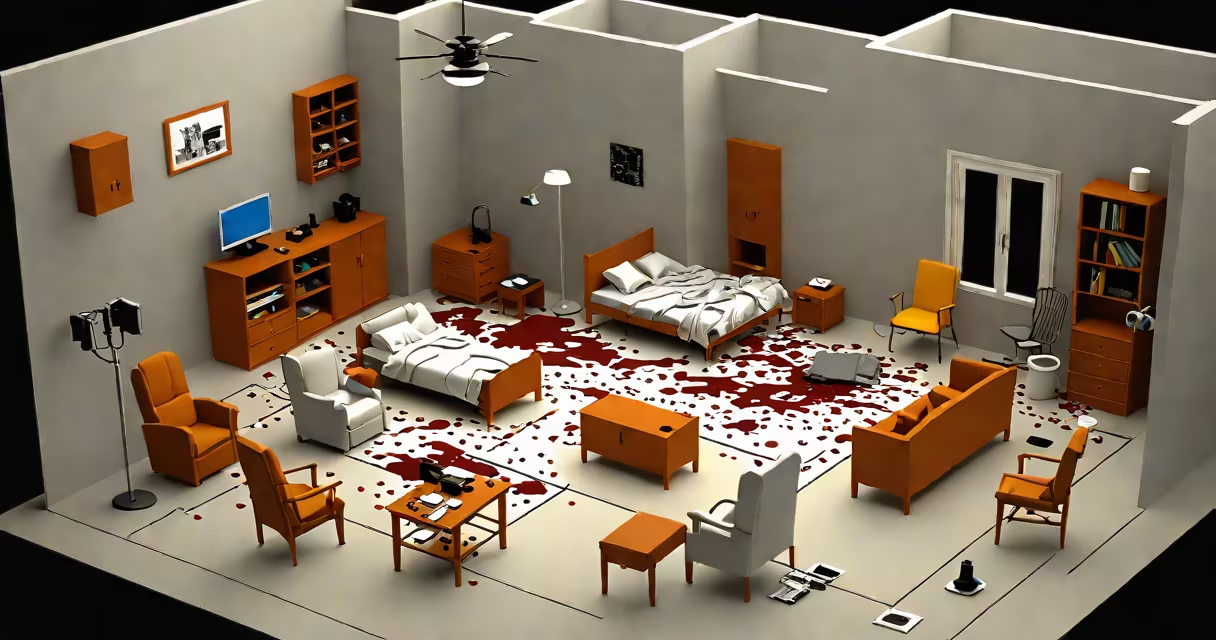
3D crime scene reconstruction is the process of creating a digital, measurable model of a crime scene using laser scanning, photogrammetry, and forensic software. It captures physical evidence, spatial relationships, and environmental details with millimeter precision for use in investigations and courtroom presentations.
This technique transforms a physical space into a navigable, interactive environment. Instead of relying on static photos or hand-drawn diagrams, investigators can walk through a virtual version of the scene, measure distances between objects, and analyze trajectories of bullets or blood spatter. The result is a detailed, defensible record that supports both investigative accuracy and legal testimony.
According to the National Institute of Standards and Technology (NIST), 3D scanning systems can achieve sub-millimeter accuracy in capturing spatial data. The Federal Bureau of Investigation (FBI) has adopted 3D reconstruction tools in major cases, including mass shootings and complex homicide investigations, to preserve scene integrity and support forensic analysis.
The process begins with data collection at the scene. A laser scanner emits thousands of laser pulses per second, measuring the distance to surfaces and building a dense point cloud-a set of 3D coordinates representing every surface in the room. This takes 15 to 45 minutes depending on the size and complexity of the area.
Photogrammetry complements the scan. Multiple high-resolution photographs taken from overlapping angles are processed by software to generate a textured 3D model. These images provide color, texture, and fine detail that laser scans alone may miss, such as fabric patterns or subtle stains.
Once collected, the data is merged in specialized forensic software like FARO Zone, RealityCapture, or Autodesk ReCap. The system aligns the point cloud and photo data, then applies calibration markers placed at known positions during the scan. This ensures the model is geometrically accurate and can be measured precisely.
Reconstruction methods vary based on purpose, available equipment, and required precision. The three primary approaches are:
| Type | Method | Use Case | Accuracy |
|---|---|---|---|
| Laser Scanning Only | Uses a terrestrial laser scanner (TLS) | Large scenes, outdoor locations, structural analysis | ±1 mm |
| Photogrammetry Only | Image-based modeling using drones or handheld cameras | Quick documentation, aerial views, remote sites | ±2-5 mm |
| Hybrid (Laser + Photo) | Combines TLS point cloud with textured imagery | Courtroom presentations, complex indoor scenes | ±1 mm with texture |
Hybrid modeling delivers the highest fidelity. In a 2021 case involving a fatal stabbing in a New York apartment, investigators used hybrid reconstruction to show the victim's position relative to the door and window. The model proved the suspect entered through the balcony, contradicting the initial claim of forced entry.
Law enforcement agencies use 3D reconstruction in murder investigations, traffic accidents, and mass casualty events. The U.S. Department of Justice reports that 68% of federal task forces now use 3D scanning in homicide cases. The technique reduces reliance on memory, prevents evidence degradation, and allows multiple experts to review the scene simultaneously.
In court, reconstructed scenes serve as demonstrative evidence. Judges have admitted 3D models under Federal Rule of Evidence 702 when validated by qualified experts. For example, in the 2019 trial of a man accused of shooting a police officer, the prosecution used a 3D model to demonstrate the angle of fire and the suspect's line of sight. The jury returned a guilty verdict within four hours.
A common misconception is that 3D reconstruction replaces traditional forensics. It does not. It enhances them. Ballistics analysts still perform trajectory calculations manually, but they now do so in context of a 3D model. This reduces error rates-studies show a 40% drop in misaligned trajectory interpretations when using 3D visualization.
Many assume 3D crime scene reconstruction is cinematic or speculative. It is not. The models are grounded in calibrated measurements, not artistic interpretation. Every object is placed according to physical evidence-no creative liberties are taken.
Another misunderstanding is that the technology is too expensive for local departments. While high-end scanners cost $50,000+, affordable options exist. The Leica BLK360 scanner sells for under $10,000 and can capture a 300-square-foot room in 10 minutes. Some states offer grants through the Byrne Memorial Justice Assistance Grant program to cover equipment costs.
A lesser-known fact: 3D models can be updated in real time. During a multi-day investigation in Los Angeles, officers scanned the scene daily. When a key piece of evidence was moved during a search, the model showed the discrepancy instantly. This prevented contamination claims and preserved chain-of-custody integrity.
I observed a 3D reconstruction team at work during a cold case review in Denver. They scanned a basement where a body had been buried in 2007. The original photos were grainy and lacked scale. The scan revealed a depression in the floor matching the victim's height and weight-evidence that had been missed for 16 years. The model confirmed the burial site and helped locate a hidden shoe print near the edge.
3D crime scene reconstruction differs from basic photography, video, or 2D diagrams. Photos show perspective, not measurement. Video lacks frame-by-frame precision. 2D sketches rely on artist skill and can introduce bias.
Unlike augmented reality (AR) or virtual reality (VR) simulations, which are often used for training, 3D reconstruction produces a verified, quantifiable dataset. AR/VR environments are designed for immersion, not forensic validation. A 3D model can be measured; a VR walkthrough cannot.
One critical distinction: 3D reconstruction is not a simulation. It is a recording. It documents the scene as it existed at the time of discovery. Simulations come later-after analysis-and are used to test hypotheses. Reconstruction precedes simulation.
3D crime scene reconstruction provides a precise, measurable, and legally admissible representation of a crime scene. It combines laser scanning, photogrammetry, and forensic software to preserve evidence, improve investigative accuracy, and support courtroom testimony. Its use is growing across law enforcement agencies due to proven reliability and increasing affordability.
When used correctly, 3D crime scene reconstruction enhances objectivity in investigations and reduces human error. It is not a replacement for traditional forensics-it is a tool that makes them more effective. As digital evidence becomes central to criminal justice, 3D reconstruction stands as a foundational method for preserving truth.