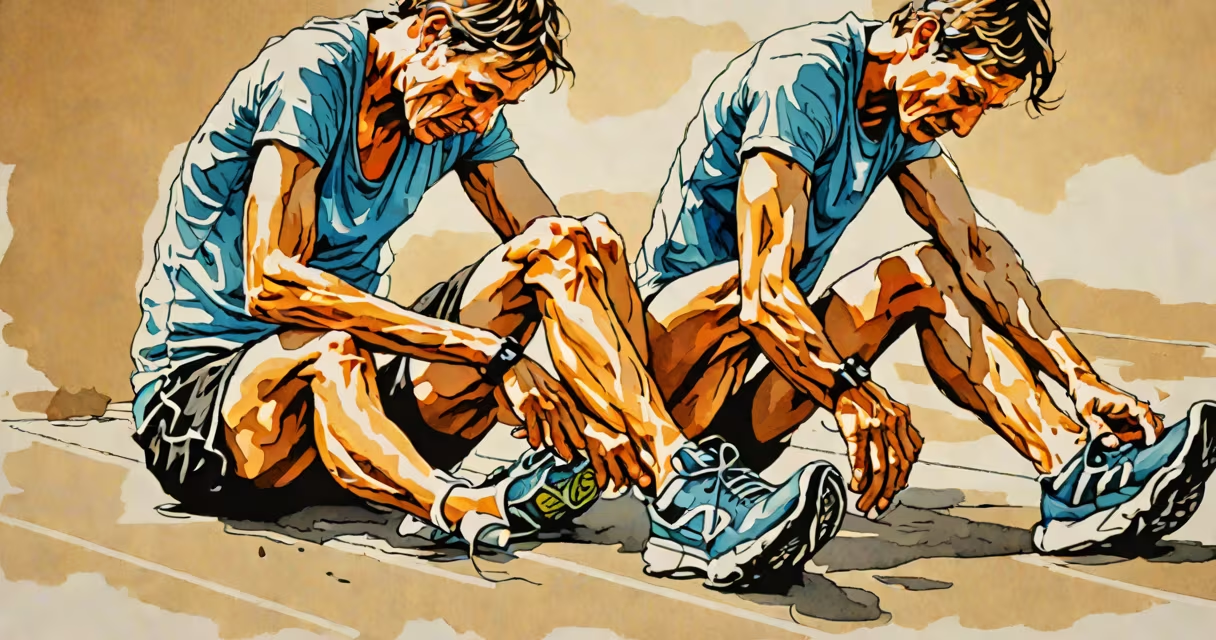
Knee pain after running occurs when stress on the joints exceeds tissue tolerance, often due to overuse, poor form, or biomechanical imbalances. It's not normal to feel sharp or persistent pain during or after runs.
This condition affects runners of all levels. The pain typically appears during or shortly after activity, ranging from dull ache to sharp stabbing sensations. Common sites include the front (patellofemoral pain), inner side (medial knee pain), or outer side (iliotibial band syndrome).
According to the American Academy of Orthopaedic Surgeons (AAOS), patellofemoral pain syndrome accounts for up to 40% of all running-related knee injuries. Overuse is the primary driver-especially when training volume increases too quickly.
The knee functions as a hinge joint under high load during running. Each foot strike delivers impact force equal to 2.5 to 3 times body weight. When muscles fail to absorb shock effectively, stress transfers to bones, cartilage, and ligaments.
Common mechanical causes include weak quadriceps and gluteal muscles, tight hamstrings, and misaligned feet. A 2021 study in the Journal of Orthopaedic & Sports Physical Therapy found that runners with weaker hip abductors were 2.3 times more likely to develop iliotibial band syndrome.
Overtraining without adequate recovery leads to microtears in tendons and cartilage. Without rest, inflammation builds, causing pain that worsens with repetition. This creates a cycle: pain reduces running frequency, which then decreases fitness and increases injury risk.
Different patterns point to distinct issues. Identifying the location and timing helps narrow the cause.
| Pain Location | Most Likely Cause | Trigger Pattern |
|---|---|---|
| Front of knee | Patellofemoral pain syndrome | Worse going downhill or after sitting long periods |
| Outer side of knee | Iliotibial band friction syndrome | Sharp pain on first few steps after starting to run |
| Inner side of knee | Medial collateral ligament strain | Often follows sudden direction changes or uneven terrain |
| Behind knee | Baker's cyst or posterior knee impingement | Swelling, stiffness, or clicking sensation |
For example, a runner who feels aching behind the kneecap after descending hills may have patellofemoral pain. That pain often improves with rest and strengthening exercises targeting the vastus medialis obliquus (VMO), a small muscle critical for tracking the kneecap properly.
Many runners assume knee pain is inevitable with distance. That belief leads to ignoring early warning signs. But research shows most cases stem from modifiable factors-not aging or genetics.
A 2022 review in British Journal of Sports Medicine concluded that 80% of runners with knee pain improved with targeted strength training and gradual mileage increases. Yet nearly half continued running through pain, worsening their condition.
Another myth: "I need new shoes." While worn-out footwear contributes, replacing shoes doesn't fix underlying muscle imbalances. A 2019 randomized trial found no significant difference in knee pain reduction between runners using new shoes versus those using proper strength training-even when shoe wear was severe.
One key distinction: acute pain during activity signals potential tissue damage. Persistent pain after running indicates overload. Distinguishing between them guides treatment. If pain lingers past 24 hours, stop running and assess form, training load, and recovery habits.
In 2020, I developed sharp pain on the outer side of my right knee after increasing weekly mileage from 15 to 30 miles. I ignored it for two weeks, thinking it would resolve. By week three, I had to walk through the last mile of a 10K.
I consulted a physical therapist. Tests revealed weak hip abductors and tight IT bands. We started a 6-week program: 3 days/week of single-leg squats, clamshells, and foam rolling. I reduced weekly mileage by 30% and added 10 minutes of walking between intervals.
After four weeks, pain dropped from 7/10 to 2/10. By six weeks, I completed a 10-mile run with no discomfort. The fix wasn't new shoes-it was addressing muscle control and load management.
See a healthcare provider if pain persists beyond 7-10 days of rest, worsens with weight-bearing, or limits daily activities. Imaging may be needed if symptoms suggest meniscus tears or ligament injuries.
Physical therapists trained in sports rehabilitation can identify movement faults such as excessive hip adduction or knee valgus (knock-kneed alignment). Corrective exercises reduce strain on the knee by improving neuromuscular control.
Preventing knee pain involves balancing training load with recovery. The 10% rule-increasing weekly mileage by no more than 10%-reduces overuse injury risk by 50%, per AAOS guidelines.
Include strength work twice weekly: focus on glutes, quads, and core. Exercises like step-ups, lunges, and deadlifts improve joint stability. Warm up with changing movements like leg swings and walking lunges before running.
Remember: soreness after running is normal. Pain is not. Addressing after running my knees hurt early prevents chronic issues and keeps you running longer.