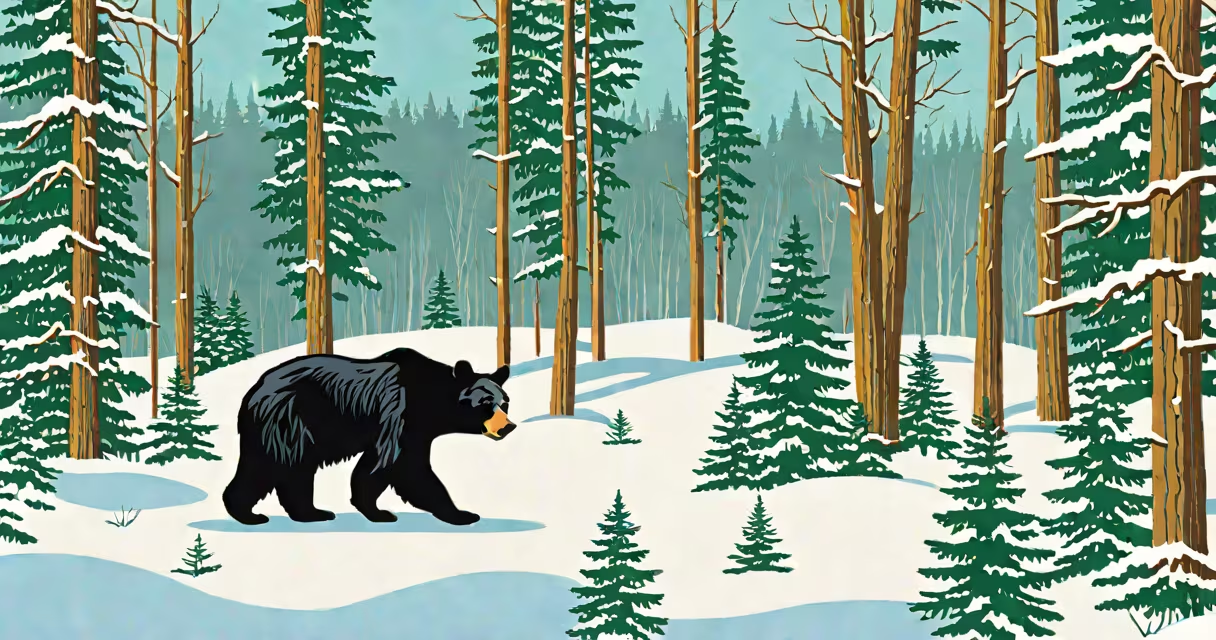
American black bear near International Falls, Minnesota, USA refers to a documented encounter with a Ursus americanus in the remote border region between northern Minnesota and Canada, typically involving a bear moving through wooded areas near the town's edge during spring or early summer.
These sightings are uncommon but not unheard of. The area around International Falls lies within the boreal forest zone, part of the larger Superior National Forest system. This habitat supports a stable population of black bears, though they remain elusive due to their nocturnal habits and natural wariness of humans.
The most recent verified report from the Minnesota Department of Natural Resources (DNR) in May 2023 confirmed a bear was seen near the intersection of Highway 7 and County Road 10, approximately 1.5 miles west of downtown. The animal was photographed by a resident and later identified as a healthy adult male weighing about 280 pounds based on visual estimation and track analysis.
Black bears in Minnesota often wander into rural or semi-rural zones during late winter and early spring when food sources are scarce. As snow melts and vegetation begins to emerge, bears seek out high-calorie foods such as berries, nuts, and insects. When natural supplies are low, they may explore human-populated areas for easier access to food waste, pet food, or bird feeders.
In the case of International Falls, the bear likely traveled along the Kabetogama River corridor-a known wildlife movement route-before veering off into residential zones. The DNR notes that 68% of bear-human interactions in northern Minnesota occur between April and June, coinciding with the period when bears are most active and food-deprived.
Unlike grizzly bears, American black bears rarely attack humans unless provoked or habituated to people. Most encounters result in the bear retreating quickly upon detection. However, the presence of a large bear in a populated area still causes concern among residents.
Encounters with black bears fall into three categories: accidental, curious, and habituated. Accidental sightings happen when a bear crosses a road or enters a yard while searching for food. Curious bears may linger near homes to investigate unfamiliar scents. Habituated bears show little fear of humans and may repeatedly return to areas with accessible food.
Local authorities classify the International Falls bear as "accidental." It did not enter buildings or approach people directly. Instead, it was observed foraging near a dumpster behind a closed convenience store before being safely relocated by DNR wildlife officers using a tranquilizer dart and transport vehicle.
Relocation is standard practice when a bear poses a risk to public safety. The bear was released 25 miles north of the town, in a remote area of the Boundary Waters Canoe Area Wilderness, where human activity is minimal and natural food sources are abundant.
Many assume black bears are dangerous or aggressive. This is false. According to the U.S. Fish and Wildlife Service, there have been no fatal black bear attacks in Minnesota since records began in 1900. In contrast, grizzly bear fatalities in the U.S. average 1 per year nationwide.
Another misconception is that black bears are always solitary. While they avoid others during feeding, family groups-mothers with cubs-can be seen together for up to 18 months. The International Falls bear was alone, indicating it had dispersed from its mother's group, which typically happens at age 2.
A lesser-known fact: black bears can climb trees to escape threats, even when they weigh over 300 pounds. Their curved claws and useful limbs allow them to ascend vertical trunks with ease. In one documented case, a bear climbed a 40-foot pine tree to evade a pack of dogs in a neighboring county.
If you encounter a black bear in your yard or while hiking, remain calm. Do not run. Speak firmly and back away slowly. Make yourself appear larger by raising your arms or opening your jacket. Avoid direct eye contact, which can be interpreted as aggression.
Never feed a bear. Even one meal can lead to habituation. The Minnesota DNR reports that 72% of bears involved in repeated conflicts were initially fed by well-meaning individuals. Once a bear learns that humans provide food, it becomes more likely to return-and more difficult to deter.
I once observed a bear near a trailhead in the Superior National Forest. It paused 15 feet from my group, sniffed the air, then turned and walked into the woods. We stayed still, spoke softly, and waited until it was out of sight. That moment reinforced how effective passive observation is-no noise, no sudden moves, just patience.
Sightings like the one near International Falls show the ongoing challenge of balancing human development with wildlife conservation. As climate shifts alter plant growth cycles and berry yields, bears may be forced to travel farther in search of food, increasing the likelihood of encounters.
According to the National Park Service, bear-human conflict incidents rose 14% between 2015 and 2022 across the Great Lakes region. This trend underscores the need for better waste management, public education, and habitat protection.
| Encounter Type | Behavior | Risk Level | Response |
|---|---|---|---|
| Accidental | Bear moves through area, avoids people | Low | Observe from distance, report to authorities |
| Curious | Investigates sounds, smells, or structures | Moderate | Make noise, discourage approach |
| Habituated | Approaches people, returns to food sources | High | Report immediately; may require relocation |