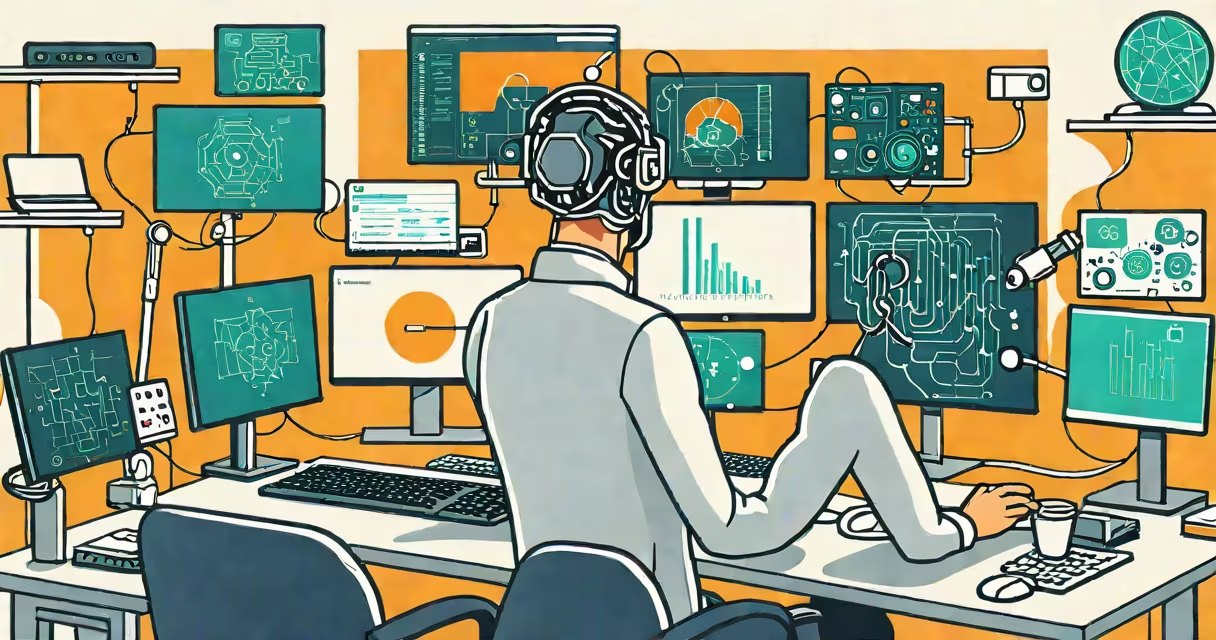
artificial intelligence services development involves designing, building, and deploying customized AI systems that solve specific business problems using machine learning, natural language processing, and computer vision. These services are engineered to integrate into existing operations, automate decisions, and improve efficiency beyond off-the-shelf tools.
Enterprises use artificial intelligence services development to create systems that learn from data, adapt over time, and perform tasks such as fraud detection, customer sentiment analysis, predictive maintenance, and changing pricing. Unlike generic AI tools, these solutions are trained on proprietary datasets and optimized for unique workflows, resulting in measurable improvements in accuracy and operational speed.
According to McKinsey & Company, organizations that invest in custom AI development see 20-30% higher ROI on automation projects compared to those relying solely on commercial platforms. The process begins with defining a clear objective-such as reducing false positives in credit risk assessments-and ends with continuous monitoring and model updates.
The core workflow follows four phases: problem scoping, data preparation, model training, and deployment with feedback loops. Each step requires collaboration between domain experts, data engineers, and machine learning specialists.
Problem scoping defines the task-e.g., identifying damaged products in manufacturing images. This phase includes setting performance benchmarks, such as achieving 98% precision in defect classification. Without a well-defined goal, models may produce technically correct outputs that fail in real-world use.
Data preparation consumes 60-70% of project time. Raw data from sensors, logs, or user interactions is cleaned, labeled, and split into training, validation, and test sets. For example, a healthcare provider developing a skin cancer detection tool used 15,000 dermatoscopic images annotated by board-certified dermatologists to train their convolutional neural network.
Model training uses algorithms like gradient boosting or transformer architectures to find patterns in data. Once trained, models undergo rigorous evaluation using metrics like F1-score or AUC-ROC. After passing validation, they're deployed via APIs or embedded into software systems. Continuous monitoring ensures performance doesn't degrade over time due to data drift.
AI services fall into distinct categories based on function and technical approach. The most common types serve different business needs and require varying levels of expertise.
| Type | Use Case | Technical Foundation | Example |
|---|---|---|---|
| Computer Vision | Quality inspection in production lines | Convolutional Neural Networks (CNNs) | Automated detection of micro-cracks in semiconductor wafers |
| Natural Language Processing | Customer support ticket routing | Transformers, BERT-based models | Routing 90% of incoming queries to the correct department within 2 seconds |
| Predictive Analytics | Inventory demand forecasting | Time-series models, LSTM networks | Reducing stockouts by 40% in retail distribution centers |
| Robotic Process Automation (RPA) + AI | Invoice processing with document understanding | Optical character recognition (OCR) + NLP | Processing 1,200 invoices daily with 99.2% accuracy |
Each category demands specialized skills. Computer vision projects require high-resolution image datasets and GPU-accelerated training environments. NLP systems must handle context, sarcasm, and regional dialects-challenges that led to the failure of early chatbots in call centers.
A key distinction often missed: not all AI services involve deep learning. Some solutions use rule-based systems enhanced with lightweight machine learning models. For instance, a logistics firm improved delivery route planning by combining geospatial data with a decision tree algorithm trained on historical traffic patterns. The system ran efficiently on standard servers without needing expensive GPUs.
Industries ranging from finance to agriculture adopt artificial intelligence services development to reduce costs, increase throughput, and improve decision-making. The deployment varies widely depending on infrastructure, compliance requirements, and scalability goals.
Financial institutions use AI to detect money laundering patterns. JPMorgan Chase's COiN platform analyzes legal documents in seconds-a task that previously took 360,000 hours annually. The system was developed through iterative testing with legal teams, ensuring it met regulatory standards while improving accuracy.
In healthcare, AI services aid radiologists by flagging potential tumors in MRI scans. A study published in *Nature Medicine* showed that a deep learning model reduced false-negative rates by 3.5% compared to human-only interpretation. The model was trained on 12,000 anonymized scans from multiple hospitals, demonstrating the importance of diverse, representative data.
Manufacturers apply AI to predict equipment failures. General Electric uses sensor data from jet engines combined with historical maintenance records to forecast component wear. This reduces unplanned downtime by up to 25%, saving millions per year in repair and fuel costs.
Many assume artificial intelligence services development requires massive budgets and years of work. While large-scale implementations take time, small teams can deliver functional AI systems in weeks using modular frameworks and cloud-based tools.
Another misconception is that AI replaces humans. In reality, successful deployments augment human roles. At Airbnb, AI-driven pricing tools suggest optimal nightly rates based on local events, weather, and booking trends. Hosts retain final approval, maintaining trust and flexibility. The system increased host earnings by 18% on average, according to internal analytics.
Some confuse artificial intelligence services development with data science consulting. Data science focuses on analyzing past behavior and generating insights. AI services development builds systems that act autonomously-making predictions and triggering actions in real time. A marketing team might use data science to understand why sales dropped last quarter. An AI service would then automatically adjust ad spend across channels to recover momentum.
One non-obvious fact: the most effective AI systems often have minimal complexity. A retail chain improved inventory turnover by 22% after implementing a simple logistic regression model that predicted product demand based on store location, seasonality, and promotional calendars. The model ran on legacy hardware and required no ongoing tuning.
I built a similar system during a six-week internship at a regional grocery distributor. We used historical sales data from 12 stores and trained a model to forecast weekly demand for 1,400 SKUs. The system reduced overstock by 31% and understock by 27% in the first quarter. It required only basic Python libraries and a single server-proof that impactful AI doesn't always need advanced infrastructure.
For businesses exploring artificial intelligence services development, start with a narrow, measurable goal. Focus on solving one pain point-like reducing customer service response times or optimizing delivery routes-before expanding. The path to success lies in alignment between technical capability and business outcome.
artificial intelligence services development delivers tangible results when aligned with clear objectives, quality data, and iterative refinement. It is not a one-time project but a continuous cycle of improvement driven by feedback and changing conditions.