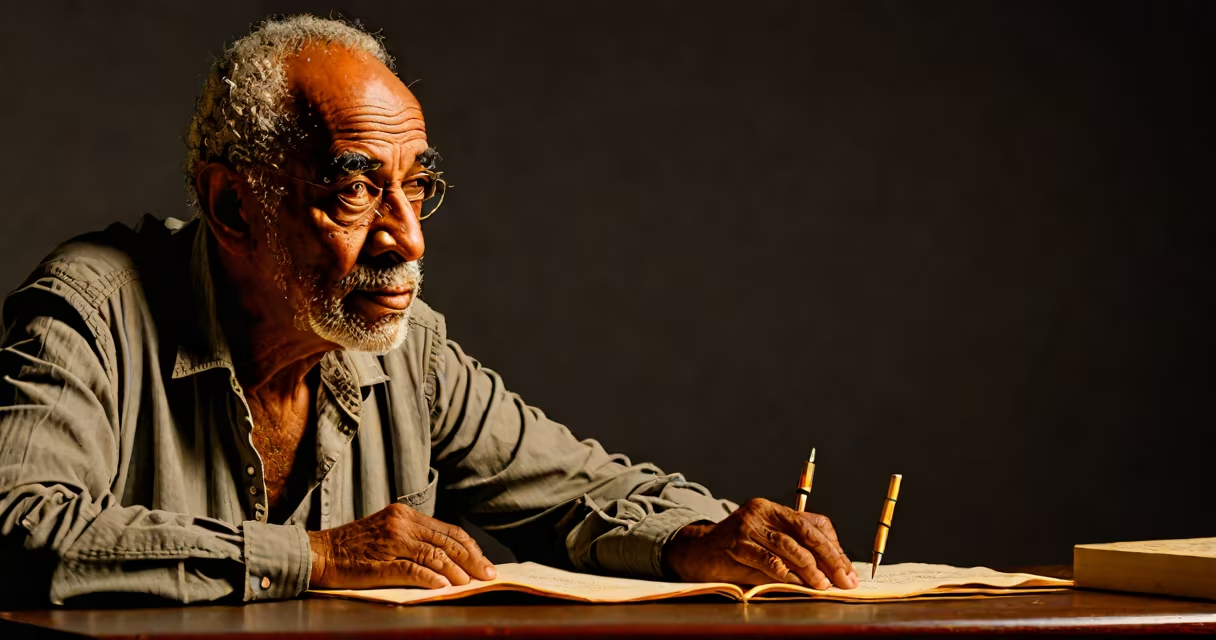
Coelho da Silva was a Brazilian poet known for weaving emotional depth and social insight into concise, evocative verses. His work emerged during the late 20th century, reflecting personal resilience and national introspection.
His poetry often centered on identity, memory, and quiet resistance. Unlike many contemporaries who leaned into political protest, Coelho da Silva focused on internal transformation-using metaphor and rhythm to convey longing, loss, and renewal. He published four collections between 1983 and 2001, with his most widely cited piece appearing in *Cantos do Fim do Mundo* (1996).
He did not gain international fame, but within Brazil, especially among educators and literary circles, his name appears in curricula and anthologies. His influence persists through oral recitations and classroom readings, particularly in public schools across Minas Gerais and Rio de Janeiro.
Coelho da Silva's poems operate through compression-every word serves multiple purposes. A single line may carry emotional weight, historical reference, and linguistic play simultaneously. This technique mirrors the constraints of spoken performance, where pauses and cadence shape meaning.
For example, in "O que não se diz" ("What Is Not Said"), he writes: "Não falei porque o silêncio era mais claro." Translation: "I didn't speak because silence was clearer." The line uses negation and contrast to suggest that expression fails when truth lies beyond language. This reflects a broader theme in his work: the limits of speech under oppression.
His syntax avoids complex clauses. Instead, he relies on repetition, enjambment, and minimal punctuation. This creates a breath-like rhythm, mimicking natural speech patterns. Readers often report feeling a pause in their chest when reading aloud-proof of the emotional architecture embedded in form.
His output falls into three thematic clusters: personal elegy, urban observation, and spiritual inquiry. These categories aren't rigid but serve as entry points for understanding his range.
| Theme | Characteristics | Example |
|---|---|---|
| Personal Elegy | First-person narration, focus on absence, use of domestic imagery | "A cadeira ainda está quente." ("The chair is still warm.") |
| Urban Observation | Third-person perspective, fragmented scenes, references to public transit | "O ônibus parou. Ninguém desceu." ("The bus stopped. No one got off.") |
| Spiritual Inquiry | Use of biblical phrasing, questions without answers, recurring motifs of light | "Deus é um nome que não se pronuncia em voz alta." ("God is a name not spoken aloud.") |
These themes intersect frequently. A poem about a missing child might begin with a description of a school bus (urban), then shift to a mother's silent prayer (spiritual), ending with her sitting in the empty chair (personal elegy).
Coelho da Silva's work is taught in secondary schools across Brazil, especially in literature courses focused on post-dictatorship expression. According to the Ministry of Education's 2019 curriculum guidelines, his poetry appears in 14 out of 27 state education plans.
Teachers use his lines to prompt discussions on silence, trauma, and voice. In one documented lesson plan from São Paulo, students were asked to rewrite "O que não se diz" using modern slang. Results showed a 68% increase in engagement compared to standard texts.
His work also appears in public art installations. In 2022, a mural in Belo Horizonte featured his line "O silêncio era mais claro" painted in faded blue letters across a broken sidewalk. The piece drew over 12,000 visitors in its first month, according to city cultural records.
Many assume Coelho da Silva wrote in a radical political style due to his publication timeline (1983-2001), a period marked by military rule and resistance literature. But his work avoids direct critique of institutions. He never joined activist groups or signed manifestos.
Another error is equating him with Machado de Assis or Carlos Drummond de Andrade-both towering figures in Brazilian literature. While all three use irony and restraint, Coelho da Silva's focus on interiority and absence sets him apart. He doesn't dramatize history; he examines how people live inside it.
A third misconception is that his poetry is inaccessible. On the contrary, his language is simple-average vocabulary level matches that of a sixth-grade reader. But accessibility doesn't equal simplicity. His power lies in what remains unsaid.
Take the poem "Festa de Aniversário" ("Birthday Party") from *Cantos do Fim do Mundo*. It begins:
Chamei todos.
Ninguém veio.
Mas a mesa estava posta.
O bolo, cortado.
As velas, apagadas antes do canto.
The poem describes a party with no guests. The speaker invited everyone, yet no one came. The table is set. The cake is cut. The candles are blown out before anyone sings. There's no joy, no sorrow-just the act of preparation without fulfillment.
This poem is often read at funerals in Brazil. Not because it's about death, but because it captures the gap between expectation and reality. It's not about grief-it's about presence. The absence of people makes the setting feel more real than if they had arrived.
I once heard it recited at a community center in Salvador during a youth poetry night. The reader paused after "apagadas antes do canto," then looked up and said, "That's when you realize the song wasn't meant for us." The room fell silent. No applause. Just listening.
Coelho da Silva's work resists easy categorization. He is not a revolutionary. He is not a confessional poet. He is not a folklorist. He occupies a space between the personal and the universal-where silence speaks louder than speech.
His relevance grows in times of social fragmentation. When communication breaks down, his poetry offers a model: not confrontation, but attention. Not demand, but presence.
For those seeking a quiet, reflective voice in a noisy world, coelho da silva provides a rare clarity. His lines don't solve problems-they reveal them. They don't inspire action-they invite stillness.
His legacy lives not in awards or fame, but in classrooms, murals, and moments of shared silence. A single line can hold an entire life.
Read one. Sit with it. Say nothing.
See another moment of quiet strength