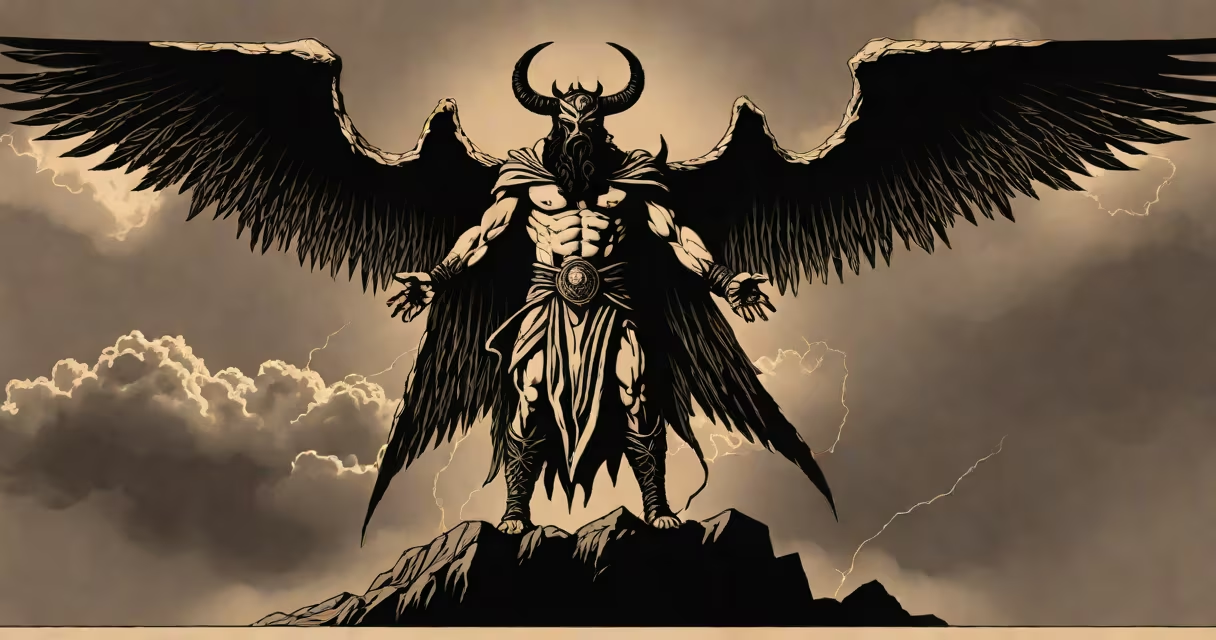
The term "Satan" in the Bible refers to a spiritual being who opposes God and tempts humans to sin, originally appearing as an accuser in the heavenly court before evolving into a personified adversary in later texts. The word itself means "adversary" or "accuser" in Hebrew.
Satan first appears in the Old Proof as part of God's heavenly council. In Job 1:6-12, he reports to God and challenges Job's faith, receiving permission to test him. This portrayal shows Satan not as a rebel but as a divine servant with investigative authority-his role is to examine human loyalty under trial. The Hebrew word ha-satan literally means "the adversary," indicating a function rather than a permanent identity.
In the New Proof, Satan becomes a more centralized figure. He appears in the Gospels as the tempter who offers Jesus power and glory during the wilderness temptation (Matthew 4:1-11). Here, he is described as a fallen angel, a spirit opposed to God's will. The book of Revelation identifies him explicitly as the "great dragon," "ancient serpent," and "deceiver of the whole world" (Revelation 12:9), linking him to the serpent in Eden and portraying him as a cosmic enemy destined for defeat.
Satan operates through deception, temptation, and accusation. His actions are always within God's sovereign control-even when he causes harm, he acts only with divine permission. In Job 1:12, God sets limits on Satan's access to Job's life, showing that evil is not autonomous but subject to divine oversight.
Jesus confronts Satan directly in the Gospels. During the temptation in the wilderness, Satan quotes Scripture to mislead Jesus, demonstrating how spiritual forces distort truth. Jesus responds with exact biblical citations, affirming that Scripture is the ultimate authority against false interpretation. This exchange establishes a pattern: Satan uses partial truths to undermine faith, while God's Word resists corruption.
Paul describes Satan as the "god of this age" who blinds people to the gospel (2 Corinthians 4:4). He is not merely a mythic villain but a real spiritual force that influences human behavior and systems. Yet Paul also emphasizes that believers have authority over such powers through Christ's victory on the cross (Ephesians 6:12).
Satan is not a single static entity. His roles shift across biblical books, reflecting theological development:
| Biblical Period | Role of Satan | Key Text |
|---|---|---|
| Old Proof | Accuser in heaven; tests human faith | Job 1:6-12 |
| Second Temple Judaism | Leader of rebellious angels; cosmic opponent | 1 Enoch 6-11 (non-canonical but influential) |
| New Proof | Tempter, deceiver, ruler of darkness | Matthew 4:1-11; Revelation 12:9 |
Some scholars note that early Jewish texts like 1 Enoch describe a group of fallen angels called the Watchers, led by figures like Semjaza. These beings are sometimes conflated with Satan in later interpretations, though they are distinct in canonical scripture. The Bible never names Satan as a former angelic being who rebelled before creation-this idea developed later in Christian tradition.
Many assume Satan is a co-equal rival to God. The Bible rejects this. Satan has no independent power. He cannot act without God's allowance. In Job 1:12, God says, "He may do whatever he wants to him." This underscores divine sovereignty-evil exists only by permission, not by right.
Another misconception is that Satan is purely evil by nature. The Bible portrays him as a created being who fell due to pride. Isaiah 14:12-15 contains a poetic lament over the fall of the "morning star," often interpreted as a reference to Satan's rebellion. The passage describes a being who sought to ascend above God's throne, saying, "I will make myself like the Most High." This desire for equality with God is the root of his downfall.
A lesser-known point: Satan is not mentioned in the Torah (the first five books of the Bible). The term appears only in the later prophets and wisdom literature. The earliest references are in Numbers 22:22 (Balaam's donkey sees an angel blocking the path), and 1 Chronicles 21:1 (Satan incites David to take a census). These passages show that Satan's role expanded over time-from a minor figure in divine court proceedings to a central antagonist in apocalyptic literature.
Consider Matthew 4:1-11. After fasting 40 days, Jesus is hungry. Satan approaches and says, "If you are the Son of God, tell these stones to become bread." Jesus replies, "It is written: 'Man shall not live on bread alone, but on every word that comes from the mouth of God.'"
Satan then takes Jesus to the temple and says, "If you are the Son of God, throw yourself down. For it is written: 'He will command his angels concerning you,' and 'On their hands they will bear you up, so that you will not strike your foot against a stone.'" Jesus responds, "Again it is written: 'Do not put the Lord your God to the test.'"
Finally, Satan shows Jesus all the kingdoms of the world and says, "All this I will give you if you bow down and worship me." Jesus says, "Away from me, Satan! For it is written: 'Worship the Lord your God, and serve him only.'"
This episode illustrates Satan's tactics: twisting Scripture, appealing to physical need, offering worldly power. Jesus defeats him not through force but through accurate knowledge of God's Word-a model for resisting temptation.
I once taught a small group about spiritual warfare using this passage. A member asked, "Why would God allow Satan to test Jesus?" I explained that testing is not punishment-it's revelation. Jesus' resistance proved his identity as the obedient Son. That moment clarified for me that Satan's presence isn't proof of God's weakness-it's evidence of God's purposeful design.
Today, many Christians still struggle with fear of demonic influence. But the Bible doesn't encourage fear-it calls for discernment. As 1 John 4:4 states, "Greater is he who is in you than he who is in the world." The believer's strength lies not in avoiding evil but in trusting Christ's authority over it.
Understanding the definition of Satan in the Bible requires rejecting both gnostic dualism (where good and evil are equal forces) and modern sensationalism (where Satan is reduced to a cartoonish figure). The biblical view is precise: Satan is a created being whose power is limited, whose goals are thwarted, and whose end is certain.
His story ends not with victory but with judgment. Revelation 20:10 states, "And the devil, who deceived them, was thrown into the lake of burning sulfur, where the beast and the false prophet had been thrown." This finality is key-the definition of Satan in the Bible is not just about opposition, but about resolution.