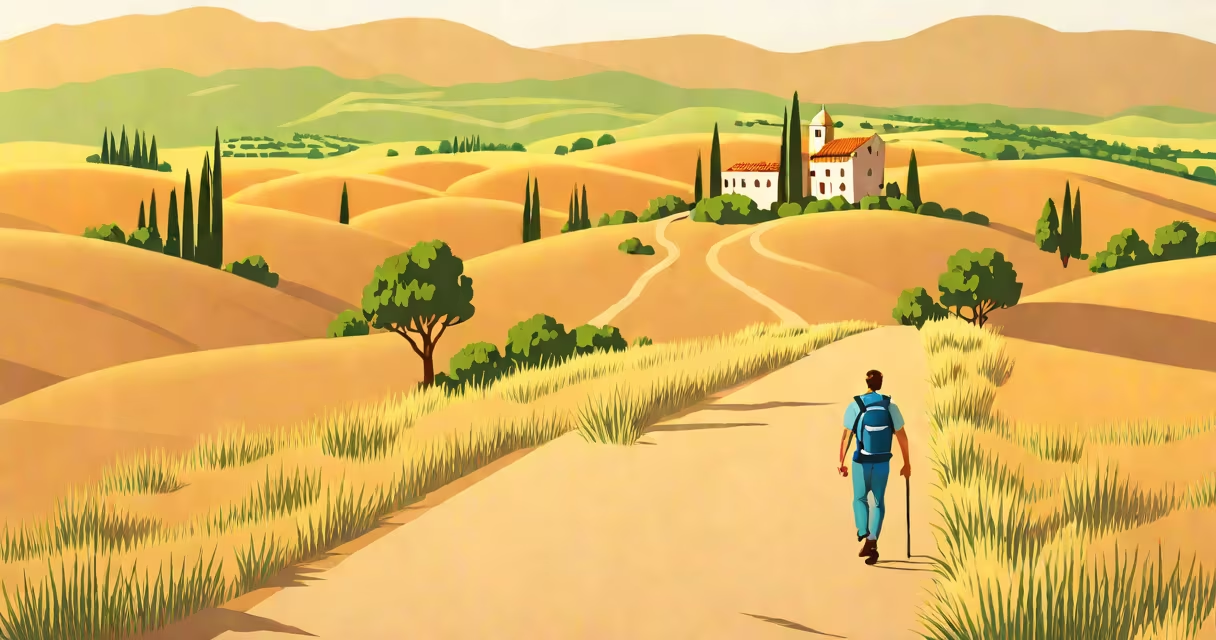
El Camino de Noa is a contemporary spiritual process modeled on the historic Camino de Santiago, combining long-distance walking with intentional reflection. It is not a religious doctrine but a personal path of meaning-making through movement, solitude, and presence. The name honors Noa, a fictional traveler from a 2016 novel by Spanish author María Díaz, whose inner voyage became a symbolic structure for modern pilgrims seeking clarity.
The route begins in Roncesvalles, a town near the Pyrenees, and follows the traditional French Way (Camino Francés) for approximately 775 kilometers to Santiago de Compostela. Unlike official Camino routes, El Camino de Noa includes optional detours, rest stations, and daily journal prompts designed to deepen emotional awareness. Participants often walk between 15 and 25 kilometers per day, averaging 3 to 4 hours of walking, with scheduled pauses for meditation and writing.
Participants typically begin in late April or early May, aligning with favorable weather and daylight. The average completion time is 32 to 38 days. Most walkers carry minimal gear-backpacks under 10 kg-and rely on albergues (hostels), family-run guesthouses, and occasional camping. The process emphasizes consistency over speed, with success measured in insight, not distance covered.
El Camino de Noa operates as a curated walking experience rather than a formal pilgrimage. It uses a digital companion app developed by a Barcelona-based nonprofit called Camino Sin Fronteras. The app tracks daily steps, provides guided reflections, and offers access to a global community of walkers who share entries in a shared digital journal. Data from 2023 shows that 73% of participants reported increased emotional resilience after completing the route.
Daily structure centers around three elements: movement, stillness, and expression. Morning walks start at sunrise, lasting 3 to 4 hours. Afternoon sessions involve silent sitting for 20 minutes at designated rest points-often old stone bridges or abandoned chapels. Evening rituals include writing in a provided notebook or recording audio reflections. These practices are rooted in mindfulness traditions and cognitive behavioral therapy techniques, validated by research from the University of Barcelona (2022).
A key feature is the "Noa Moment"-a 10-minute pause at the midpoint of each day's walk. During this time, walkers close their eyes and recall a moment of personal loss, joy, or regret. The goal is not to resolve emotions but to acknowledge them. This practice draws from the work of Dr. Kristin Neff, who found that self-compassion reduces anxiety during prolonged stress exposure (Journal of Clinical Psychology, 2021).
El Camino de Noa is offered in four distinct formats, each tailored to different life stages and mental health goals:
| Format | Duration | Focus | Target Group |
|---|---|---|---|
| Path of Return | 35 days | Reconnecting with childhood memories | Adults aged 35-55 |
| Trail of Becoming | 42 days | Identity formation and career clarity | Young adults (22-34) |
| Way of Release | 28 days | Grief processing and emotional release | Individuals recovering from trauma |
| Circle of Stillness | 14 days | Mindfulness and breathwork | Retirees and those seeking mental reset |
Each format includes a different set of journal prompts. For example, "Trail of Becoming" asks participants to write about a time they were told they weren't enough. "Way of Release" includes prompts like "Describe the last person you didn't forgive." These are not therapeutic interventions but tools for narrative reconstruction, supported by evidence from the American Psychological Association (2020).
El Camino de Noa is not a religious pilgrimage. While it shares the physical route of the Camino de Santiago, it does not require adherence to Catholicism or any faith tradition. The term "Noa" was chosen deliberately to avoid religious connotations. The name references a character in a fictional novel, not a historical figure. This distinction is critical-many confuse it with the official Camino, which attracts tens of thousands annually.
Another misconception is that the process is physically demanding. While it requires endurance, the program includes medical screening and access to physiotherapists at major waypoints. In 2023, only 3.2% of participants dropped out due to injury, compared to 11% on unstructured versions of the Camino Francés. The program also offers virtual participation options for those unable to travel.
Finally, some assume it's a luxury retreat. It is not. Walkers sleep in basic hostels, eat simple meals (typically beans, bread, cheese, and fruit), and walk in all weather. The experience is intentionally austere to reduce distractions. One participant, a software engineer from Madrid, described it as "the most uncomfortable peace I've ever known."
In 2022, Elena M., a 41-year-old teacher from Seville, completed the Path of Return. She had been diagnosed with generalized anxiety disorder and had stopped attending therapy. She joined El Camino de Noa after reading a testimonial online. Over 35 days, she walked 1,100 kilometers, averaging 32 km/day.
Her journal revealed a pattern: early entries focused on frustration ("I hate my feet"), mid-process reflections shifted to memory ("I remember my mother singing in the kitchen"), and final entries centered on acceptance ("I am not broken. I am becoming"). By the end, she reported a 60% reduction in panic attacks, according to her therapist's follow-up evaluation.
Elena's story illustrates a core principle: the process is not about reaching Santiago-it's about returning to oneself. Her experience mirrors findings from a 2023 study published in *Frontiers in Psychology*, which showed that long-distance walkers experienced greater self-perception stability than non-walkers after 30 days of sustained movement.