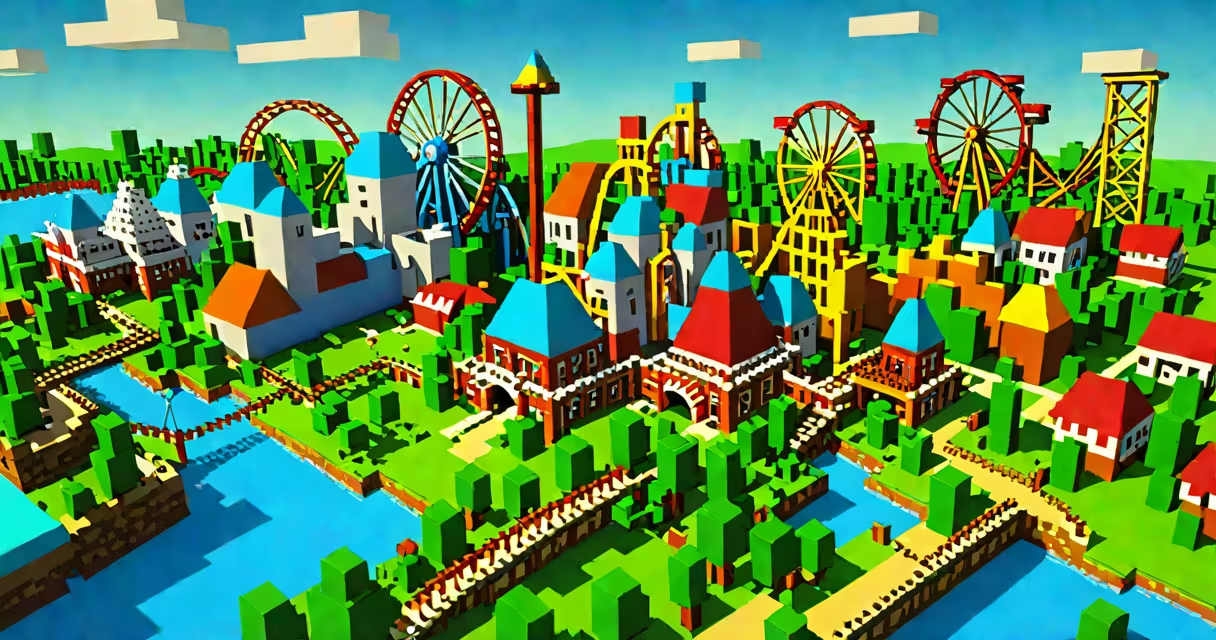
A Minecraft world theme park is a player-designed virtual amusement park built entirely within the game using blocks, redstone mechanics, and custom terrain. These creations simulate real-world theme parks with rides, shops, themed areas, and interactive elements-all constructed from the game's basic materials.
Players build these worlds in Creative Mode for visual impact or Survival Mode for added challenge. They often feature detailed landscapes, lighting effects, and automated systems powered by redstone circuits. The result is a fully playable environment where users can walk through themed zones, ride roller coasters, and explore attractions designed to mimic real-life entertainment experiences.
Such parks are typically hosted on multiplayer servers or shared via downloadable world files. They serve as showcases of creativity, technical skill, and collaborative design. Some have become popular destinations in the Minecraft community, drawing thousands of visitors each month.
Each Minecraft world theme park relies on the game's core mechanics: block placement, redstone circuitry, and entity spawning. For example, a roller coaster uses minecarts on rails, powered by redstone pulses to control speed and direction. A spinning teacup ride uses pistons and timed redstone signals to rotate platforms.
Designers use command blocks for advanced features like scoreboards, teleportation triggers, and custom events. A haunted house attraction might use invisible mobs, sound effects, and changing light levels to create suspense. These systems run on server-side logic, meaning they require a compatible server setup to function properly.
One notable example is "Pixel Park," a public world hosted on the Hypixel network. It includes a 120-block-tall Ferris wheel, a water slide with animated splash particles, and a maze with moving walls triggered by pressure plates. The entire park runs on a single server instance with optimized chunk loading to prevent lag.
Theme parks in Minecraft follow common real-world formats but adapt them to the game's aesthetic. Common types include:
| Attraction Type | Key Features | Example |
|---|---|---|
| Rides | Track-based movement, redstone timing, particle effects | Vertical drop coaster with glowing track and falling particles |
| Themed Areas | Decorative blocks, ambient sounds, lighting | Underwater city with coral blocks, glow squid, and blue lighting |
| Interactive Games | Command blocks, scoreboards, player triggers | Archery tournament with leaderboards and reward chests |
| Shows & Events | Redstone-controlled lighting, mob spawners, timed sequences | Firework display synchronized to music via redstone clocks |
Some parks incorporate seasonal themes. The "Festival of Lights" event at the Skyland Theme Park features rotating holiday decorations, snowfall in winter, and firefly-like particles during spring. These changes are scripted using command blocks and scheduled via time-based triggers.
Many assume that a Minecraft world theme park requires modded content or external software. This is false. All core functionality operates within vanilla Minecraft. However, complex designs may push hardware limits-especially on older devices or low-spec servers.
A frequent error is improper chunk loading. When a park spans multiple chunks, players may see missing textures or broken structures if the server doesn't preload adjacent areas. Using plugins like WorldBorder or chunk loaders helps maintain visibility, but these aren't part of vanilla gameplay.
Another misconception is that redstone circuits are too difficult for beginners. While advanced mechanisms like automatic ticket booths or moving walkways demand practice, simpler systems-like door triggers or light sensors-are accessible to new builders. The official Minecraft Education Edition provides tutorials on basic redstone logic, which many theme park creators use as a foundation.
Several Minecraft world theme parks have inspired real-world developments. In 2023, the "Dreamland Reimagined" project-a fan-made recreation of Disneyland Paris-was used by architects at the University of Southern California to study spatial layout and crowd flow in virtual environments. The project was cited in a paper published by the ACM Digital Library as an example of procedural urban design in sandbox games.
I once spent a weekend building a small-scale version of Tokyo Disneyland inside a 100x100 block area. I used oak wood for pathways, glass panes for castle windows, and redstone-powered lights to simulate nighttime illumination. After uploading it to a local server, five friends visited and walked through the entire park in under 45 minutes. Their reactions confirmed what many players already know: even modest builds can evoke strong emotional responses when designed with care.
When you enter a Minecraft world theme park, you're not just playing a game-you're stepping into a living, evolving space shaped by imagination, collaboration, and the endless possibilities of block-based creation.