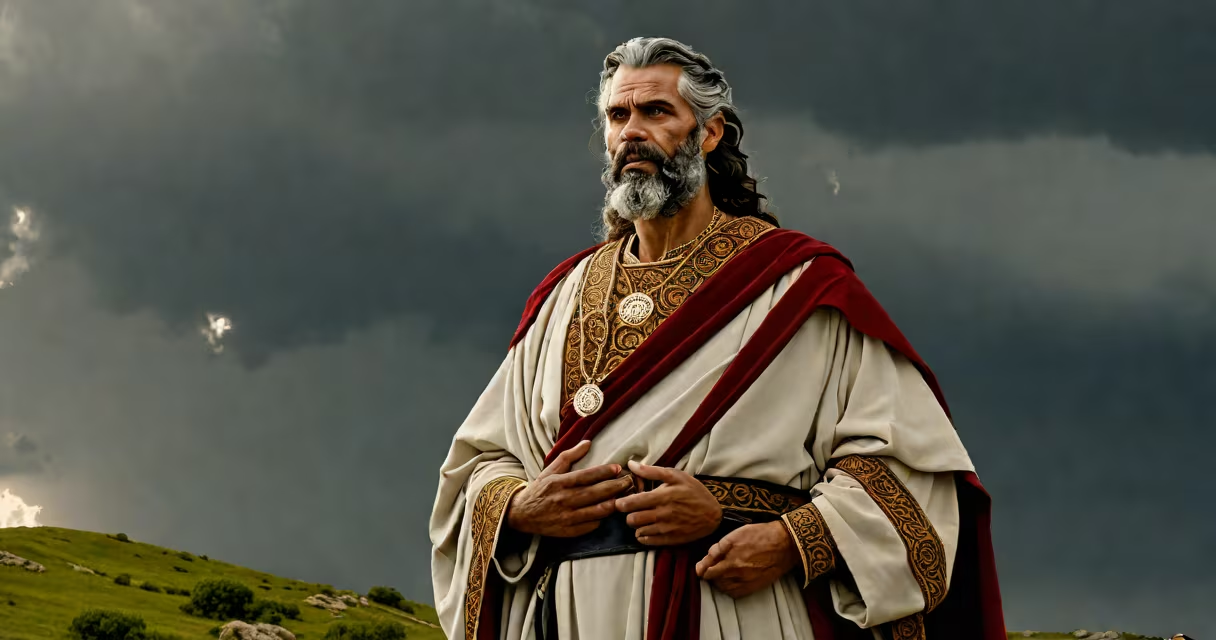
The elias bible meaning derives from the Hebrew name Elijah, meaning "my God is Yahweh," referring to the 9th-century BCE prophet who challenged false worship and performed miracles under divine authority. He appears in 1 Kings 17-19 and 2 Kings 1-2, serving as a central figure in Israel's religious history.
Elias is not a name used in the original Hebrew Bible. The Greek Septuagint and Latin Vulgate transliterated the Hebrew Elijah as Elias. This form persists in Christian traditions, especially in Catholic and Eastern Orthodox liturgies. Modern English translations typically restore the original Hebrew spelling, Elijah, but the name Elias remains in theological references and hymns.
His story begins during the reign of King Ahab, when drought struck Israel due to widespread worship of Baal. Elias appeared in the wilderness, sustained by ravens, then challenged 450 prophets of Baal on Mount Carmel. After he called fire from heaven to consume a sacrifice, the people acknowledged Yahweh as the true God. He later fled Jezebel's threat, was fed by a widow in Zarephath, and returned to confront Ahab's sin.
Elias operated as a covenant mediator. His actions were not personal acts of power but signs of God's presence. When he prayed for rain, the sky darkened. When he raised the widow's son from the dead, it confirmed his prophetic role. These events were not magic-they were divine interventions framed through human agency.
He did not act alone. His successor, Elisha, received a double portion of his spirit. The transfer occurred at the Jordan River, where Elias was taken up in a whirlwind. Elisha then split the river with a cloak, fulfilling the promise of continuity in prophetic authority.
According to 2 Kings 2:11, Elias ascended to heaven in a chariot of fire. This event became foundational for messianic expectations. Malachi 4:5 states that Elijah would return before the "great and terrible day of the Lord." Christians interpret this as fulfilled in John the Baptist, who wore similar clothing and preached repentance.
Three primary interpretations of Elias exist: historical, symbolic, and eschatological. The historical view treats him as a real person whose deeds are documented in the Deuteronomistic History. The symbolic view sees him as a model of faithfulness amid corruption. The eschatological view ties him to end-time prophecy.
| Tradition | View of Elias | Key Text |
|---|---|---|
| Jewish | Prophet who restored worship of Yahweh; expected to return before Messiah | Malachi 3:1, 4:5 |
| Christian | Prefiguration of Christ; John the Baptist as his fulfillment | Matthew 11:14, Mark 9:11-13 |
| Mormon (LDS) | Returned in 1836 to restore priesthood keys; part of restoration theology | D&C 2:1-2, D&C 110:13 |
A common misconception is that Elias is a separate individual from Elijah. In reality, Elias is a transliteration of Elijah. The name appears in Greek and Latin texts but not in the original Hebrew. The confusion arises because some English Bibles retain "Elias" in quotations (e.g., Luke 1:17), while others standardize to "Elijah."
Some assume Elias was a priest or king. He was neither. He was a lay prophet-anointed by God, not by lineage. His authority came from direct encounter with God, not office. This distinguishes him from Aaronic priests or Davidic kings.
Another error is equating Elias with Enoch. Both were taken bodily to heaven, but their stories differ. Enoch walked with God and was taken without dying (Genesis 5:24). Elias was taken in a fiery chariot after confronting evil rulers. Their similarities lie in divine departure, not identity.
One non-obvious fact: Elias never wrote a book. His life is recorded in narrative form across two books of Kings. No letters, prayers, or sermons attributed to him survive. His message was delivered through action and speech, not written scripture.
In 1 Kings 18:20-39, Ahab summoned 450 prophets of Baal and 400 prophets of Asherah to Mount Carmel. Elias challenged them: "Call on your god. I will call on Yahweh. The God who answers by fire-he is God."
After the prophets of Baal failed, Elias rebuilt Yahweh's altar using twelve stones. He poured water over the wood and sacrifice until the trench filled. He prayed. Fire fell from heaven, consuming the offering, the wood, the stones, and even the water. The people fell on their faces and cried, "Yahweh-he is God!"
This event illustrates the elias bible meaning: divine sovereignty over nature, rejection of false gods, and the power of faithful prayer. It is not a miracle for spectacle-it is a demonstration of covenant loyalty.
I once stood at the site traditionally identified as Mount Carmel near Haifa, Israel. The terrain matches the biblical description: a ridge overlooking the Mediterranean, with a dry valley below. Standing there, I saw how the wind would carry sound and smoke. The scale of the event becomes tangible-not myth, but geography and history.
Modern usage of "Elias" often appears in literature and film as a symbol of resistance. In *The Chosen*, a television series about Jesus' life, Elias is referenced in John the Baptist's mission. The show draws on the idea that Elijah's return is not a physical reappearance but a spiritual renewal.
The elias bible meaning is not just about a man in a cloak. It is about the enduring demand for moral courage, the rejection of compromise, and the belief that God speaks through those who stand alone.