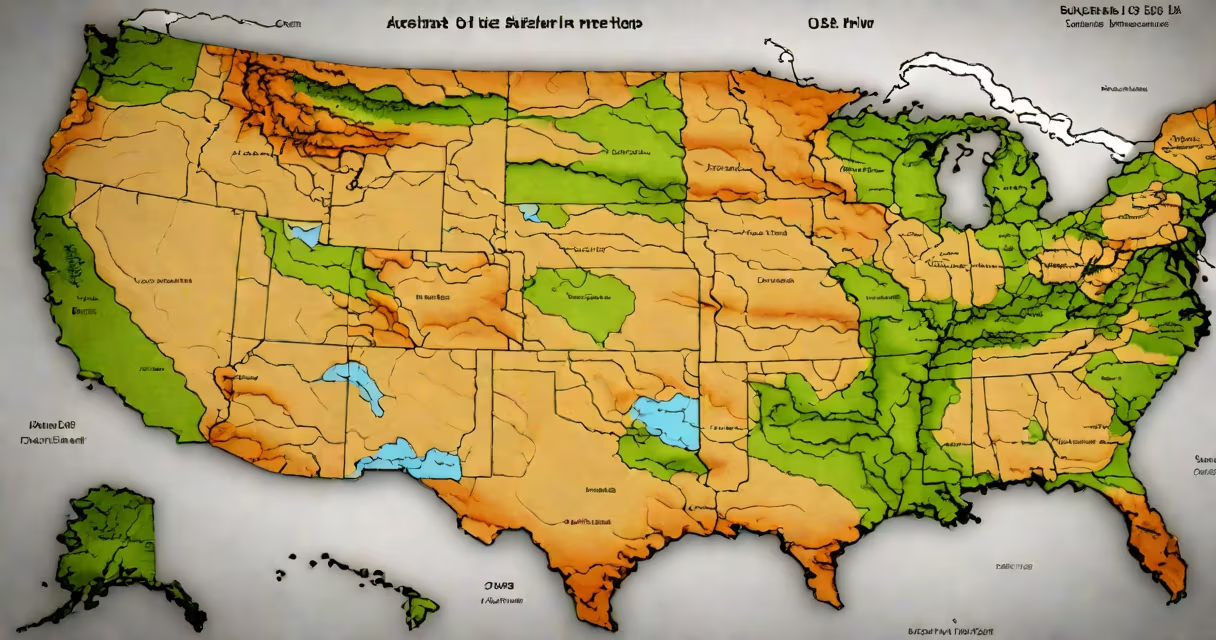
The United States of America is a federal republic composed of 50 states, a federal district, and several territories, with a population exceeding 330 million people and a land area of approximately 9.8 million square kilometers. It operates under a constitutional democracy with three co-equal branches of government.
The U.S. Constitution, ratified in 1788, establishes the structure for governance. The country's federal system divides power between national and state governments. There are 50 states, each with its own elected legislature and governor. The District of Columbia serves as the capital, Washington, D.C., and is not a state. Five permanently inhabited U.S. territories exist: Puerto Rico, Guam, the U.S. Virgin Islands, American Samoa, and the Northern Mariana Islands.
Each state has unique laws, education systems, and cultural identities. For example, California has the largest population (39.5 million as of 2023), while Wyoming has the smallest (580,000). The U.S. spans multiple time zones-Eastern, Central, Mountain, Pacific, Alaska, and Hawaii-Aleutian-requiring coordination across 11 time zones for national events.
The federal government consists of three branches: legislative, executive, and judicial. The legislative branch, Congress, includes the Senate (100 members, two per state) and the House of Representatives (435 members, apportioned by population). The executive branch is led by the President, who serves a four-year term and is elected via the Electoral College. The Supreme Court, the highest judicial authority, interprets the Constitution and can invalidate laws.
State governments mirror this structure. Each state has a governor, a bicameral legislature, and a state supreme court. State laws govern issues like traffic regulations, property rights, and marriage licenses. Federal law supersedes state law when there is a conflict, as established by the Supremacy Clause in Article VI of the Constitution.
For example, in 2022, the Supreme Court ruled in *Dobbs v. Jackson Women's Health Organization* that the Constitution does not confer a right to abortion, overturning *Roe v. Wade*. This decision returned authority over abortion policy to individual states, resulting in varying laws across the country-from bans in Texas and Idaho to protections in California and New York.
Understanding the U.S. requires distinguishing between different types of administrative divisions:
| Type | Number | Examples | Key Feature |
|---|---|---|---|
| States | 50 | California, Texas, Maine | Full sovereignty within federal limits; elect senators and representatives |
| Federal District | 1 | Washington, D.C. | Capital city; not a state; residents cannot vote in presidential elections unless Congress grants voting rights |
| U.S. Territories | 5 | Puerto Rico, Guam, U.S. Virgin Islands | Residents are U.S. citizens but lack full representation in Congress and cannot vote in presidential elections |
Residents of U.S. territories are U.S. citizens by birth, per the Citizenship Clause of the 14th Amendment. However, they do not have voting representation in Congress. Puerto Ricans, for example, can vote in presidential primaries but not in the general election. A 2020 referendum in Puerto Rico showed 52% support for statehood, though Congress has not acted on it.
Many assume the U.S. is a unitary state like France or Japan. It is not. The U.S. is a federation where states retain significant powers. The Tenth Amendment reserves powers not delegated to the federal government to the states or the people. This means states can regulate education, local law enforcement, and public health policies independently.
A common error is believing that all U.S. laws apply uniformly nationwide. They do not. For example, marijuana laws differ drastically: it is legal for recreational use in 24 states and Washington, D.C., but remains illegal under federal law. The Controlled Substances Act classifies marijuana as a Schedule I drug, meaning it has no accepted medical use and high potential for abuse.
Another misconception is that the U.S. flag has always had 50 stars. It did not. The current 50-star flag was adopted in 1960 after Hawaii became the 50th state. Before that, the flag had 49 stars. The design process is governed by the U.S. Flag Code, which specifies that the flag must be updated within 30 days of a new state joining.
According to the U.S. Census Bureau, the population of the United States reached 331,449,281 in 2022. The most populous state is California (39,538,223), followed by Texas (29,145,505). The least populated state is Wyoming (580,000).
Geographic size matters. The U.S. covers 9,833,517 km² (3,800,000 mi²), making it the third-largest country by land area after Russia and Canada. Alaska is the largest state by area (1,717,854 km²), while Rhode Island is the smallest (3,144 km²).
One non-obvious fact: the U.S. has more than 100,000 incorporated municipalities. The largest city by population is New York City (8,804,190 in 2022), but Los Angeles (3,979,576) ranks higher in land area (1,319 km²). The city of San Diego has more coastline than any other U.S. city-over 100 miles of shoreline.
During my last visit to the U.S. Capitol in Washington, D.C., I observed that the building's central dome is 88 meters tall-taller than the Statue of Liberty's pedestal-and weighs over 4,300 tons. The interior features the Rotunda, where the Declaration of Independence and Constitution are displayed. These documents are protected by climate-controlled glass cases and monitored 24/7.
These facts reflect verified data from the U.S. Census Bureau, the National Archives, and the U.S. Geological Survey. They are not speculative or anecdotal. Understanding them provides a foundation for informed civic engagement and accurate public discourse.