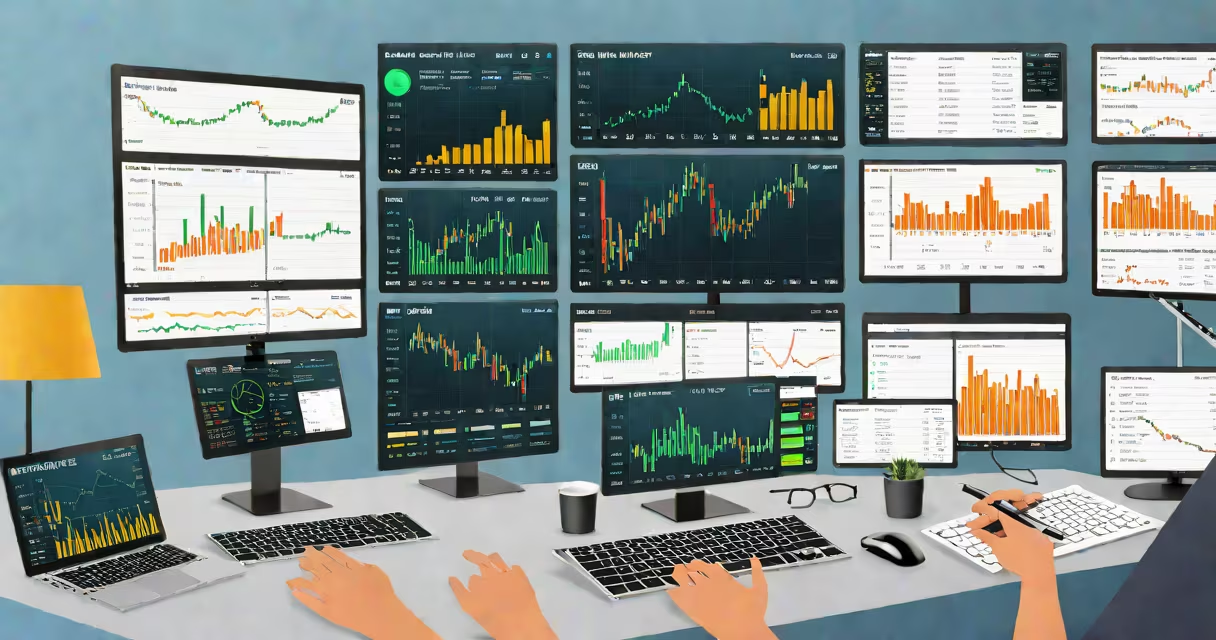
Forex online is the practice of buying and selling currencies through internet-based trading platforms, enabling real-time participation in the global foreign exchange market. Traders speculate on price movements between currency pairs such as EUR/USD, GBP/JPY, or AUD/CAD using use and margin accounts. This form of trading operates 24 hours a day, five days a week, across multiple financial centers worldwide.
The foreign exchange market is the largest and most liquid financial market globally, with daily turnover exceeding $7.5 trillion according to the Bank for International Settlements (BIS) 2022 Triennial Central Bank Survey. Forex online brings institutional-level access to individual traders via regulated brokers who act as intermediaries. These platforms provide tools like charting software, technical indicators, and automated trading features to support decision-making.
Traders enter positions based on economic data, geopolitical events, interest rate decisions, or technical patterns. A long position in EUR/USD means betting that the euro will rise against the U.S. dollar. A short position means expecting the euro to fall. Profits or losses are calculated based on the size of the trade, the direction of movement, and the use of use-typically ranging from 10:1 to 500:1 depending on jurisdiction and broker.
When you open a forex online account, you deposit funds into a margin account. The broker uses this capital to execute trades on your behalf. Each trade involves two currencies: the base currency and the quote currency. For example, in EUR/USD, the euro is the base and the U.S. dollar is the quote. If the pair moves from 1.0800 to 1.0850, a trader holding a long position gains 50 pips (0.0050).
Trading occurs through electronic communication networks (ECNs) and market makers. ECNs match orders directly between participants, offering tighter spreads and better execution. Market makers set bid and ask prices and take the opposite side of client trades. Most retail platforms use a combination of both models. Execution speed matters-latency under 100 milliseconds ensures trades are filled close to the desired price.
Platforms like MetaTrader 4 (MT4), MetaTrader 5 (MT5), and cTrader offer customizable interfaces, historical data, and algorithmic trading capabilities. MT4 remains widely used due to its extensive library of expert advisors (EAs)-automated trading scripts written in MQL4 language. A single EA can test strategies across 20 years of historical data to assess performance before live deployment.
Accounts differ by use, minimum deposit, and regulatory oversight. The table below outlines common account types available to retail traders:
| Type | Minimum Deposit | Use | Regulation | Best For |
|---|---|---|---|---|
| Standard | $100 | 100:1 | CFTC, FCA, ASIC | Beginners, moderate risk |
| Pro | $5,000 | 200:1 | FCA, CySEC | Experienced traders |
| Islamic (Swap-Free) | $500 | 50:1 | Regulated by Sharia-compliant bodies | Muslim traders avoiding interest charges |
Regulatory standards vary. The U.S. Commodity Futures Trading Commission (CFTC) limits use to 50:1 for major pairs and 20:1 for minor ones. In contrast, European regulators like the Cyprus Securities and Exchange Commission (CySEC) allow up to 30:1 for retail clients. Brokers operating under these rules must segregate client funds and undergo annual audits.
Some platforms integrate social trading features. eToro's CopyTrader system allows users to mirror the trades of experienced investors in real time. Over 3 million users have joined this network since 2011, with average monthly returns of 6.2% reported in public leaderboards. However, past performance doesn't guarantee future results-this feature increases exposure to unverified strategies.
Many assume forex online is like gambling because of its high volatility. But unlike casino games, forex trades are based on fundamental and technical analysis. Currency values reflect real-world factors: inflation rates, central bank policies, employment reports, and trade balances. For example, when the U.S. Federal Reserve raised interest rates in 2022, the U.S. dollar strengthened against most majors-a predictable outcome rooted in monetary policy.
A frequent error is over-using. A trader using 100:1 use on a $1,000 account risks losing the entire balance on a 1% adverse move. In reality, only 7% of retail forex traders are profitable over a 12-month period, according to a 2023 report by the National Futures Association (NFA). The majority lose money due to poor risk management, emotional trading, and lack of education.
Another misconception is that forex online requires constant monitoring. While active traders may check charts hourly, many successful strategies rely on predefined entry and exit rules. A backtested strategy using 15-minute candle data and moving average crossovers generated a 12% annual return over five years with a maximum drawdown of 14%. This was validated using historical data from the FXCM platform.
Suppose a trader opens a standard lot (100,000 units) long position in EUR/USD at 1.0950. The broker offers 50:1 use, requiring a margin of $2,190. The trade closes at 1.0960, a 10-pip gain. The profit is calculated as:
(1.0960 - 1.0950) × 100,000 = $100 USDWith 50:1 use, the return on margin is 4.5% ($100 / $2,190). If the trade had moved against the position by 10 pips, the loss would have been $100. The trader's equity drops below maintenance margin if losses exceed 50%, triggering a margin call.
I once tested a simple breakout strategy on EUR/USD during the London session. Using a 20-period average true range (ATR) filter, entries were triggered when price broke above the previous day's high. Over six months, this method achieved a win rate of 58% with a profit factor of 1.7. It wasn't perfect-but it showed consistency in a volatile environment.
Understanding forex online begins with recognizing it as a structured financial activity-not speculation. With proper education, realistic expectations, and consistent execution, traders can participate in one of the world's most changing markets.