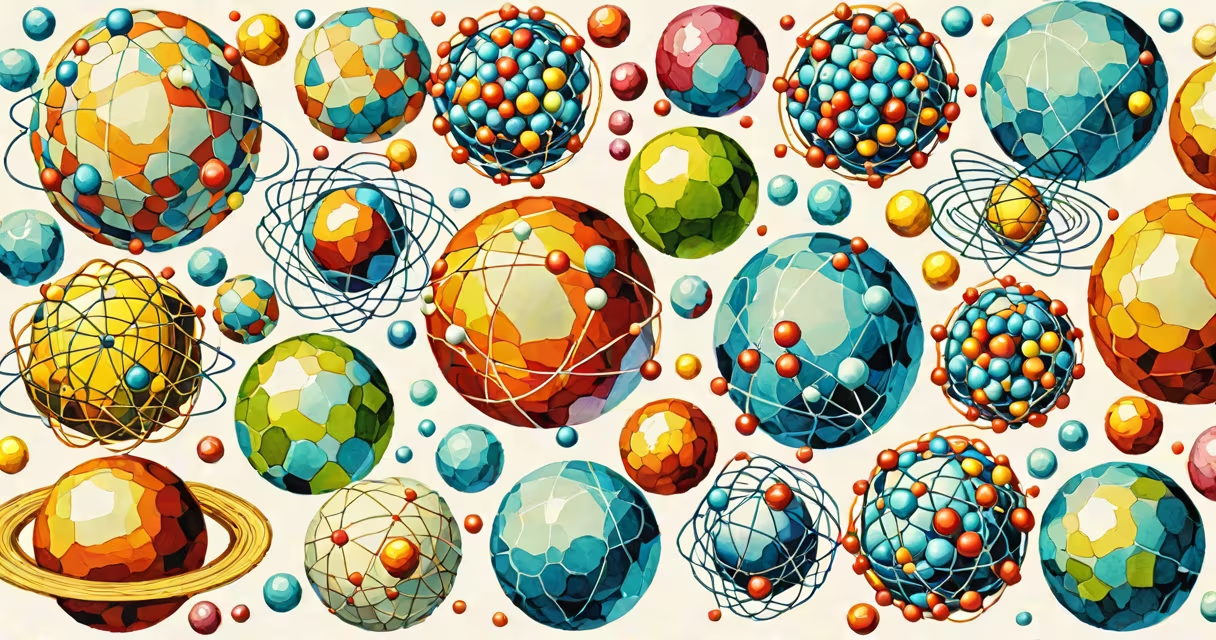
The science of atoms studies the fundamental building blocks of matter-protons, neutrons, and electrons-and how they combine to form elements, molecules, and all physical substances. This field integrates experimental observation, mathematical modeling, and theoretical prediction to explain behavior at scales invisible to the naked eye.
Atoms are not solid balls. They consist of a dense nucleus surrounded by a cloud of electrons occupying specific energy levels. The arrangement of these electrons determines chemical properties. For example, carbon has six electrons arranged in two shells: two in the first, four in the second. This configuration allows carbon to form four covalent bonds-a trait essential to life's complexity.
Modern atomic theory began with John Dalton's 1808 hypothesis that elements are composed of indivisible particles. Later discoveries revealed atoms are divisible. Ernest Rutherford's gold foil experiment in 1909 showed atoms have a small, positively charged nucleus. Niels Bohr refined this model in 1913 by proposing electrons orbit in fixed energy levels. Today, quantum mechanics describes electrons not as particles in orbits, but as probability distributions called orbitals.
An atom's identity comes from its proton count-the atomic number. Hydrogen has one proton; uranium has 92. Neutrons add mass without changing elemental identity. Atoms with the same number of protons but different neutrons are isotopes. Carbon-12 has six neutrons; carbon-14 has eight. Carbon-14 decays predictably over time, enabling radiocarbon dating of organic materials up to 50,000 years old.
Electrons exist in regions of space called orbitals-s, p, d, and f shapes determined by wave functions. The s orbital is spherical; the p orbital resembles a dumbbell. Electron configuration follows the Aufbau principle: fill lower-energy orbitals first. Oxygen (atomic number 8) has the configuration 1s² 2s² 2p⁴-two electrons in the first shell, two in the 2s orbital, and four in the 2p set.
| Particle | Charge | Mass (relative) | Location |
|---|---|---|---|
| Proton | +1 | 1 | Nucleus |
| Neutron | 0 | 1 | Nucleus |
| Electron | -1 | ~1/1836 | Orbitals around nucleus |
Quantum mechanics governs atomic behavior. The Schrödinger equation predicts electron probability densities. A hydrogen atom's ground state electron has a 90% chance of being within 100 picometers of the nucleus. This probabilistic nature contrasts sharply with classical mechanics, where position and momentum are precisely known.
Understanding atoms enables technologies shaping modern life. Silicon chips rely on controlled doping-adding impurities to alter electron flow. A single silicon transistor contains about 10 billion atoms. When voltage is applied, electrons move through engineered pathways, forming logic gates that process data.
Medical imaging uses atomic principles. Positron emission tomography (PET) scans detect gamma rays emitted when positrons (antielectrons) collide with electrons in the body. The resulting annihilation produces two photons traveling in opposite directions. Detectors measure this pair, reconstructing internal structures with millimeter precision.
In 2018, researchers at the National Institute of Standards and Technology measured the fine-structure constant-a dimensionless number describing electromagnetic interactions-with uncertainty below 1 part in 100 million. This precision validates quantum electrodynamics, a theory that treats electrons and photons as interacting fields.
Atoms are not empty. While most of an atom's volume is empty space, the electron cloud occupies it continuously. An analogy fails: imagining a marble in a football stadium doesn't capture the reality of quantum fields. Electrons aren't orbiting like planets-they exist as standing waves in orbitals.
Some assume atoms are stable and unchanging. But atoms undergo radioactive decay. Carbon-14 decays at a half-life of 5,730 years. After one half-life, half the original sample remains. After five half-lives (about 28,650 years), less than 3% remains. This predictable decay forms the basis of radiometric dating in archaeology and geology.
A common error is equating atomic size with visibility. Atoms are ~0.1 nanometers wide-too small for visible light to resolve. Scanning tunneling microscopes (STM) bypass this limit. By measuring electron tunneling current between a sharp tip and a surface, STM images individual atoms. In 1989, IBM scientists spelled "IBM" using 35 xenon atoms on a nickel surface-proof that atomic manipulation is possible.
I once watched a live demonstration of STM at a university lab. The screen showed a grid of iron atoms on a copper surface. As the tip scanned, the atoms appeared as peaks. When the voltage was adjusted, the image changed-electrons shifted positions. That moment confirmed: atoms aren't static. They respond to energy input in ways we can observe and control.
the science of atoms differs from chemistry and biology. Chemistry focuses on how atoms bond and rearrange during reactions. Biology examines systems built from atoms-cells, organisms, ecosystems. The science of atoms operates at a deeper level, explaining why bonds form and how energy moves between states.
It also differs from astrophysics, which applies atomic theory to stars and galaxies. Nuclear fusion in the sun converts hydrogen into helium via proton-proton chain reactions. Each reaction releases energy as photons. Over 10^38 such reactions occur per second in the sun's core, powering Earth's climate and photosynthesis.
Quantum mechanics, a branch of the science of atoms, extends beyond single atoms. Entanglement-where two particles share a state regardless of distance-defies classical intuition. In 2022, Chinese physicists demonstrated quantum entanglement across 1,200 kilometers using satellites. This supports quantum communication networks, where information is transmitted securely through correlated particle states.
the science of atoms is not a single theory but a structure of interconnected concepts. From the stability of noble gases to the instability of plutonium-239, atomic behavior follows laws derived from decades of experimentation and refinement. Its insights enable everything from nuclear power to MRI machines. Without it, modern technology would not exist.