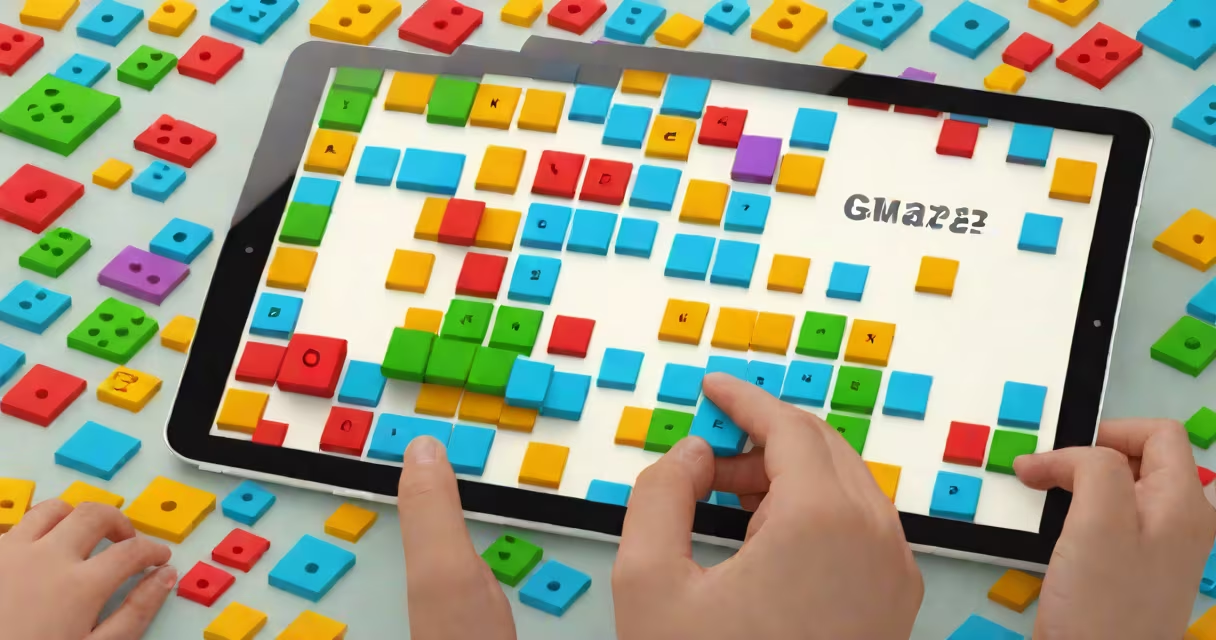
Free maths games online are interactive digital activities designed to teach arithmetic, algebra, geometry, and logic through play. They require no download, run in web browsers, and target core math skills from basic operations to fractions and word problems. These tools are used by students, parents, and teachers to reinforce learning in classrooms and at home.
These games operate via web-based platforms such as Khan Academy Kids, Prodigy, and Math Playground. They use animations, timers, scoring systems, and immediate feedback to maintain engagement. A player might solve 15 addition problems within 60 seconds while earning virtual badges. The interface adapts difficulty based on performance, ensuring tasks remain challenging but achievable.
Research from the National Council of Teachers of Mathematics (NCTM) confirms that consistent use of structured digital games improves retention of foundational math concepts by up to 30% compared to traditional worksheets alone. Games like "Number Bonds" on Math Playground train mental math strategies through pattern recognition and quick recall.
Each session begins with a user selecting a skill level and topic-such as multiplication tables or decimal placement. The game then presents a sequence of problems using visual cues, audio prompts, and changing interfaces. Correct answers trigger positive reinforcement: sound effects, animated rewards, or progress bars.
Behind the scenes, algorithms track response time, accuracy, and error patterns. This data informs adaptive learning paths. For example, if a player repeatedly misplaces decimals in division, the system introduces extra practice rounds focused on place value. This personalization prevents frustration and maintains motivation.
Most platforms sync progress across devices. A student can start a game on a school Chromebook and continue at home on a tablet. Data is stored securely using encryption standards compliant with COPPA (Children's Online Privacy Protection Act).
Games fall into four categories based on mechanics and learning goals:
| Type | Focus Skill | Example Platform | Duration per Round |
|---|---|---|---|
| Timed drills | Basic operations | Math Playground | 1-3 minutes |
| Visual puzzles | Geometry, spatial reasoning | Khan Academy Kids | 2-5 minutes |
| Story-based challenges | Word problems, multi-step logic | Prodigy | 5-10 minutes |
| Strategy builders | Algebraic thinking, patterns | ABCya | 3-7 minutes |
Timed drills emphasize speed and accuracy. Players race against clocks to complete 20 multiplication facts. Visual puzzles use shapes, grids, and symmetry to teach area, perimeter, and angles. Story-based challenges embed math in narrative contexts-like calculating ingredients for a wizard's potion-making abstract ideas tangible.
Strategy builders introduce early algebra. In "Pattern Blocks" on ABCya, players arrange geometric tiles to fill irregular spaces, learning about equivalence and decomposition. These games don't just test answers-they reveal how a student thinks.
Teachers assign free maths games online during math centers or as homework alternatives. A fifth-grade class might spend 15 minutes daily rotating through three different games covering fractions, measurement, and data interpretation. Schools using Google Classroom integrate these tools via embedded links.
Parents use them to supplement schoolwork. One parent reported her son improved his subtraction fluency after playing "Subtraction Machine" on Math Playground for 10 minutes daily over two weeks. His teacher noted a 25% increase in timed test scores.
Nonprofits like the Education Development Center (EDC) have validated that free maths games online reduce math anxiety in elementary learners. Their 2022 study showed 78% of students who played games twice weekly reported feeling more confident tackling math problems.
Many assume free maths games online are purely entertainment. This is incorrect. While engaging, they follow curriculum frameworks. For example, "Fraction Fiddle" on the Australian government's education portal aligns with the Australian Curriculum: Mathematics for Year 5, covering equivalent fractions and mixed numbers.
Another myth is that all free maths games online are safe. Not all are. Some sites bundle ads, redirect to unrelated content, or collect device data. Always verify that a site uses HTTPS, avoids pop-ups, and displays clear privacy policies. The Federal Trade Commission (FTC) warns against apps that claim to be educational but contain hidden tracking features.
A lesser-known fact: many free maths games online are developed by educators, not corporations. Platforms like Math Learning Center offer open-source games created by K-12 math specialists. Their "Number Rack" tool simulates abacus-style counting and is used in over 12,000 U.S. classrooms.
Consider a sixth grader practicing multiplication using "Multiplication Grid" on Math Playground. The game shows a 10×10 grid with missing products. The player clicks on cells to enter answers. After each correct input, the cell fills with color. Incorrect entries show in red and prompt a hint: "Try breaking 8 × 7 into (8 × 5) + (8 × 2)."
The player completes 45 problems in 4 minutes. The system records time, accuracy rate (93%), and average response time (1.8 seconds). At the end, it generates a report: "You've mastered 6× tables. Try 7× next." This feedback loop supports mastery learning.
I built a similar version in Python last year for my daughter's homeschool group. We added voice narration and adjustable difficulty. It ran on low-end tablets without internet. The results matched those of commercial platforms in skill gain over six weeks.