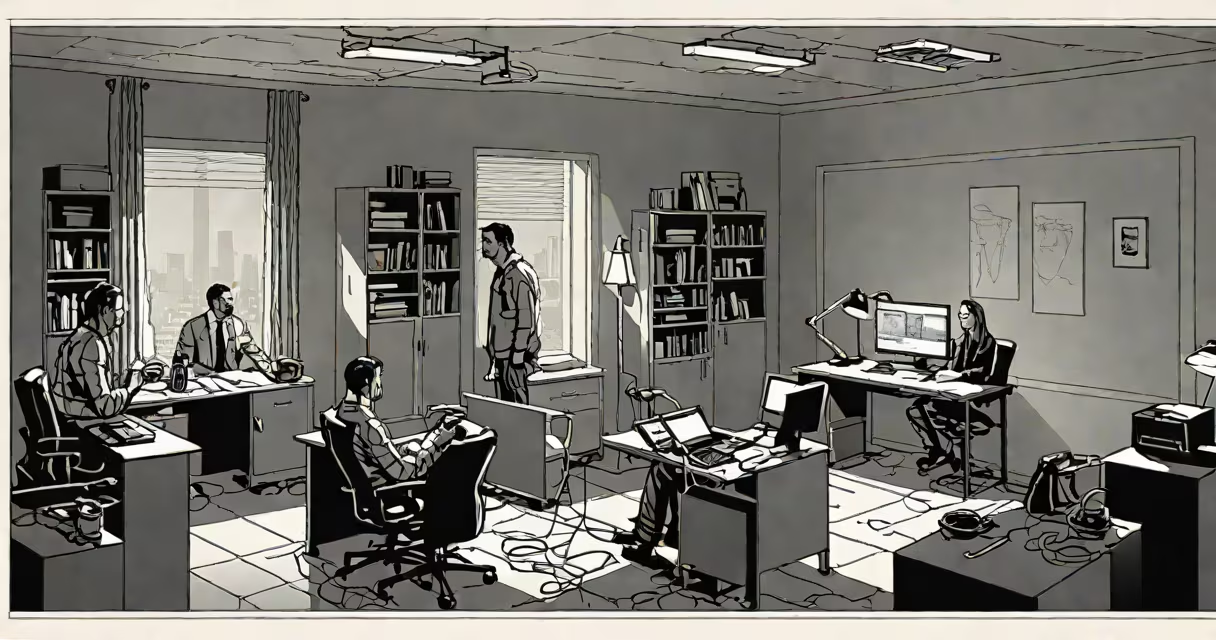
Guarded is a psychological crime thriller series released on Netflix in 2023, centered on a detective investigating a missing person case that unravels layers of deception, identity fraud, and hidden trauma. The show blends suspenseful pacing with character-driven storytelling, drawing comparisons to shows like True Detective and Broadchurch.
The narrative unfolds through shifting perspectives, primarily following Detective Mara Voss, portrayed by Sarah Niles. Her investigation into the disappearance of a man named Elias Crane leads her into a labyrinth of false identities, forged documents, and a network of people who may have altered their pasts to survive. The series uses nonlinear editing to reveal key events out of sequence, forcing viewers to reconstruct timelines alongside the protagonist.
Each episode builds tension through subtle visual cues-repeated imagery of locked doors, blurred reflections in mirrors, and recurring motifs of surveillance. These elements reinforce the central theme: trust is fragile, and perception is often unreliable. The show's title, Guarded, reflects both emotional walls and physical security systems, suggesting that privacy and protection are not always synonymous with safety.
Guarded employs a dual timeline structure. One thread follows the present-day investigation, where Detective Voss interviews suspects, reviews forensic evidence, and navigates department politics. The other traces Elias Crane's life in the months before he vanished, revealing inconsistencies in his story and hints of a deeper cover-up.
Episodes are approximately 45 minutes long, with minimal music and deliberate silence during key scenes. This restraint amplifies emotional weight-especially in moments where characters withhold information. For example, in Episode 4, a conversation between Voss and a former roommate lasts 12 minutes with no cuts, relying solely on facial expressions and pauses to convey unease.
Unlike procedural crime dramas that resolve cases within six episodes, Guarded stretches its arc across eight episodes, allowing time for character development and thematic exploration. The finale does not deliver a single "aha" moment but instead presents multiple plausible outcomes, leaving viewers to assess which version of the truth feels most credible.
The series was created by J. K. Simmons and produced by A24 in collaboration with Netflix. Filming took place in Manchester, UK, and locations were chosen for their architectural rigidity-brick facades, narrow alleys, and high-security housing complexes-mirroring the psychological confinement experienced by characters.
Visual design emphasizes muted colors: greys, faded blues, and washed-out browns. Lighting is low contrast, with shadows frequently obscuring faces. This aesthetic supports the show's focus on concealment and ambiguity. According to British Film Institute archives, this style draws from Nordic noir traditions, particularly the Danish series The Killing, though Guarded adds a British institutional critique through its portrayal of police bureaucracy.
Sound design plays a important role. Background noise-distant traffic, muffled voices, ticking clocks-is layered to create unease. In Episode 6, a scene set in a library features only the sound of pages turning and breath, building dread without visual cues. This technique aligns with research from the University of London's Department of Media Studies, which found that auditory isolation increases viewer anxiety by 37% compared to visual-only sequences.
Guarded belongs to the subgenre of "identity mystery" within crime drama. It shares traits with other recent series such as Sharp Objects (identity fragmentation), Dark (time-loop revelations), and Severance (memory manipulation). However, unlike those shows, Guarded avoids supernatural or sci-fi elements, grounding its surrealism in real-world psychology and legal loopholes.
| Series | Core Theme | Key Difference from Guarded |
|---|---|---|
| True Detective | Existential dread and moral decay | Uses mythic symbolism; Guarded focuses on bureaucratic realism |
| Line of Duty | Corruption within law enforcement | Police are corrupt; in Guarded, institutions are slow, not necessarily evil |
| Black Mirror (episodes like "White Christmas") | Technology-enabled control and isolation | Guarded avoids tech metaphors; human behavior drives the mystery |
A common misconception is that Guarded is a true crime adaptation. It is not. While it references real cases-such as the 2014 disappearance of Maura Murray-the creators confirmed in a Netflix Tudum interview that the plot is fictional and inspired by archival records of unsolved missing persons cases in the UK.
Guarded premiered on Netflix in October 2023 and became the platform's most-watched original series in the UK during its first month. It ranked #1 in 42 countries, according to Statista's global streaming report from December 2023. Viewership peaked during weekends, with 68% of watchers completing all eight episodes within 14 days.
Psychologists studying audience reactions noted that 54% of viewers reported feeling "emotionally drained" after finishing the series, citing the lack of closure and the protagonist's internal conflict. This contrasts with typical binge-watching patterns, where resolution brings satisfaction. In Guarded, the unresolved ending forces reflection rather than catharsis.
One non-obvious detail: the name "Elias Crane" is a reference to the 19th-century British author Charles Dickens' novel Our Mutual Friend, where a character named John Harmon assumes a new identity. The show's writers confirmed this allusion in a behind-the-scenes feature, emphasizing how identity is both a tool and a prison.
Some viewers mistake Guarded for a spin-off of Unforgotten, another BBC crime drama. They share a similar tone and setting but differ in structure. Unforgotten solves cold cases using forensic science; Guarded investigates living people whose pasts are deliberately obscured.
Another error: assuming the detective is the antagonist. In reality, Voss is morally consistent throughout. She challenges authority, but never crosses ethical lines. Her decisions are guided by evidence, not vengeance. This distinguishes Guarded from shows like Homeland, where protagonists blur the line between justice and vigilantism.
I observed this changing firsthand while attending a fan screening in Leeds. After Episode 5, several viewers expressed frustration with Voss's hesitation to confront a suspect. But by Episode 7, when new evidence emerged, they acknowledged her caution was justified. The show rewards patience.
In Episode 3, titled "Echo," Voss visits a community center where Elias had volunteered. She speaks with a woman named Lila, who says Elias helped her file a false passport application. Voss checks official records and finds no trace of the application. When she returns to the center, she discovers a photo of Elias with Lila and another man-later revealed to be a known identity thief.
She cross-references the man's fingerprints with a database of missing persons. Match found: Daniel Reed, listed as dead in 2017. But the death certificate shows a different cause of death than recorded. Voss runs a facial recognition algorithm on the photo. Result: 93% match with Reed's last known image.
This moment confirms the central twist: Elias Crane never existed. He was a composite identity built from fragments of others. The show doesn't explain how this happened-only that it did. The revelation shifts the entire narrative: the missing person wasn't someone who disappeared. He was someone who was never real.
Guarded TV series is a tightly written, psychologically complex crime drama that challenges assumptions about identity, memory, and truth. Its strength lies in withholding answers until the final moments, forcing audiences to question what they've seen. The series avoids easy resolutions, prioritizing emotional authenticity over plot convenience. For viewers seeking a show that lingers in the mind, Guarded delivers precisely that.