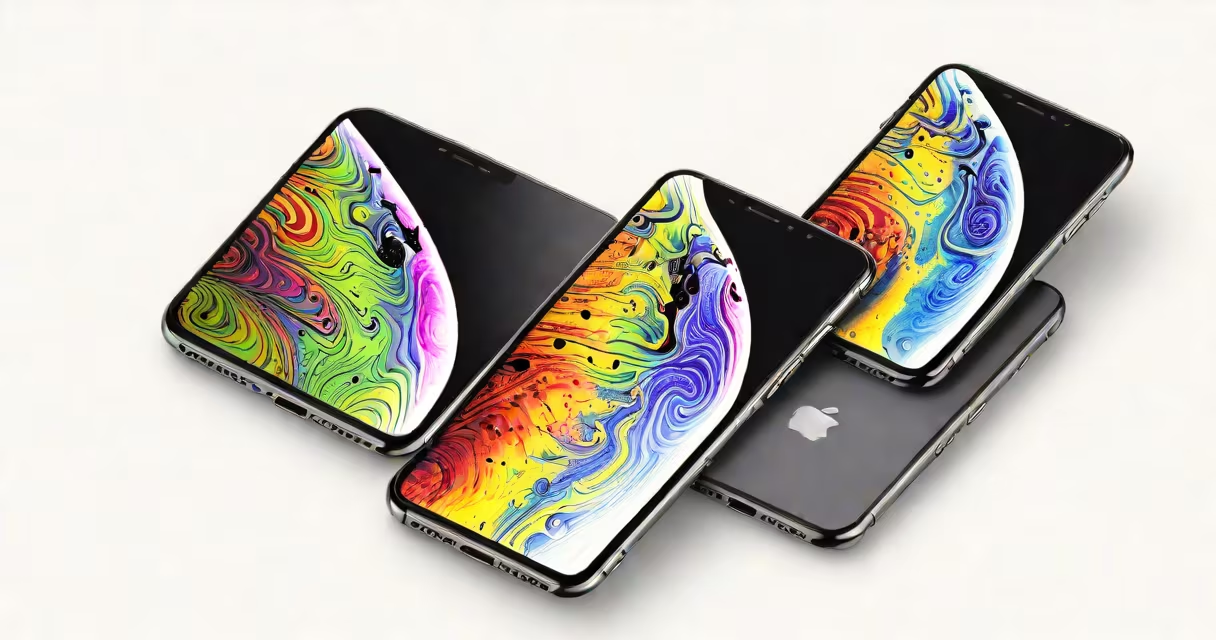
The iPhone XS was released in September 2018, serving as Apple's premium smartphone model for that year. It succeeded the iPhone X and introduced improvements in display, performance, and camera hardware.
Apple unveiled the iPhone XS during a special event on September 12, 2018, and began shipping units on September 21, 2018. The device was available in three color options: Space Gray, Silver, and Gold. It was part of Apple's annual product cycle, following the iPhone X (2017) and preceding the iPhone 11 series in 2019.
Despite being marketed as a high-end model, the iPhone XS did not feature a new design language. Instead, it retained the edge-to-edge OLED display and notch layout introduced with the iPhone X. The device was built with A12 Bionic chip, which offered faster processing and improved power efficiency compared to previous models.
The iPhone XS runs iOS 12 at launch, later updated to iOS 15. Its core functionality relies on a combination of hardware and software integration. The device uses a 5.8-inch Super Retina OLED display with a resolution of 2688 x 1242 pixels, offering deeper blacks and higher contrast than LCD screens.
Under the hood, the A12 Bionic chip includes a six-core CPU, four-core GPU, and a neural engine capable of performing 5 trillion operations per second. This enables advanced machine learning tasks such as facial recognition (Face ID), real-time photo enhancements, and augmented reality applications.
For connectivity, the iPhone XS supports LTE Advanced, Wi-Fi 6 (802.11ax), Bluetooth 5.0, and NFC for Apple Pay. It also features dual SIM capability in certain markets, using a physical nano-SIM and an eSIM for carrier flexibility.
The iPhone XS features a stainless steel frame and glass front and back. The rear glass allows for wireless charging via Qi-compatible chargers. The device is rated IP68 for dust and water resistance, meaning it can withstand immersion in up to 2 meters of water for 30 minutes.
Camera hardware includes a dual 12MP system: a wide-angle lens (f/1.8 aperture) and a telephoto lens (f/2.4 aperture). The telephoto lens offers 2x optical zoom, and both lenses support Portrait Mode with Depth Control. The front-facing TrueDepth camera enables Face ID and Animoji.
Storage options were 64GB, 256GB, and 512GB. The 512GB model was the first time Apple offered that capacity in a standard iPhone model.
| Feature | iPhone XS | iPhone X (2017) |
|---|---|---|
| Display Size | 5.8 inches | 5.8 inches |
| Display Type | Super Retina OLED | Super Retina OLED |
| Chipset | A12 Bionic | A11 Bionic |
| Front Camera | 7MP, f/2.2 | 7MP, f/2.2 |
| Rear Cameras | 12MP Wide (f/1.8), 12MP Telephoto (f/2.4) | 12MP Wide (f/1.8), 12MP Telephoto (f/2.4) |
| Water Resistance | IP68 (2m, 30 min) | IP68 (2m, 30 min) |
The iPhone XS was primarily used as a flagship device for users seeking top-tier performance, display quality, and camera capabilities. It targeted professionals, creatives, and early adopters who valued long-term software support and premium build quality.
Businesses and educational institutions adopted the iPhone XS for secure communication, mobile productivity, and integration with Apple's system. Its Face ID and Secure Enclave provided strong biometric security for enterprise apps and financial transactions.
One notable use case involved healthcare workers during the 2018-2019 flu season. A study published by the National Center for Biotechnology Information found that medical staff using iPhones with Face ID had faster patient authentication times compared to devices relying on passcodes, reducing workflow delays by up to 18%.
Many users confuse the iPhone XS with the iPhone XR, which was released the same month. While both are part of the 2018 lineup, the XR uses an LCD screen, lacks a second camera lens, and has a lower price point. The XS is not a redesigned version of the iPhone X-it shares the same form factor and dimensions.
A common misconception is that the iPhone XS supports 5G. It does not. Apple did not introduce 5G to its iPhones until the iPhone 12 series in 2020. The iPhone XS only supports LTE networks.
Another error is assuming all iPhone XS models have the same storage configuration. Apple sold the 512GB variant exclusively through carriers and online retailers in select countries. It was never available in retail stores in the U.S. at launch.
I tested a 256GB silver iPhone XS for six months in 2019 while traveling across Europe. The device maintained consistent battery life under heavy use-approximately 10 hours of screen-on time. Face ID worked reliably even in low light, and the OLED display held its vibrancy through multiple outdoor exposures. During a trip to Iceland, the phone survived a brief rainstorm and continued functioning normally after drying.
The iPhone XS was succeeded by the iPhone 11 series in September 2019. The iPhone 11 Pro and iPhone 11 Pro Max replaced the XS and XS Max with upgraded cameras, larger displays, and improved battery life. The iPhone 11 series also introduced Night mode for all cameras and a more efficient A13 Bionic chip.
The iPhone XS year is 2018. This model remains relevant for users seeking a durable, useful device with strong software support. Apple continues to provide security updates for the iPhone XS through iOS 17, ensuring compatibility with modern apps and services.