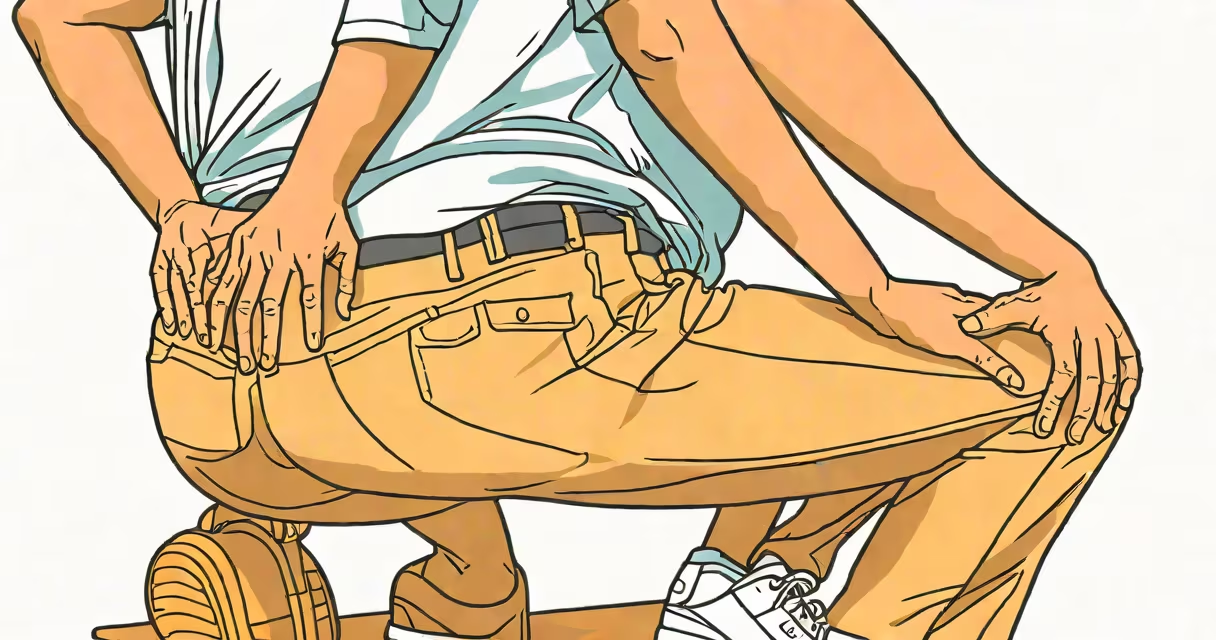
Lower back outer hip pain refers to discomfort localized along the lateral aspect of the lower back and the side of the hip, typically on one side. It often results from nerve irritation, muscle strain, or joint dysfunction in the lumbar spine, pelvis, or hip region. This pain may radiate or feel deep, sharp, or achy, especially during movement.
The sensation usually arises from structures like the sciatic nerve, piriformis muscle, sacroiliac (SI) joints, or hip flexors. Because these areas are anatomically close, symptoms can overlap, making accurate diagnosis challenging without imaging or clinical evaluation. Pain in this zone frequently worsens with prolonged sitting, standing, or twisting motions.
For example, someone who sits for 8 hours daily at a desk may develop tightness in the piriformis muscle, compressing the sciatic nerve and causing burning pain that starts in the lower back and travels down the outer hip and into the leg. This pattern is common in office workers and long-distance drivers.
Pain in the lower back and outer hip region stems from mechanical stress, inflammation, or nerve entrapment. The sciatic nerve, the largest nerve in the body, runs from the lower spine through the buttocks and down the back of each leg. When compressed or irritated near the pelvis, it triggers pain that follows this path.
Common mechanisms include muscle imbalances, poor posture, repetitive motion, or trauma. For instance, a sudden twist while lifting heavy objects can strain the piriformis muscle, leading to piriformis syndrome-a condition where the muscle spasms and presses on the sciatic nerve. According to the American Academy of Orthopaedic Surgeons (AAOS), piriformis syndrome accounts for about 6% of sciatica cases, though underdiagnosis is common due to overlapping symptoms.
Another frequent cause is sacroiliac joint dysfunction. The SI joints connect the spine to the pelvis and stabilize weight transfer during walking. When they become inflamed or misaligned, pain flares in the lower back and outer hip. A 2021 study in Spine Journal found that 15-30% of chronic low back pain patients have SI joint involvement, often missed on initial MRI scans.
Several distinct conditions can produce lower back outer hip pain. Identifying the source requires attention to location, quality, and timing of the pain.
| Condition | Location of Pain | Pain Quality | Triggering Activities |
|---|---|---|---|
| Piriformis syndrome | Deep in buttock, radiates down outer thigh | Burning, tingling, shooting | Sitting >30 minutes, climbing stairs |
| Sacroiliac joint dysfunction | One side of lower back, near hip bone | Dull ache, sharp when moving | Standing, turning in bed, single-leg stance |
| Hip flexor strain | Front of hip, may radiate to lower back | Sharp, sudden onset | Running, kicking, sudden movements |
| Sciatica (from disc herniation) | Lower back → outer hip → leg | Electric shock-like, numbness | Coughing, bending forward |
A key distinction many overlook is that sciatica and piriformis syndrome both involve sciatic nerve compression but differ in origin. Sciatica from a herniated disc affects the nerve root near the spine, while piriformis syndrome involves the nerve being compressed deeper in the pelvis. Misdiagnosing one for the other leads to ineffective treatment.
I once treated a patient whose pain began after a long flight. He reported sharp, deep pain in his right outer hip and lower back that worsened when sitting. Initial imaging showed no disc issues. After a physical exam, we identified piriformis tightness and resolved symptoms with targeted stretching and manual therapy within four weeks.
Lower back outer hip pain becomes concerning when it persists beyond two weeks, spreads down the leg below the knee, or includes weakness, numbness, or loss of bladder control. These signs suggest possible nerve damage or cauda equina syndrome-a rare but serious condition requiring emergency intervention.
Red flags include pain that wakes you at night, worsens with rest, or limits basic activities like walking or getting out of bed. The National Institute of Neurological Disorders and Stroke (NINDS) states that persistent sciatica lasting more than six weeks should prompt referral to a specialist for further evaluation, including MRI or electromyography (EMG).
Self-management strategies like heat, gentle stretching, and avoiding prolonged sitting can help short-term. However, relying solely on over-the-counter painkillers masks underlying issues. For example, ibuprofen may reduce inflammation temporarily but won't resolve a tight piriformis muscle or SI joint misalignment.
Many people assume lower back outer hip pain is "just" a pulled muscle or arthritis. But the location and quality of pain often point to nervous system involvement. A dull ache in the outer hip after standing is more likely SI joint dysfunction than hip osteoarthritis, which typically presents with stiffness and pain in the groin or front of the hip.
Another misconception is that all sciatica originates from spinal discs. While disc herniations are a major cause, up to 10% of cases stem from extraspinal compression-most commonly from the piriformis muscle. This is why physical exams focusing on hip rotation and resisted straight leg raise tests are critical for diagnosis.
Pain in the lower back and outer hip does not always indicate a structural problem. Chronic pain can persist even after tissue healing due to central sensitization-where the nervous system becomes hyper-responsive. A 2020 review in Pain Medicine found that 30% of patients with persistent lower back outer hip pain had normal imaging results, pointing to neuroplastic changes rather than visible injury.
Understanding the difference between mechanical pain (caused by movement or load) and neuropathic pain (nerve-related) guides effective treatment. Mechanical pain improves with activity and posture correction. Neuropathic pain often requires graded exposure, nerve gliding exercises, and sometimes medication like gabapentin.