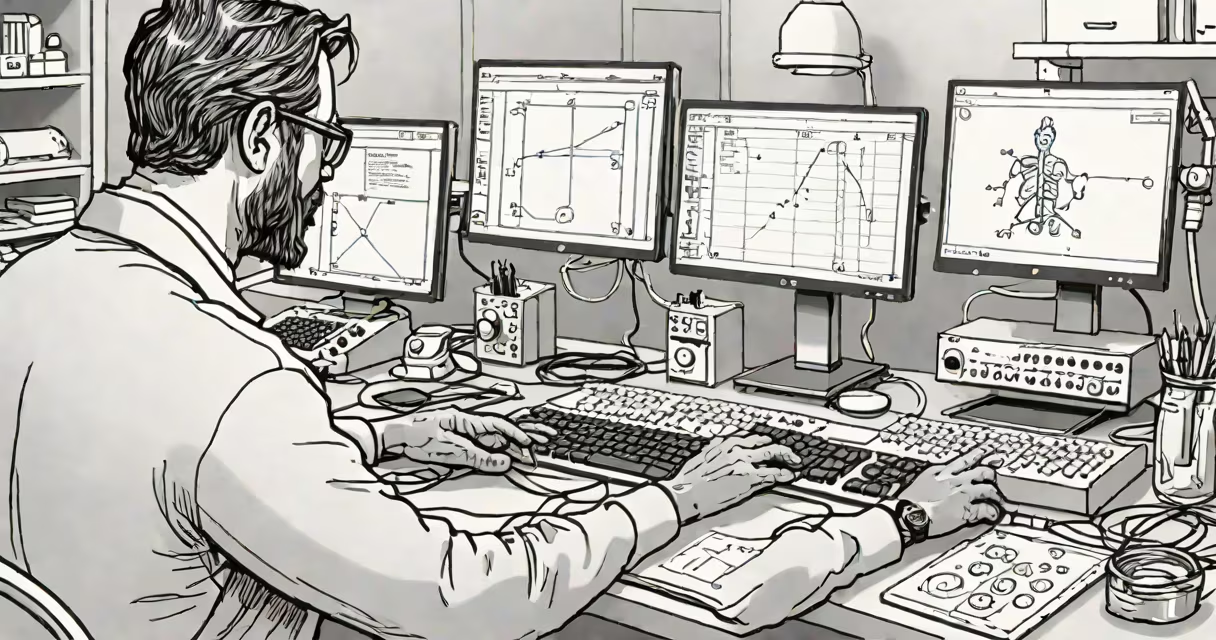
A medical software engineer develops, tests, and maintains software used in healthcare environments-such as imaging systems, electronic health records, and implantable devices-ensuring it meets strict safety, accuracy, and regulatory standards like those set by the U.S. Food and Drug Administration (FDA).
These engineers work at the intersection of computer science and clinical medicine. They design software that processes patient data, controls medical equipment, or supports diagnosis and treatment decisions. Unlike general-purpose software, medical software must function reliably under high-stakes conditions where errors can lead to harm.
For example, a pacemaker's control algorithm must respond correctly to heart rhythms within milliseconds. A failure in this system could result in death. Medical software engineers build and validate such systems using formal methods, rigorous testing, and traceability from requirements to implementation.
Medical software engineers follow a structured development lifecycle. Requirements are gathered from clinicians, patients, and regulators. These are translated into technical specifications, then implemented in code. The software undergoes multiple layers of testing: unit tests, integration tests, system validation, and clinical trials if required.
Each step must be documented to meet audit standards. The FDA requires that software used in medical devices be developed under a quality management system (QMS), such as ISO 13485 or IEC 62304. These standards mandate version control, risk analysis, and traceability matrices linking features to test cases.
For instance, a blood glucose monitor app must accurately display readings from a sensor. Engineers verify that the algorithm correctly interprets raw data, handles edge cases (like low battery or signal noise), and alerts users when values fall outside safe ranges. All of this is validated through simulated and real-world usage.
Medical software engineering includes several specialized domains based on application area:
| Type | Focus Area | Regulatory Pathway | Example Application |
|---|---|---|---|
| Diagnostic Imaging Software | Image processing for MRI, CT, ultrasound | Class II or III FDA clearance | Automated tumor detection in brain scans |
| Clinical Decision Support | Alerts and recommendations based on patient data | Class II FDA approval | Drug interaction warnings in EHRs |
| Device Control Systems | Software that operates life-support equipment | Class III FDA premarket approval | Pump controllers for insulin delivery |
| Health Information Systems | Electronic health records, scheduling, billing | Class I or II, depending on function | Secure patient portal with encrypted messaging |
Some engineers focus on embedded systems-writing code that runs on microcontrollers inside devices like infusion pumps. Others specialize in cloud-based platforms that store and analyze large-scale patient data while complying with HIPAA privacy rules.
One non-obvious requirement: software must be maintainable over decades. A pacemaker implanted in 2005 may still require updates. Engineers must design systems with long-term support in mind, including secure update mechanisms and backward compatibility.
Medical software engineers are employed by medical device manufacturers (e.g., Medtronic, Philips), hospitals' IT departments, government agencies (like the FDA's Center for Devices and Radiological Health), and startups developing digital therapeutics.
They are essential for enabling precision medicine. For example, a machine learning model trained on thousands of retinal scans can detect early signs of diabetic retinopathy. The engineer ensures the model is validated across diverse populations and performs consistently in real clinics.
Without them, even advanced hardware like MRI machines would lack the software to reconstruct images from raw signals. Their work enables faster diagnoses, reduces human error, and improves patient outcomes.
People often assume that "medical software engineer" means someone who codes apps for fitness trackers or wellness platforms. That's incorrect. While those roles involve software development, they don't carry the same legal and safety responsibilities.
Another misconception: that medical software is just a subset of general software. In reality, it's governed by far stricter rules. A mobile app that tracks steps doesn't need FDA approval. But an app that analyzes ECGs to detect arrhythmias does-and must be developed under regulated processes.
Even the term "engineer" is misleading. Not all medical software developers hold engineering degrees. Some come from computer science or biology backgrounds. However, the role demands formal training in software engineering principles, risk assessment, and regulatory frameworks.
One key distinction: medical software engineers do not diagnose patients. They build tools that assist clinicians. The final decision remains with a licensed healthcare provider. The software is a partner, not a replacement.
In 2019, a major hospital network deployed a new ICU monitoring system that integrated data from ventilators, heart monitors, and lab results. The system was designed to flag sepsis early using predictive algorithms.
The team included five medical software engineers. They spent 18 months building the system under IEC 62304 standards. They wrote 120,000 lines of code, ran 4,000 test cases, and documented every change. The software underwent peer review and external audit.
After deployment, the system reduced sepsis-related mortality by 22% over 12 months. The success wasn't due to flashy AI-it came from careful engineering, data validation, and clinician feedback loops.
I once worked on a project to develop software for a portable ultrasound device used in rural clinics. The goal was to enable non-specialists to perform basic scans and send images to specialists via satellite. The challenge wasn't just making the software run on low-power hardware-it was ensuring that poor image quality didn't lead to misdiagnosis.
We added visual cues for motion artifacts and limited the user's ability to adjust gain or frequency without training. We also built in automatic quality checks. After field testing in Uganda, we found that false-positive rates dropped from 37% to 9% after these changes. That's the kind of impact medical software engineers make-not with headlines, but with precision.
Some compare medical software engineering to building with LEGO blocks-each component must fit perfectly and never fail. But unlike LEGO, the pieces are invisible, and failure isn't just a broken model-it's a patient's life.
Finally, the path to becoming a medical software engineer often involves a blend of education and certification. Many earn degrees in computer science, biomedical engineering, or electrical engineering. Some pursue certifications like the Certified Professional in Healthcare Information and Management Systems (CPHIMS) or the FDA's training modules on medical device regulation.
Medical software engineering is not a single job title. It's a discipline shaped by science, law, and ethics. It demands attention to detail, empathy for users, and a commitment to doing no harm-even when the code runs silently in the background.
Every time a doctor sees a clear scan, receives an accurate alert, or safely adjusts a drug dose, a medical software engineer likely helped make that possible.