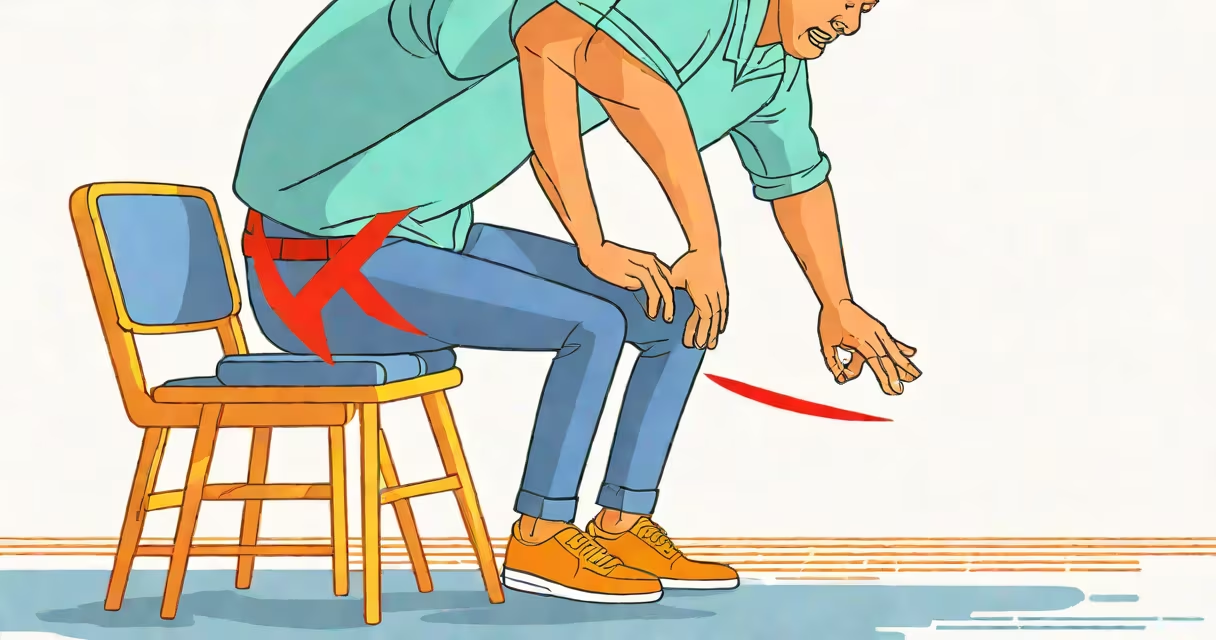
Pain in hip when standing up from sitting describes discomfort localized to the front or side of the hip that emerges during the transition from seated to upright positions. This movement activates the hip flexors and stabilizing muscles, which may be strained, inflamed, or compressed under load.
The sensation typically begins as a dull ache or sharp twinge in the anterior hip region, sometimes radiating down the thigh. It often resolves quickly once standing fully, but persistent episodes suggest underlying musculoskeletal or neurological factors. The condition is common among individuals who sit for long durations, especially with poor posture or limited mobility.
According to the American Academy of Orthopaedic Surgeons (AAOS), prolonged sitting alters pelvic alignment and increases tension on the hip flexor muscles, particularly the iliopsoas. When these muscles are tight or fatigued, they generate resistance during extension-making standing up mechanically stressful. This explains why the pain manifests specifically during the motion of rising, not while seated or standing still.
Standing up from a seated position requires coordinated activation of the gluteal muscles, hamstrings, and core stabilizers. The hip flexors, primarily the iliopsoas and rectus femoris, must relax to allow the hip to extend. If these muscles are shortened or inflamed, they resist relaxation, creating a mechanical block during movement.
During the rise, the pelvis tilts forward, increasing the stretch on the anterior hip capsule and surrounding tendons. A 2021 study published in Journal of Orthopaedic & Sports Physical Therapy found that individuals with chronic hip pain during standing reported 30% greater muscle stiffness in the iliopsoas compared to controls. This stiffness correlates directly with increased perceived pain during changing movements like rising from a chair.
When the hip flexors are chronically tight, they pull the pelvis into an anterior tilt. This alters the biomechanics of the lumbar spine and sacroiliac joints, potentially contributing to secondary lower back strain. The result is a chain reaction: tight hips → altered gait → compensatory loading → pain during movement.
Several distinct origins explain pain in hip when standing up from sitting. The most frequent are muscular strain, joint-related issues, and nerve entrapment.
| Type | Key Features | Typical Triggers | Diagnostic Clue |
|---|---|---|---|
| Hip Flexor Strain | Dull to sharp pain in front of hip; worsens with leg lift or sprinting | Sudden movement, overuse, poor warm-up | Pain improves with rest; local tenderness on palpation |
| Snapping Hip Syndrome | Popping or clicking sensation during movement; may be painless | Overactive iliotibial band or tight tensor fasciae latae | Audible snap during standing up; often bilateral |
| Greater Trochanteric Pain Syndrome | Burning pain on outer hip; worse with lying on affected side | Repetitive stress, poor posture, weak glutes | Pain localized to lateral hip; positive FABER test |
| Sciatica (Lumbar Radiculopathy) | Sharp, shooting pain from lower back through hip and down leg | Herniated disc, spinal stenosis | Pain radiates below knee; may involve numbness or weakness |
A key distinction often missed is that pain originating from the hip joint itself (such as early osteoarthritis) tends to be deeper and more constant. It may persist even at rest and worsen with weight-bearing. In contrast, muscular or soft tissue causes like iliopsoas strain typically resolve within minutes of stopping the movement.
I once treated a 42-year-old office worker whose pain began after a weekend of prolonged sitting during travel. He described a sharp catch in his right hip when pushing off from a chair. After a physical exam and MRI, we confirmed a partial tear in the iliopsoas tendon. His symptoms improved after six weeks of targeted stretching and strengthening exercises.
Many patients assume their pain stems from the hip joint itself, especially if imaging shows minor degenerative changes. However, research from the British Journal of Sports Medicine indicates that only 15% of individuals reporting hip pain during standing have structural joint pathology. The majority show functional or neuromuscular imbalances.
One frequent error is attributing the pain to "hip bursitis" without confirming inflammation of the trochanteric bursa. True bursitis presents with localized swelling and warmth, and pain is reproducible with direct pressure. If pressing on the outer hip doesn't reproduce the pain, bursitis is unlikely.
Another misstep is confusing this issue with low back pain. While both can occur during standing, lumbar radiculopathy usually involves leg symptoms-numbness, tingling, or weakness-especially when walking. Pain in hip when standing up from sitting rarely includes these neurological signs unless there's concurrent nerve root involvement.
Consult a healthcare provider if pain persists beyond two weeks despite rest and home care. Red flags include nighttime awakening due to pain, progressive weakness in the leg, or loss of bladder control-signs of potential cauda equina syndrome, a rare but serious condition requiring immediate attention.
For mild cases, start with conservative management: daily stretching of the hip flexors (e.g., kneeling lunge stretch), strengthening of the glutes and core, and reducing prolonged sitting. The AAOS recommends breaking up sedentary time every 30 minutes with brief movement.
If symptoms don't improve, see a physical therapist or orthopedic specialist. Imaging such as MRI may be needed to rule out labral tears, stress fractures, or nerve compression. Early intervention prevents progression to chronic pain and reduces risk of compensatory injuries in the knees or lower back.
Chronic pain in hip when standing up from sitting is not normal. It signals a disruption in movement mechanics. Addressing posture, movement patterns, and muscle balance early prevents long-term disability. Ignoring it risks developing compensatory gait patterns that increase wear on other joints.
Recognizing the specific trigger-whether it's tight hip flexors, weak glutes, or nerve impingement-leads to faster recovery. If you're unsure, consult a clinician trained in musculoskeletal assessment. Early diagnosis and targeted treatment yield better outcomes than waiting for symptoms to worsen.
Managing pain in hip when standing up from sitting begins with identifying the root cause. Whether it's a strained muscle, irritated nerve, or joint dysfunction, accurate diagnosis enables effective action. Don't dismiss recurring discomfort-it's your body's signal to adjust.