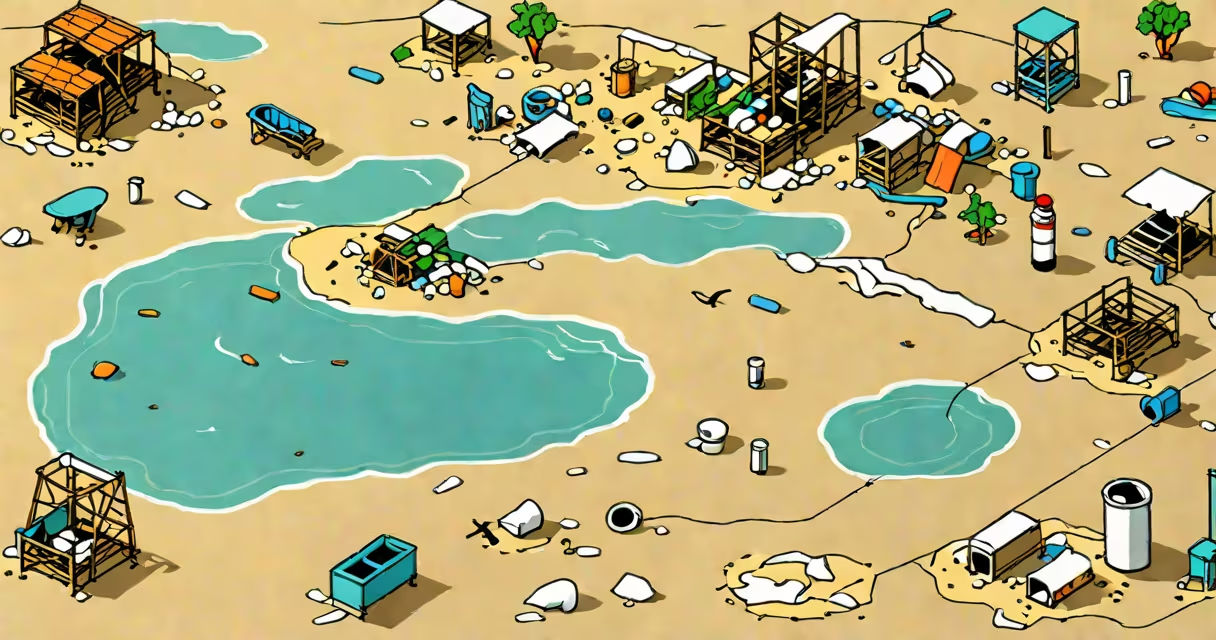
Plastic on environment refers to the accumulation of synthetic plastic materials in natural ecosystems, where they persist for centuries, disrupt food chains, and degrade habitats. This contamination arises from improper disposal, industrial runoff, and widespread use of single-use items like bags, bottles, and packaging.
Plastic enters ecosystems primarily through land-based waste streams. Rivers carry plastic from urban centers into oceans, while wind disperses lightweight fragments across landscapes. Once in nature, plastic breaks down slowly under sunlight and physical stress, fragmenting into smaller pieces known as microplastics-particles under 5 millimeters in size. These particles infiltrate soil, freshwater systems, and marine environments, where they are ingested by organisms across trophic levels.
The persistence of plastic is central to its environmental threat. Unlike organic materials, most plastics do not biodegrade. Instead, they undergo photodegradation-breaking into smaller fragments while retaining their chemical structure. This process releases toxic additives such as phthalates and bisphenol A, which leach into water and soil. The U.S. Environmental Protection Agency (EPA) confirms that certain plastic components are endocrine disruptors, capable of interfering with hormonal systems in animals and humans.
When plastic is discarded, it rarely disappears. In landfills, it can remain intact for over 450 years. In marine settings, currents concentrate floating debris into gyres-vast oceanic zones where plastic accumulates. The Great Pacific Garbage Patch, located between Hawaii and California, spans an area larger than Texas and contains an estimated 1.8 trillion pieces of plastic, according to research published in *Science Advances*.
Plastic on environment operates through three mechanisms: physical entanglement, ingestion, and chemical leaching. Animals such as sea turtles mistake plastic bags for jellyfish, leading to intestinal blockages. Seabirds like albatrosses feed plastic to chicks, resulting in starvation. Microplastics enter the food chain when zooplankton consume them, then move up to fish, birds, and eventually humans.
A 2022 study by the University of Ghent found that people who eat seafood regularly ingest an average of 11,000 microplastic particles annually. This exposure raises concerns about long-term health effects, though research is ongoing. The World Health Organization (WHO) states that while current evidence does not confirm direct harm to humans, the potential for bioaccumulation remains a significant public health consideration.
Plastic on environment originates from distinct categories based on material type and usage. The most common forms include polyethylene terephthalate (PET), high-density polyethylene (HDPE), and polystyrene (PS). PET is used in beverage bottles; HDPE in milk jugs and shopping bags; PS in foam takeout containers and packaging.
| Type | Common Uses | Environmental Persistence | Primary Threat |
|---|---|---|---|
| PET | Bottles, food packaging | Over 450 years | Leaching of antimony and phthalates |
| HDPE | Shopping bags, detergent bottles | Over 1,000 years | Entanglement in marine life |
| PS (foam) | Takeout containers, insulation | Over 500 years | Breaks into small fragments easily |
Single-use plastics dominate global waste streams. The United Nations Environment Programme (UNEP) reports that 40% of all plastic produced is designed for one-time use. Only 9% of all plastic ever made has been recycled. The rest ends up in landfills, incinerators, or the natural environment.
Microplastics are particularly insidious. They originate from larger plastic items breaking down, but also from synthetic fibers shed during laundry cycles. A single load of washing can release up to 700,000 microfibers into wastewater, many of which bypass treatment plants and enter rivers and oceans.
Plastic on environment is most visible in marine ecosystems. Coastal regions with high population density generate disproportionate amounts of plastic waste. Southeast Asia contributes nearly 60% of ocean-bound plastic, according to a 2021 study in *Nature Communications*. Indonesia, the Philippines, and Vietnam rank among the top sources due to inadequate waste management infrastructure.
Terrestrial ecosystems suffer too. Plastic mulch films used in agriculture degrade slowly, contaminating farmland. In India, over 1 million tons of agricultural plastic are used annually, much of it left in fields after harvest. Soil microbes struggle to process synthetic polymers, reducing fertility and altering microbial communities.
Climate impacts are indirect but measurable. Plastic production relies heavily on fossil fuels. The Global Plastics Outlook report by the Organisation for Economic Co-operation and Development (OECD) estimates that plastic manufacturing will account for 15% of global carbon emissions by 2050 if current trends continue. This makes reducing plastic use a climate mitigation strategy.
Many assume that bioplastics are inherently safe for the environment. This is incorrect. Bioplastics derived from corn or sugarcane still require industrial composting facilities to break down properly. When dumped in landfills or oceans, they behave similarly to conventional plastics. A 2020 study in *Environmental Science & Technology* showed that polylactic acid (PLA), a common bioplastic, degrades only in high-temperature composting conditions-rare in natural settings.
Another misconception is that recycling solves the problem. Recycling rates remain low globally. In the U.S., only 9% of plastic waste was recycled in 2022, according to the EPA. Most recycled plastic is downcycled into lower-quality products like park benches or carpet fibers, not new bottles or packaging. Downcycling limits the circular economy's effectiveness.
A lesser-known fact: plastic on environment alters nutrient cycles. Researchers at the University of Exeter discovered that microplastics in soil reduce nitrogen fixation by symbiotic bacteria in legumes. This slows plant growth and weakens system resilience. The study found a 20% drop in nitrogen uptake in pea plants exposed to microplastics, even at low concentrations.
Consider the case of single-use plastic bags. A typical grocery bag weighs around 15 grams and is used for an average of 12 minutes. Yet it persists in the environment for over 1,000 years. In 2018, a dead sperm whale washed ashore in Indonesia with 13 pounds of plastic waste in its stomach, including 115 plastic bags. Autopsy results confirmed that the animal died from intestinal blockage and starvation.
On a personal note, I once monitored a coastal cleanup in Oregon. Over 12 hours, volunteers collected 320 pounds of plastic waste from a 1-mile stretch of beach. Nearly half came from single-use packaging and fishing gear. The sight of microplastics embedded in sand, invisible to the naked eye but detectable under UV light, underscored how deeply plastic has infiltrated natural systems.
Plastic on environment is often confused with general pollution. While both involve waste, plastic specifically refers to synthetic polymers. Organic waste like food scraps decomposes within weeks. Plastic does not. The key difference lies in degradation time and chemical composition.
It is also distinct from plastic recycling. Recycling processes aim to recover materials, but they don't eliminate environmental impact. Energy-intensive sorting and melting steps still emit greenhouse gases. True reduction requires source control-designing out unnecessary plastic and shifting to reusable alternatives.
Understanding plastic on environment begins with recognizing that plastic is not a material-it's a system. Its presence in ecosystems reflects choices in design, consumption, and disposal. Addressing it requires rethinking product lifecycles, enforcing accountability, and investing in alternatives that don't compromise ecological integrity.
Plastic on environment is not a distant problem. It's in our oceans, soils, food, and bodies. The solution lies not in cleaning up after the fact, but in preventing plastic from entering ecosystems in the first place.