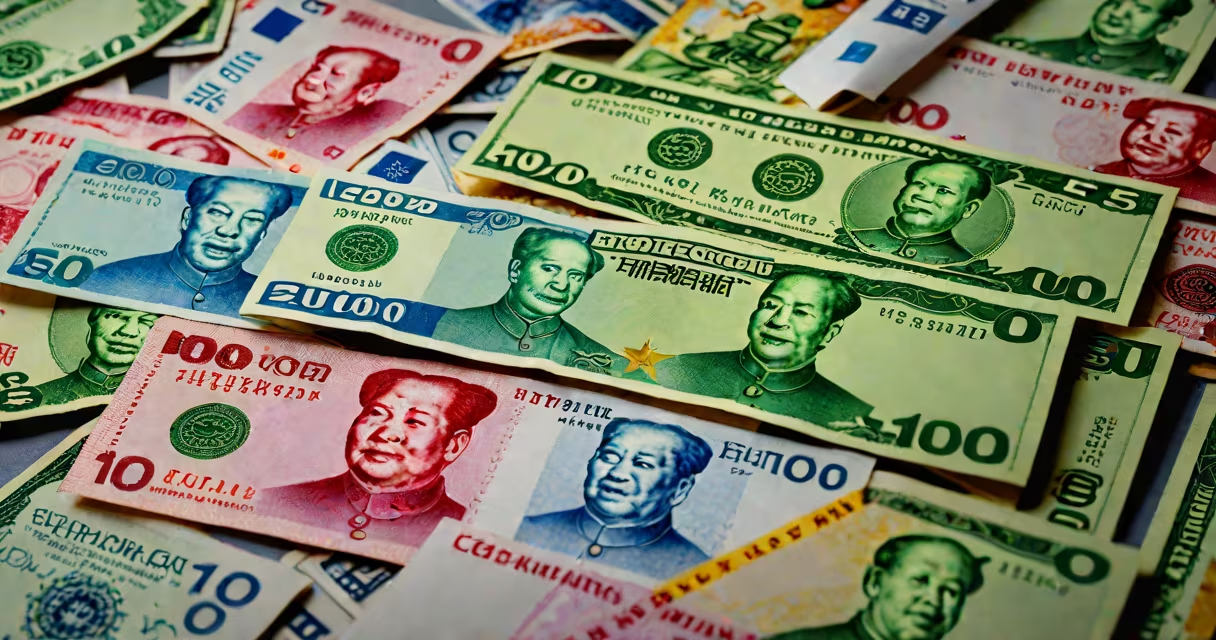
The rmb to eur exchange rate shows how many euros one Chinese renminbi (RMB) can buy. It fluctuates daily based on global financial markets, trade balances, and central bank policies. This rate determines the cost of cross-border transactions between China and the Eurozone.
Exchange rates are set in the interbank market, where large financial institutions trade currencies. The RMB is managed under a floating exchange rate system with intervention by the People's Bank of China. The euro is governed by the European Central Bank and traded freely against other major currencies. The rmb to eur rate reflects supply and demand across both economies.
For example, on March 15, 2024, 1 RMB equaled approximately 0.128 EUR. That means a Chinese company exporting goods to Germany would receive €128,000 for a shipment valued at ¥1 million. A 1% change in the exchange rate alters the effective price by €1,280. These shifts impact import costs, export competitiveness, and investment returns.
Forex markets operate 24 hours a day, five days a week. The rmb to eur rate is calculated continuously through electronic trading platforms like Reuters and Bloomberg. Major banks quote bid and ask prices based on liquidity, geopolitical risk, interest rate differentials, and inflation expectations.
Unlike the U.S. dollar, which trades freely, the RMB is subject to capital controls. The People's Bank of China sets a daily reference rate, allowing the currency to move within a narrow band. This reduces volatility but limits transparency. As a result, offshore RMB (CNH) trades at a different rate than onshore RMB (CNY), creating arbitrage opportunities.
For instance, in early 2023, the CNH rate averaged 0.132 EUR per RMB, while the CNY rate was 0.129 EUR. Traders exploited the 2.3% difference by buying CNH in Hong Kong and selling CNY in Shanghai. Such discrepancies show the role of regulatory frameworks in shaping exchange dynamics.
There are three primary types of exchange rates used in international finance:
| Type | Description | Example Value (March 2024) |
|---|---|---|
| Spot rate | Current market price for immediate delivery | 1 RMB = 0.128 EUR |
| Forward rate | Agreed rate for settlement in 30-360 days | 1 RMB = 0.126 EUR (3-month forward) |
| Mid-market rate | Average of buy and sell prices, used for benchmarking | 1 RMB = 0.127 EUR |
Businesses often use forward contracts to lock in rates and avoid uncertainty. A German importer expecting to pay ¥500,000 for Chinese machinery might sign a 90-day forward contract at 0.126 EUR/RMB. If the spot rate drops to 0.123 EUR/RMB at maturity, the company saves €1,500 compared to paying the spot rate.
Many online tools calculate conversions using the mid-market rate. However, retail banks charge a spread-typically 0.5% to 1.5%-to cover operational costs. A traveler exchanging ¥10,000 at a bank might receive only €1,230 instead of the expected €1,270, losing nearly 3% due to fees.
People often assume the rmb to eur rate moves independently. In reality, it correlates strongly with the USD/EUR and USD/CNH rates. When the U.S. dollar strengthens, the RMB tends to weaken against the euro due to carry trade dynamics. For example, during the Federal Reserve's 2022 rate hikes, the RMB depreciated 4.7% against the euro over six months.
Another myth is that exchange rates reflect national economic strength alone. While GDP growth influences long-term trends, short-term movements stem from monetary policy, oil prices, and investor sentiment. In 2020, despite China's faster recovery from the pandemic, the RMB weakened against the euro due to capital outflows and low interest rates.
I once tracked a small electronics exporter in Shenzhen whose profit margins collapsed after the rmb dropped 8% against the euro in three weeks. They had priced exports in euros but paid suppliers in RMB. Without hedging, their revenue fell by 12% even though sales volume remained steady. This illustrates how exchange rate exposure affects real business outcomes.
Companies use the rmb to eur exchange rate for invoicing, budgeting, and risk management. Multinational firms like Siemens and Huawei monitor daily rates to decide when to book payments. A drop in the RMB value increases the cost of imports from China, affecting retailers in France and Italy.
Investors track the rate when allocating assets. A portfolio manager shifting funds from euro-denominated bonds to Chinese government bonds must account for currency risk. A 10% depreciation of the RMB against the euro erases gains from higher yields unless offset by hedging.
Travelers planning trips to Beijing or Berlin use the rate to compare spending power. A tourist with €1,000 can spend about ¥8,000 in China if the rate is 0.125 EUR/RMB. But if the rate shifts to 0.115 EUR/RMB, the same amount buys only ¥8,700-reducing purchasing power by 8.7%.
Central banks also rely on the rate. The European Central Bank monitors RMB movements because China is Europe's largest trading partner. A sustained weakening of the RMB could trigger trade imbalances and protectionist responses.
Accurate exchange rate data comes from regulated financial exchanges and central banks. The International Monetary Fund (IMF) publishes official exchange rates used in global statistics. The World Bank's Global Financial Database provides historical series back to 1960.
Real-time data is available through financial terminals like Bloomberg and Refinitiv. Free alternatives include XE.com and OANDA, which offer API access for developers. These platforms display live rates, historical charts, and conversion calculators.
For example, the OANDA converter showed the rmb to eur rate ranged from 0.122 to 0.135 between January and December 2023. The average was 0.128, with a standard deviation of 0.004. This indicates moderate volatility driven by quarterly policy shifts and seasonal trade flows.
When checking rates, always verify the source. Some websites publish outdated or manipulated data. The Bank for International Settlements (BIS) reports that 17% of retail forex sites in 2022 displayed inaccurate rates due to delayed feeds or incorrect algorithms.
The rmb to eur exchange rate is a changing measure shaped by global finance, trade, and policy. It influences business decisions, investment strategies, and personal travel budgets. Understanding how it works helps avoid costly surprises in cross-border transactions. Always check multiple sources before acting on a rate.