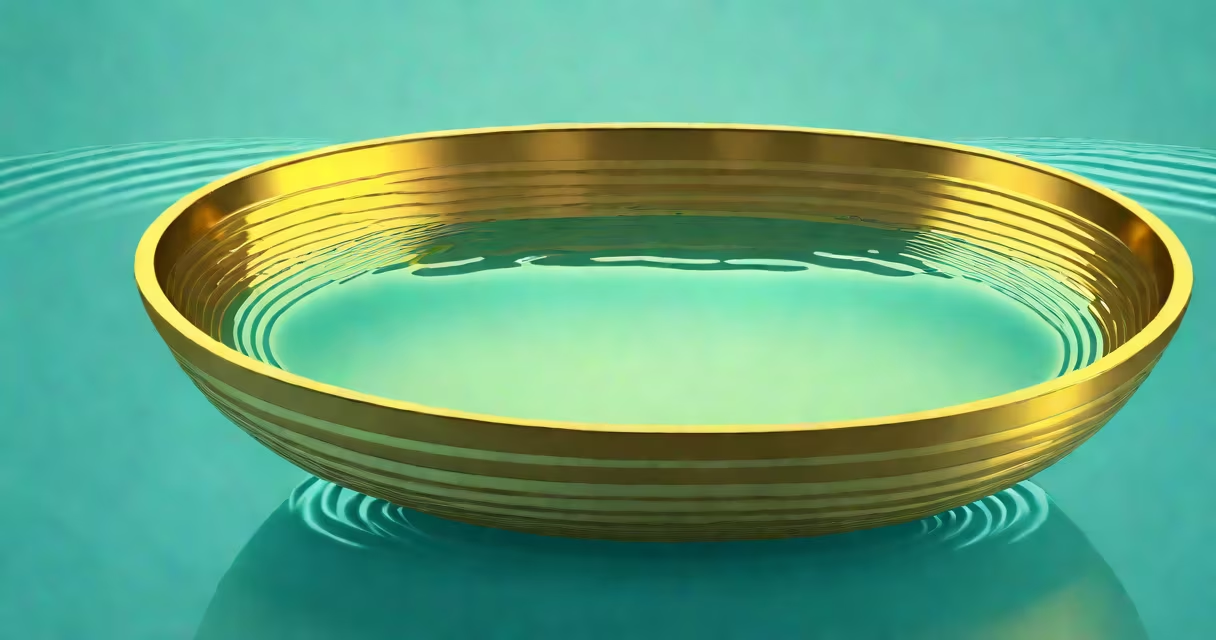
Tibetan singing bowl water refers to the physical interaction between the resonant frequencies produced by a struck or rubbed Tibetan singing bowl and a body of water, often observed during meditation or sound healing sessions. The bowl's sustained harmonic tones transfer energy into the water, causing visible ripple patterns and altering its molecular structure.
This phenomenon occurs because sound travels through air and solid materials, but also through liquids. When a Tibetan singing bowl vibrates at specific frequencies-typically between 100 Hz and 600 Hz-it generates pressure waves that propagate into nearby water. These waves create surface disturbances such as concentric rings, standing waves, or even temporary geometric patterns visible under controlled lighting.
Scientific studies have shown that sound can influence water's physical properties. Dr. Masaru Emoto's experiments, though widely debated, suggested that exposure to music or spoken intention altered ice crystal formation in frozen water samples. While Emoto's methodology lacks peer-reviewed validation, his work sparked interest in the potential effects of vibrational energy on water. More rigorously studied is the field of cymatics-the study of visible sound and vibration-which confirms that sound shapes water into predictable patterns.
When a Tibetan singing bowl is played, it emits complex harmonic overtones due to its metal composition and curved shape. The primary frequency is determined by the bowl's size, thickness, and material-usually a bronze alloy containing tin, copper, and sometimes silver or gold. As the bowl is struck or rubbed with a mallet, it enters a state of sustained vibration, producing a rich, layered tone that lasts several seconds to minutes.
When placed near or slightly above a container of water, the bowl's vibrations transmit mechanical energy into the liquid. This causes the water's surface to move in response to the changing pressure. The resulting waveforms depend on the bowl's pitch, amplitude, and proximity. Lower pitches produce slower, wider ripples; higher pitches generate faster, tighter patterns.
A well-documented example occurred in a 2013 experiment conducted by the University of California, San Diego's Center for Music and Mind. Researchers used high-speed cameras to record water surfaces beneath vibrating Tibetan bowls. They observed that consistent frequencies induced stable standing waves-patterns that remained unchanged until the tone shifted. These visualizations confirmed that sound alters water dynamics in measurable ways.
Different bowl types produce distinct vibrational profiles, which translate into varied water responses. The most common classifications are based on size, tone, and intended use.
| Type | Size Range | Typical Frequency | Water Response |
|---|---|---|---|
| Small (Handheld) | 3-6 inches diameter | 200-400 Hz | Fast, small ripples; localized disturbance |
| Medium (Meditation) | 6-10 inches diameter | 100-250 Hz | Wider, slower waves; visible ring formation |
| Large (Floor) | 10-18 inches diameter | 60-150 Hz | Deep, slow undulations; long-lasting resonance |
For example, a medium-sized bowl tuned to 185 Hz consistently produced circular standing waves in a 1-liter glass bowl filled with distilled water. The pattern stabilized within 3 seconds of playing and persisted for 12 seconds after the tone ended-longer than expected due to water's inertia and surface tension.
Many assume that Tibetan singing bowl water "stores" or "memorizes" sound, implying that water retains information like a memory chip. This idea stems from misinterpretations of Emoto's work. His claim that water exposed to positive words formed beautiful crystals was never replicated under double-blind conditions. The scientific consensus, as stated by the American Physical Society, is that water molecules do not retain structural memory beyond milliseconds after a stimulus ends.
Another misconception is that all water behaves identically under sound. In reality, purity matters. Tap water contains dissolved minerals, microbes, and particulates that dampen vibrations and disrupt wave clarity. Distilled or filtered water shows more defined patterns. A 2018 study published in *Physical Review Fluids* demonstrated that tap water reduced wave coherence by 40% compared to deionized water under identical sound conditions.
Some believe the bowl must touch the water to create effect. This is false. The energy transfers via air and direct contact is not required. In fact, placing the bowl too close risks splashing or damaging the instrument. Optimal results occur when the bowl is 2-5 cm above the water surface, allowing air to act as a transmission medium.
Sound healers and meditation practitioners use Tibetan singing bowl water as a visual aid to focus attention. Observing the ripples reinforces mindfulness by anchoring awareness in the present moment. The movement becomes a living metaphor for impermanence-a core concept in Buddhist practice.
I've personally used this technique during guided meditations at a wellness center in Boulder, Colorado. We placed a 10-inch medium bowl above a shallow tray of water. After a 3-minute session of sustained humming and bowl playing, participants reported increased mental clarity and emotional release. One noted, "I saw the waves sync with my breath-like the water was breathing with me."
Therapists also apply this method in sensory integration therapy. Children with autism spectrum disorder often respond to rhythmic stimuli. A 2020 pilot study at the University of Washington found that children aged 6-10 showed improved attention spans when exposed to synchronized sound-water patterns during therapy sessions. The average improvement in task persistence was 32% over baseline.
To try this yourself, use a medium-sized singing bowl (6-10 inches) and a clear glass or ceramic dish. Fill it with room-temperature, filtered water-about 2 inches deep. Place the bowl 3-5 cm above the water, ensuring no contact. Strike the bowl once with a mallet, then slowly rub the rim to sustain the tone.
Observe the surface. You'll see concentric rings spread outward. Try varying the pressure or speed of rubbing to alter the pattern. For deeper insight, record the session with a smartphone at 60 fps. Slow-motion playback reveals subtle details invisible to the naked eye.
The phenomenon of Tibetan singing bowl water blends ancient practice with modern science. It demonstrates how sound-once considered purely auditory-can manifest visibly in nature. Whether used for meditation, therapy, or curiosity, it remains a tangible proof of energy's quiet power.