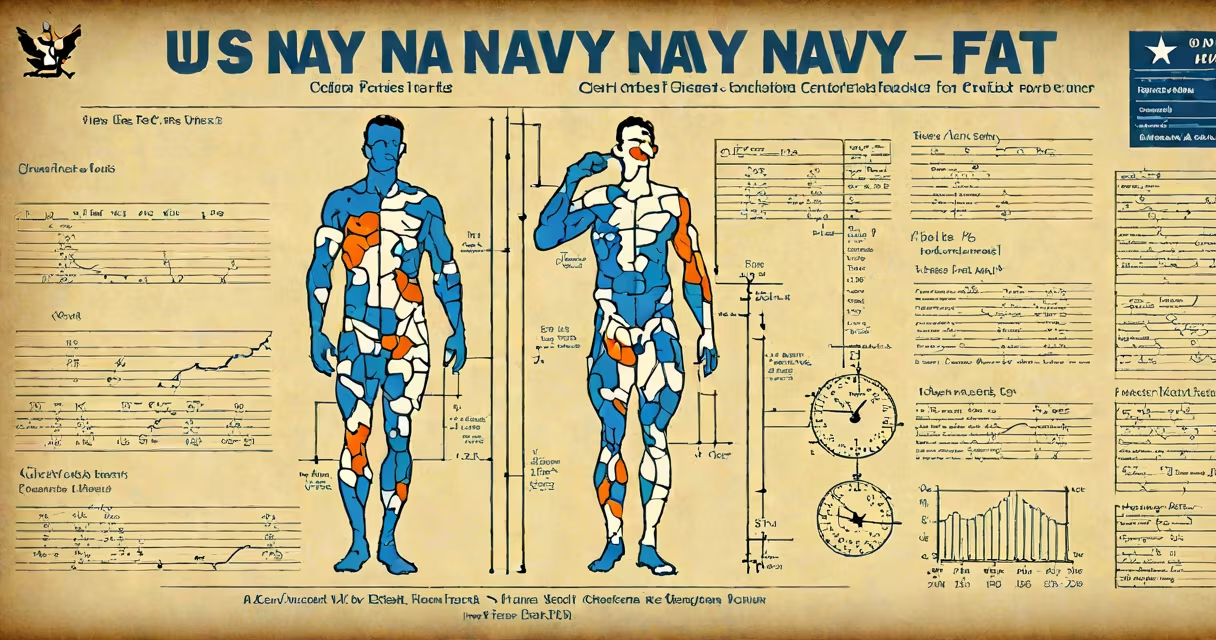
The US Navy body fat calculator is a standardized method used to estimate body fat percentage based on waist, neck, and height measurements. It determines whether a service member meets the Navy's physical fitness and body composition standards. The tool applies specific formulas for men and women, ensuring consistent evaluation across all ranks.
Body fat percentage is a key metric in military readiness. The Navy requires personnel to maintain a body fat level below 20% for men and 30% for women. Exceeding these limits results in mandatory counseling, fitness programs, or administrative action. The calculator uses direct measurements taken during annual physical exams or fitness evaluations.
Unlike general wellness tools, the US Navy body fat calculator is not designed for personal health tracking. It serves a regulatory function within the Department of Defense. Its formulas are derived from research published by the U.S. Army Research Institute of Environmental Medicine and validated through large-scale military population studies.
The calculator applies a two-step process: measure key body dimensions, then apply a gender-specific formula. For men, the formula is:
Body Fat % = (495 / (1.0324 - 0.19077 * log10(waist - neck) + 0.15456 * log10(height))) - 450For women, it is:
Body Fat % = (495 / (1.29579 - 0.35004 * log10(waist + hip - neck) + 0.22100 * log10(height))) - 450Measurements must be in centimeters. Waist circumference is taken at the navel level, neck at the base of the larynx. Height is measured without shoes. All values are entered into the official Navy Body Composition Assessment (BCA) form.
A real-world example: A male sailor, 180 cm tall, with a waist of 88 cm and neck of 38 cm, calculates as follows:
This result is under the 20% threshold, so he passes.
The US Navy uses two forms depending on the setting: the BCA Form 101 (for medical facilities) and the BCA Form 102 (for field assessments). Both require the same input data but differ in layout and approval workflows.
| Type | Use Case | Required Measurements | Accuracy Margin |
|---|---|---|---|
| Standard BCA | Annual fitness evals | Waist, neck, height | ±1.5% |
| Field BCA | Deployed units, remote locations | Waist, neck, height, weight | ±2.0% |
Field assessments include weight because they're conducted without access to calibrated scales. The added variable improves accuracy in low-resource environments. However, standard assessments rely solely on circumferences to reduce error from scale calibration drift.
Non-compliance often stems from misreporting measurements. A 2021 study by the Naval Health Research Center found that 14% of failed assessments resulted from incorrect neck measurement technique. The correct method involves placing the tape at the cricoid cartilage, not the thyroid notch.
Many assume the US Navy body fat calculator is based on BMI. This is false. BMI ignores muscle mass and visceral fat distribution. The Navy's method accounts for body shape differences between individuals with similar weights.
Another myth is that the calculator is outdated. The current version was updated in 2019 and aligns with the 2018 DOD Body Composition Guidelines. It incorporates data from over 100,000 service members across all branches.
Some believe body fat percentage can be estimated via skinfold calipers. While valid in clinical settings, calipers are not used in Navy assessments due to inconsistency between evaluators. The circumference method is more reproducible across different training sites.
I once observed a training session where four evaluators measured the same sailor's waist. Two reported 85 cm, one 87 cm, and one 89 cm. Using the circumference-based calculator, the resulting body fat estimates varied by 3.2 percentage points. When recalibrated using standardized protocols, all readings converged to within 0.5 cm.
Body fat percentage correlates with physical performance and injury risk. A 2020 analysis by the Defense Health Agency showed that personnel above the Navy's limit had a 2.3× higher rate of musculoskeletal injuries during deployment. This impacts mission effectiveness and healthcare costs.
The tool is not punitive-it's preventive. Service members who fail are enrolled in the Navy Fitness Program, which includes nutrition coaching and supervised exercise. Over 70% of those who complete the program pass the follow-up assessment within six months.
Understanding the difference matters. If you're preparing for a Navy physical, use only the official BCA forms. Do not rely on online calculators labeled "military-ready." They often omit gender-specific adjustments and use outdated equations.