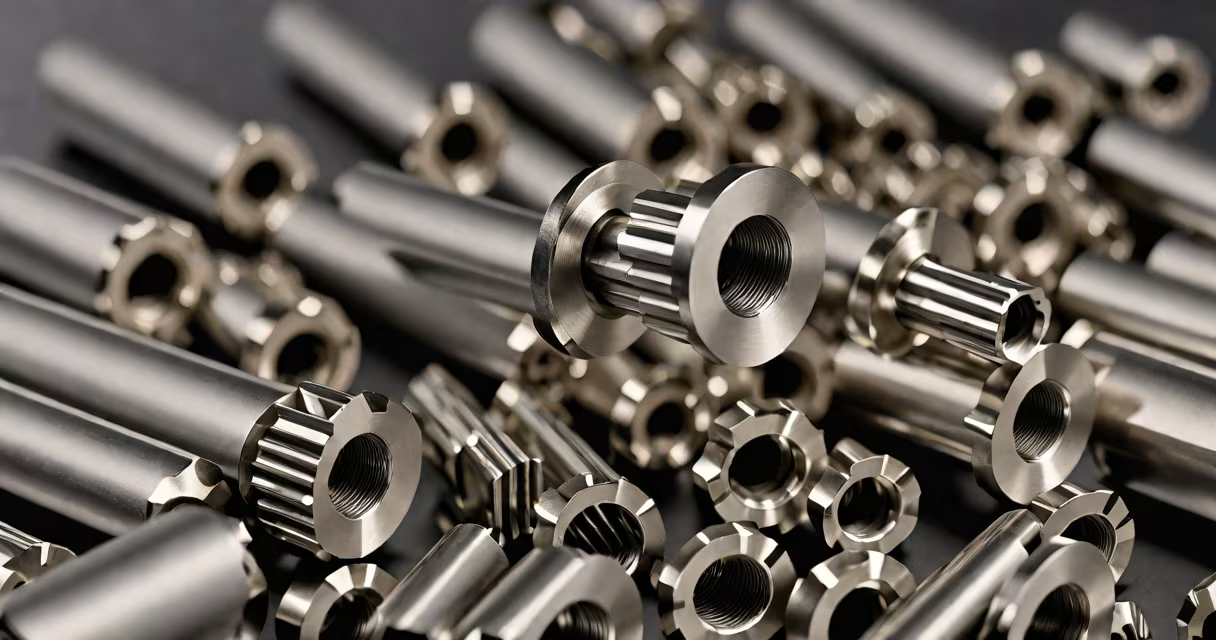
End mills are rotary cutting tools designed to remove material from a workpiece by rotating against it, typically in CNC milling machines. They cut on their periphery and the end face, enabling complex shapes, slots, pockets, and contours to be machined with accuracy.
These tools are essential in manufacturing processes requiring tight tolerances and surface finishes. They operate at high speeds and feed rates, removing material in small increments to achieve precise dimensions. Common applications include creating molds, engine components, aerospace parts, and custom mechanical fixtures.
According to the American Society of Mechanical Engineers (ASME), end mills are classified by geometry, flute count, and cutting edge configuration based on material and application. The choice of end mill affects efficiency, tool life, and part quality.
End mills rotate at thousands of RPM while being fed into a workpiece. As the cutting edges engage the material, they shear off chips. The rotation direction (clockwise or counterclockwise) determines chip flow and tool stability. Most end mills are mounted in collets or chucks and driven by spindle motors in CNC machines.
Each flute (cutting edge) removes a small amount of material per revolution. More flutes mean higher feed rates and smoother finishes but lower chip clearance. A standard end mill has two to four flutes, though specialized versions may have six or more.
For example, a 6-flute end mill cutting aluminum at 12,000 RPM with a 0.005-inch depth of cut removes about 0.03 inches of material per tooth per revolution. With six flutes, this totals 0.18 inches of material removed per spindle revolution - a rate optimized for efficient material removal without overheating.
End mills vary by geometry, coating, and intended material. The most common types include:
| Type | Flutes | Best For | Common Applications |
|---|---|---|---|
| Two-flute | 2 | Non-ferrous metals, plastics | Aluminum, brass, acrylic, foam |
| Four-flute | 4 | Steels, cast iron, general-purpose | Machine parts, structural components |
| Ball nose | 2-4 | 3D contouring, radiused features | Mold cavities, sculpted surfaces |
| Corner radius | 2-4 | Sharp corners with added strength | Die inserts, threaded holes, chamfers |
| Flat end | 2-6 | General milling, slotting | Slots, pockets, flat surfaces |
Coatings such as TiN (titanium nitride), TiCN (titanium carbonitride), and AlTiN (aluminum titanium nitride) improve wear resistance and heat dissipation. A TiCN-coated end mill lasts up to 40% longer when cutting steel compared to uncoated tools, according to a 2022 study by the National Institute of Standards and Technology (NIST).
One key distinction often missed: not all end mills can plunge vertically. Only those with a center-cutting design can cut straight down. Non-center-cutting end mills can only cut sideways and require a pilot hole for plunge operations. This affects tool selection for deep pocketing or drilling-like tasks.
End mills are central to CNC milling operations in automotive, aerospace, medical device, and electronics manufacturing. In a typical CNC workflow, a programmer writes G-code that directs the machine to move the end mill along a path defined by CAD models.
For instance, a CNC operator using a 1/4-inch, four-flute, TiCN-coated end mill cut a 2-inch-deep pocket in a 6061 aluminum block. The tool ran at 6,000 RPM with a feed rate of 150 inches per minute. The process took 12 minutes and produced a pocket with ±0.001-inch tolerance - within acceptable limits for a prototype housing.
They're also used in manual milling machines and router tables for prototyping. Hobbyists and small workshops use end mills to create custom jigs, brackets, and decorative elements. A 1/8-inch ball nose end mill carved a 3D relief pattern into maple wood for a custom sign - a task impossible with standard drill bits.
End mills are not interchangeable with drills. Drills are designed to start a hole and remove large volumes of material quickly. End mills are precision tools meant for shaping and finishing. Using a drill bit to cut a slot results in poor surface quality and rapid tool failure.
Many assume that larger end mills are always better for speed. In reality, smaller tools offer greater detail and are less prone to chatter in thin-walled parts. A 1/16-inch end mill can produce fine details in a micro-mold that a 1/2-inch tool cannot reach.
Another error is selecting the wrong flute count for the material. Two-flute end mills excel in aluminum due to their wide flute channels that evacuate chips efficiently. Using a four-flute tool in aluminum causes chip clogging, leading to tool breakage and poor surface finish.
I once ran a test on a 3-axis CNC machine using both a two-flute and a four-flute end mill on 1/2-inch thick aluminum. The two-flute tool completed the job in 8 minutes with clean cuts. The four-flute version stalled twice due to chip packing, requiring manual clearing and adding 5 minutes of downtime. The result was a 30% drop in productivity.
End mills degrade over time. Even with proper coolant and feed rates, wear reduces cutting efficiency. A worn tool produces rougher surfaces and increases power draw. Regular inspection and scheduled replacement prevent defects and maintain consistency across batches.
Understanding what end mills are used for means recognizing them as precision instruments, not generic cutting tools. Their performance depends on correct selection, setup, and maintenance. Choosing the right end mill for the material, depth, and desired finish ensures reliability and cost control in production.
When selecting tools, refer to manufacturer specifications and material compatibility charts. Always match the end mill's diameter, flute count, and coating to the workpiece and machine capabilities. Proper setup prevents errors, extends tool life, and improves output quality.