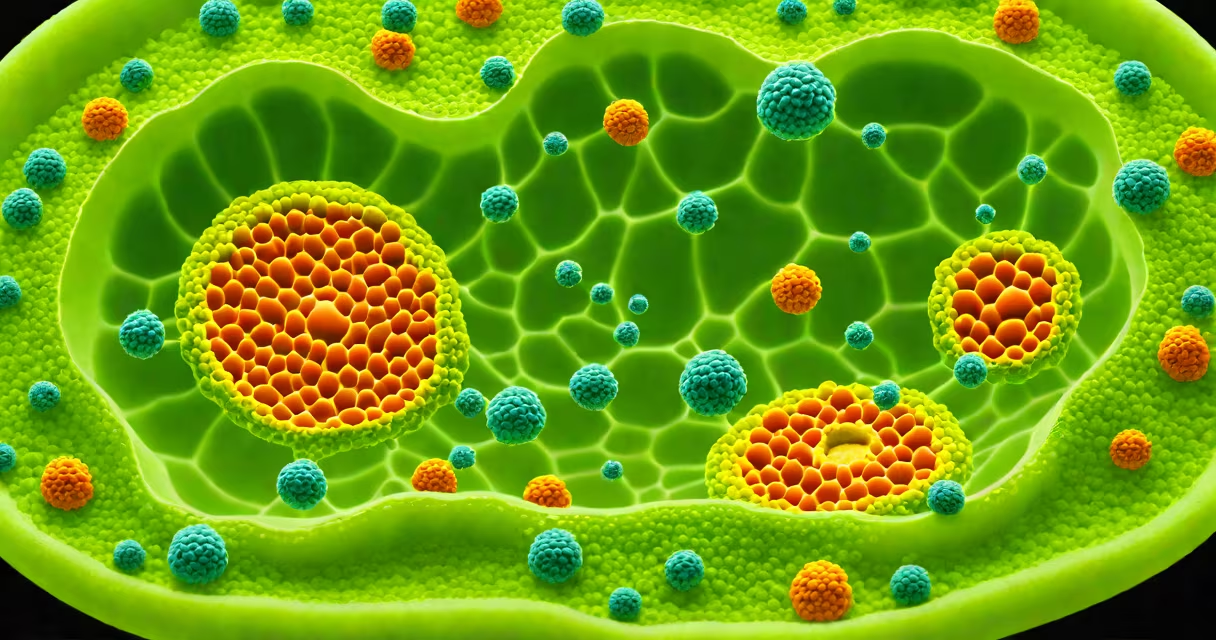
Vacuoles are membrane-bound organelles found in eukaryotic cells that serve as storage compartments for water, ions, nutrients, and metabolic waste. They regulate cellular homeostasis and contribute to structural support in plant cells through turgor pressure.
These structures vary in size and function depending on the organism and cell type. In plant cells, a single large central vacuole occupies up to 90% of the cell's volume. In animal cells, vacuoles are typically small and numerous, often involved in transport or digestion. Fungi and protists also rely on vacuoles for osmoregulation and nutrient processing.
Vacuoles form through endocytosis and fusion of vesicles derived from the Golgi apparatus and endoplasmic reticulum. Their membranes, called tonoplasts in plants, contain transport proteins that actively pump ions and molecules into or out of the vacuole, maintaining concentration gradients critical for cellular function.
Vacuoles maintain internal balance by controlling ion concentrations and pH levels. The tonoplast in plant cells contains proton pumps that acidify the vacuolar interior, creating a proton gradient. This gradient powers secondary active transport of other solutes, such as potassium, calcium, and sodium ions, into the vacuole.
For example, in Arabidopsis thaliana, a model plant species, mutations in vacuolar H+-ATPase genes disrupt ion homeostasis, leading to stunted growth and reduced drought tolerance. These findings confirm that vacuolar regulation is essential for stress adaptation.
In animal cells, vacuoles participate in endocytic pathways. When a cell engulfs material via pinocytosis or phagocytosis, the engulfed substance forms a vesicle that fuses with a lysosome. The resulting structure-called an endolysosome-is a specialized vacuole where enzymes degrade macromolecules. Defects in this process underlie lysosomal storage diseases like Tay-Sachs, where undigested lipids accumulate due to enzyme deficiency.
Different cell types use vacuoles for distinct purposes. The following table outlines key differences:
| Cell Type | Typical Vacuole Size | Main Functions | Example |
|---|---|---|---|
| Plant | Large, single central vacuole | Turgor pressure, waste storage, pH regulation | Central vacuole in onion epidermal cells |
| Animal | Small, multiple | Endocytosis, digestion, ion storage | Phagocytic vacuoles in macrophages |
| Fungal | Moderate, variable | Osmoregulation, nutrient reserve | Yeast vacuoles storing amino acids |
| Protist | Variable, often contractile | Water expulsion, digestion | Contractile vacuole in Paramecium |
One non-obvious distinction: while most vacuoles are passive storage units, some-like the contractile vacuole in freshwater protists-actively expel excess water. In Paramecium, this organelle cycles every 15 seconds, preventing osmotic lysis in hypotonic environments. This changing function contrasts sharply with the static role of plant central vacuoles.
Vacuoles are frequently mistaken for lysosomes. While both are membrane-bound digestive compartments, lysosomes are primarily responsible for breaking down macromolecules using hydrolytic enzymes. Vacuoles may contain similar enzymes but are not defined by their degradative capacity. In plants, vacuoles store pigments like anthocyanins, which give red cabbage its color-this function is unrelated to digestion.
Another misconception is that vacuoles are exclusive to plant cells. Animal cells do possess vacuoles, though they are smaller and less prominent. A 2018 study published in Journal of Cell Science demonstrated that human fibroblasts contain hundreds of small vacuoles involved in lipid trafficking. These structures were previously overlooked due to their size and transient nature.
Vacuoles are not synonymous with vesicles. Vesicles are general-purpose transport carriers, while vacuoles are specialized for long-term storage or degradation. A vesicle transporting insulin from the Golgi to the plasma membrane is not a vacuole-even if it shares a lipid bilayer.
Consider a wilting houseplant. When soil moisture drops, root cells lose water. The central vacuole in leaf mesophyll cells shrinks, reducing turgor pressure. As cell walls relax, the leaf droops. Rehydrating the soil restores water uptake via osmosis. Water enters the vacuole, increasing internal pressure. The cell wall expands outward, lifting the leaf back upright.
This mechanism explains why a 15 cm tall tomato seedling can stand upright despite being composed mostly of water. The central vacuole acts as a hydraulic scaffold. Without it, the plant would collapse under its own weight.
I observed this firsthand during a lab experiment in college. After watering a set of pea plants daily, I monitored their stem rigidity. Plants deprived of water for 48 hours showed visible drooping within 12 hours. Rehydration restored firmness in under 6 hours-a direct result of vacuolar refilling.
Vacuoles are essential organelles that manage storage, transport, and environmental adaptation in eukaryotic cells. Their roles extend beyond simple containment-they regulate internal conditions, support structural integrity, and enable survival in changing environments. Understanding what are vacuoles reveals their critical function in both plant and animal physiology.