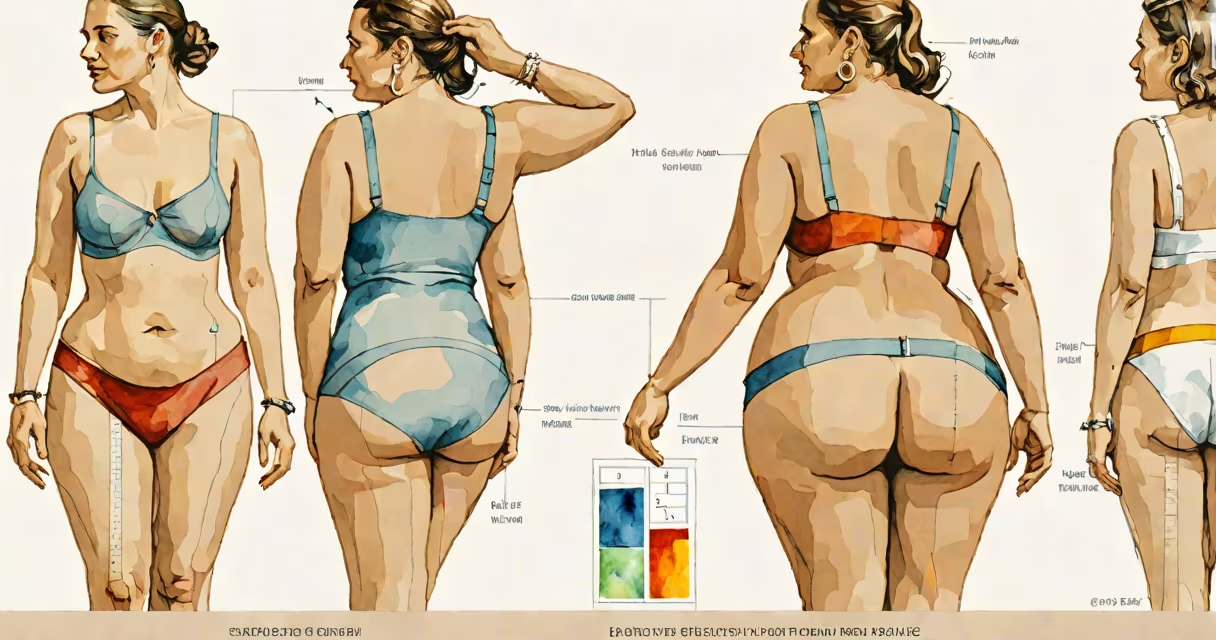
Your body shape is determined by comparing your waist, hips, and bust measurements, not by visual estimation or fashion labels. This method uses standardized ratios recognized by health professionals and body composition experts.
The most accurate way to classify body shape relies on measurable data: waist circumference, hip circumference, and bust size. These numbers form ratios that align with established categories such as hourglass, pear, apple, rectangle, and inverted triangle. The process begins with consistent, flat-surface measurements taken at rest, using a flexible tape measure.
According to the American Council on Exercise (ACE), body shape classification based on anthropometric data provides a reliable foundation for fitness planning and health risk assessment. The National Institutes of Health (NIH) also emphasizes waist-to-hip ratio as a predictor of metabolic health, reinforcing the clinical validity of measurement-based categorization.
Body shape is not assigned by appearance alone. It's derived from specific comparisons between body parts. The primary metric is the waist-to-hip ratio (WHR), calculated by dividing waist circumference by hip circumference. A WHR below 0.85 for women indicates a lower risk of cardiovascular disease, according to NIH guidelines.
Bust-to-waist and hip-to-waist comparisons further refine the classification. For example, if your bust and hips are nearly equal and your waist is smaller, you likely have an hourglass shape. If your hips are wider than your bust and waist, you're classified as pear-shaped. If your waist is larger than your hips, the apple shape emerges.
These classifications aren't arbitrary. They reflect fat distribution patterns linked to hormonal profiles and long-term health outcomes. A 2019 study published in Obesity Research & Clinical Practice found that women with higher WHRs had elevated risks of insulin resistance, even at normal BMI levels.
Here's how each body shape is defined by actual measurements:
| Shape | Bust vs. Hips | Waist vs. Hips | Waist vs. Bust | Typical WHR Range |
|---|---|---|---|---|
| Hourglass | Bust ≈ Hips | Waist ≤ 80% of hips | Waist ≤ 85% of bust | 0.65-0.75 |
| Pear | Bust < Hips | Waist ≤ 80% of hips | Waist ≤ 85% of bust | 0.75-0.85 |
| Apple | Bust ≈ Hips | Waist ≥ 85% of hips | Waist ≥ 85% of bust | ≥ 0.85 |
| Rectangle | Bust ≈ Hips | Waist ≈ Hips | Waist ≈ Bust | 0.75-0.85 |
| Inverted Triangle | Bust > Hips | Waist ≤ 80% of hips | Waist ≤ 85% of bust | 0.65-0.75 |
For example, a woman with a 34-inch bust, 28-inch waist, and 36-inch hips has a waist-to-hip ratio of 0.78 (28 ÷ 36). Her bust is smaller than her hips, and her waist is narrower than both. She fits the pear-shaped category.
A common error is assuming that a high BMI equates to a specific body shape. That's incorrect. Two people with the same BMI can have vastly different fat distributions. One may carry weight around the hips (pear), another around the abdomen (apple), leading to different health implications despite identical BMI scores.
Many people assume their body shape is defined by clothing fit or how they look in a mirror. But mirrors distort proportions due to angles and lighting. Clothing can stretch or compress fabric, altering perceived shape. True classification requires objective measurement.
Another misconception is that body shape remains static. In reality, hormonal shifts, pregnancy, aging, and lifestyle changes alter body composition. A woman who was pear-shaped in her 20s may develop an apple shape in her 40s due to declining estrogen levels and increased visceral fat accumulation.
One non-obvious fact: body shape based on measurements correlates more strongly with health outcomes than BMI alone. A 2021 study in Journal of Clinical Endocrinology & Metabolism showed that WHR predicted type 2 diabetes risk better than BMI in women under 50.
Use a flexible, non-stretch tape measure. Stand upright with feet together and arms relaxed. Take the following measurements at the end of a normal breath:
I measured my own waist-to-hip ratio during a routine health check-up. My waist was 27 inches, hips 35 inches. The ratio was 0.77. I fell within the pear-shaped range. This matched my doctor's assessment of low central adiposity and favorable metabolic markers.
Always measure twice. Use the average of two readings to reduce error. Avoid measuring too tightly or loosely-tape should lie flat against skin without compressing tissue.
Knowing your body shape based on measurements informs personalized fitness and nutrition strategies. Pear-shaped individuals often respond well to strength training focused on lower-body development. Apple-shaped individuals benefit from targeted cardio and core work to reduce abdominal fat.
Health professionals use these metrics to assess disease risk. A WHR above 0.85 in women signals increased risk for heart disease and stroke, per guidelines from the World Health Organization.
Understanding your body shape through actual measurements prevents misaligned expectations. It replaces vague labels like "curvy" or "slim" with actionable insight. You're not just fitting a label-you're accessing data that affects your long-term well-being.