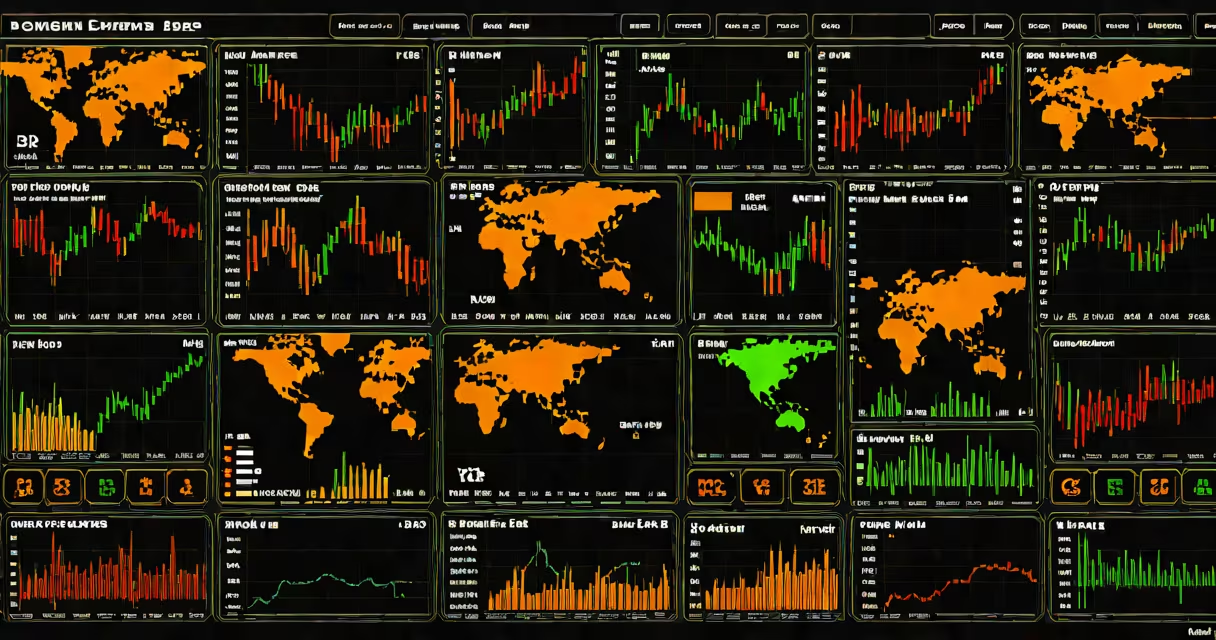
The foreign exchange market, commonly known as forex or FX, is a global decentralized marketplace where currencies are traded. It operates 24 hours a day, five days a week, enabling the conversion of one nation's currency into another's for international trade, travel, and investment.
Forex transactions occur between banks, financial institutions, corporations, governments, and individual traders. The market determines exchange rates based on supply and demand, economic indicators, interest rates, and geopolitical events. Daily turnover exceeds $7 trillion, making it the largest financial market in the world.
Unlike stock exchanges, forex has no central location. Trading happens electronically over-the-counter (OTC), with major hubs in London, New York, Tokyo, and Sydney. Participants buy and sell currency pairs-such as EUR/USD or JPY/USD-based on anticipated movements in value.
Currency values fluctuate constantly due to economic data, central bank policies, political stability, and investor sentiment. For example, if the U.S. Federal Reserve raises interest rates, the U.S. dollar often strengthens because higher yields attract foreign capital.
Trading occurs in pairs. The first currency is the base, the second is the quote. In EUR/USD, the euro is the base, and the dollar is the quote. A rate of 1.10 means one euro buys 1.10 U.S. dollars. Traders profit when the base currency appreciates relative to the quote.
Market participants include central banks, commercial banks, hedge funds, multinational corporations, and retail traders. Central banks may intervene to stabilize their currency during extreme volatility. Corporations use forex to hedge against losses from exchange rate swings on overseas contracts.
Forex activity falls into three categories: spot trades, forwards, and futures.
| Type | Settlement Time | Use Case | Example |
|---|---|---|---|
| Spot | Two business days | Immediate currency conversion | Buying 10,000 euros at 1.12 USD/EUR |
| Forward | Agreed future date | Hedging long-term exposure | Locking in a rate for a shipment in six months |
| Futures | Standardized contract date | Speculation or hedging with use | Trading a contract to buy yen at a set price in three months |
Spot markets dominate volume. Over 90% of daily forex trades settle within two business days. Forwards allow customization of terms, while futures are standardized and traded on exchanges like the Chicago Mercantile Exchange.
Many assume forex is only for large institutions. Retail traders now access the market through online brokers with low minimum deposits. You can start with as little as $100, though risk remains high due to use.
Another myth is that forex is purely speculative. While speculation drives short-term movement, the market supports essential functions: enabling cross-border payments, facilitating imports and exports, and allowing tourists to convert money abroad.
Consider a U.S.-based tech firm shipping $500,000 worth of servers to Germany. The German client pays in euros. At the time of shipment, the exchange rate is 1.10 USD/EUR. The firm receives €454,545.
Three months later, the euro drops to 1.20 USD/EUR. The same shipment would now yield only €416,667. That's a $37,878 loss in revenue. To avoid such swings, the company could enter a forward contract to lock in the 1.10 rate, ensuring predictable cash flow.
This scenario illustrates how businesses use forex tools to manage uncertainty. Without them, even small fluctuations could impact profitability.
In 2022, I monitored live forex data during a Federal Reserve announcement. When the Fed signaled a rate hike, the U.S. dollar spiked 1.8% against the euro within minutes. Major banks adjusted positions instantly. Retail traders saw rapid price changes on their platforms. The event confirmed how quickly macroeconomic news moves markets.
According to the Bank for International Settlements (BIS), the average daily turnover in global foreign exchange markets reached $7.5 trillion in 2022, up from $6.6 trillion in 2019. This growth reflects increased participation from emerging economies and digital trading platforms.
Another fact often missed: most forex trades involve the U.S. dollar. About 88% of all transactions include USD, either as the base or quote currency. This dominance stems from the dollar's role as the world's primary reserve currency, backed by the strength of the U.S. economy and financial system.
Individuals can exchange currency through banks, credit unions, or specialized services like Wise or Revolut. These providers offer better rates than airport kiosks, which often charge hidden fees. For example, exchanging $1,000 at a typical airport exchange might cost $100 in fees and poor rates. Using a dedicated service reduces that to under $5.
For active trading, platforms like MetaTrader 4 or Interactive Brokers provide access to real-time pricing, charting tools, and margin accounts. These tools allow traders to place limit orders, set stop-losses, and analyze trends using technical indicators.
When choosing a broker, verify regulation by bodies such as the U.S. Commodity Futures Trading Commission (CFTC) or the UK's Financial Conduct Authority (FCA). Unregulated platforms pose significant fraud risks.
Foreign exchange is not a single entity but a network of interconnected systems, institutions, and instruments. Its function extends beyond finance-it shapes global commerce, influences inflation, and affects everyday prices for goods and services.
Understanding what is the foreign exchange begins with recognizing it as the engine of international monetary exchange. From a tourist buying souvenirs abroad to a corporation managing a multi-million-dollar contract, the foreign exchange market quietly powers global economic integration.