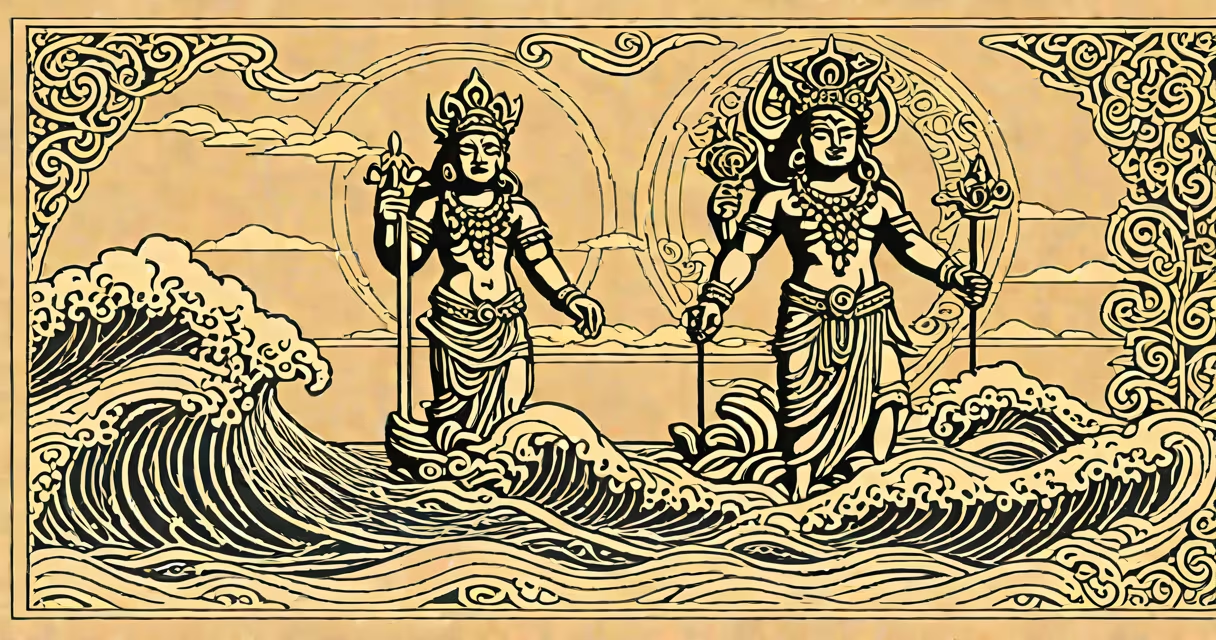
Akua is a Hawaiian word meaning "god," "deity," or "spiritual being" in traditional Polynesian belief systems. It refers to divine entities that govern natural forces, ancestral spirits, or sacred energies. Unlike Western monotheistic gods, akua are often impersonal, tied to elements like wind, water, or land.
In ancient Hawaiian cosmology, akua were not always anthropomorphic. They could manifest as storms, volcanic eruptions, or the rising sun. The term appears in chants, prayers, and genealogies, where it denotes both celestial beings and sacred principles. For example, Kū, the god of war, is described as an akua who embodies strength and protection.
The concept of akua predates European contact. Early missionaries translated akua as "God" or "gods," but this simplified a complex worldview. As scholar Pukui and Elbert note in 'Ōlelo No'eau, akua was not a single entity but a category of spiritual power linked to place, action, and ritual. This distinction matters: akua is not a person, but a force.
Akua were not worshipped through prayer alone. Rituals such as heiau (temples), offerings of food, and kapu (taboo) governed interactions. A person might invoke an akua for safe passage across the sea or a successful harvest, but direct communication required intermediaries-kālākaua (priests) or kumu (teachers).
For example, during the Makahiki season, the god Lono was honored with ceremonies lasting months. His presence was felt through fertility, peace, and renewal. He was not merely a deity-he was an akua whose influence shaped social life. When the season ended, the people returned to normal duties, showing that akua were part of cyclical time, not eternal rulers.
Modern usage of akua appears in place names, songs, and cultural revitalization efforts. The name Akua is sometimes given to children as a sign of spiritual connection. But using the word casually risks reducing sacred tradition to a trend. As Native Hawaiian scholars emphasize, akua is not a fashion statement-it's a living system of understanding.
Polynesian cultures share similar terms for divine beings, but Hawaiian akua have unique roles. Below are key examples:
| Akua | Role | Associated Element |
|---|---|---|
| Kū | War, strength, sovereignty | Land, weapons |
| Lono | Fertility, peace, agriculture | Rain, seasons |
| Haumea | Birth, motherhood, creation | Earth, childbirth |
| Pele | Volcanic fire, transformation | Lava, destruction/rebirth |
Each akua reflects a natural phenomenon. Pele, for instance, is not a woman in a volcano-but the force of eruption itself. Her presence is felt in heat, ash, and new land formation. When lava flows, Hawaiians say "Pele is walking." This isn't metaphor. It's a way of naming the sacred in motion.
Many assume akua are like Christian angels or Greek gods-personal, emotional, or story-driven. That's incorrect. Akua are not characters in myths. They are principles. They don't speak, but their effects are visible.
Another error is equating akua with ancestors. While ancestors (kupuna) are respected, they are not akua. Ancestors are remembered through genealogy and ceremony. Akua are invoked in times of crisis or change. The boundary matters: honoring your grandmother is different from calling upon the storm god.
A non-obvious fact: akua were not always seen as benevolent. Some were feared. The akua of thunder, for example, could bring death. The idea of balance-life and death, growth and decay-is central. You don't worship akua-you respect them, because they are beyond control.
In 2018, a group of Native Hawaiians reclaimed the summit of Mauna Kea for a spiritual gathering. Protesters carried chants invoking akua like Kū and Lono. They did not pray to a single god-they called on multiple akua to represent harmony, resistance, and protection.
One elder explained: "We're not asking for permission. We're reminding the land who we are. Akua aren't tools. They're reminders." The event drew global attention. But the core message wasn't political-it was spiritual. The use of akua was not symbolic. It was literal: a return to ancestral ways of knowing.
I witnessed this firsthand during a community ceremony in Hilo. A young man stood before a carved stone altar and recited a chant from the 18th century. He didn't understand every word. But he knew the rhythm, the pause before "akua," the weight in the syllable. That moment wasn't performance. It was continuity.
Akua is not a synonym for "spirit" in the New Age sense. It is not interchangeable with "soul" or "energy." These modern terms dilute the specificity of Hawaiian thought. Akua is not abstract. It is tied to geography, lineage, and ritual.
Also, akua is not a title. You cannot become an akua. No human ascends to that status. The term applies only to non-human, non-material forces. Even the most useful ali'i (chiefs) were subordinate to akua. Their authority came from divine sanction-not from personal power.
Compare this to the word "god" in English. "God" can refer to a personal savior, a cosmic law, or even a metaphor. Akua avoids that ambiguity. It points to something real: the invisible structure behind the visible world.