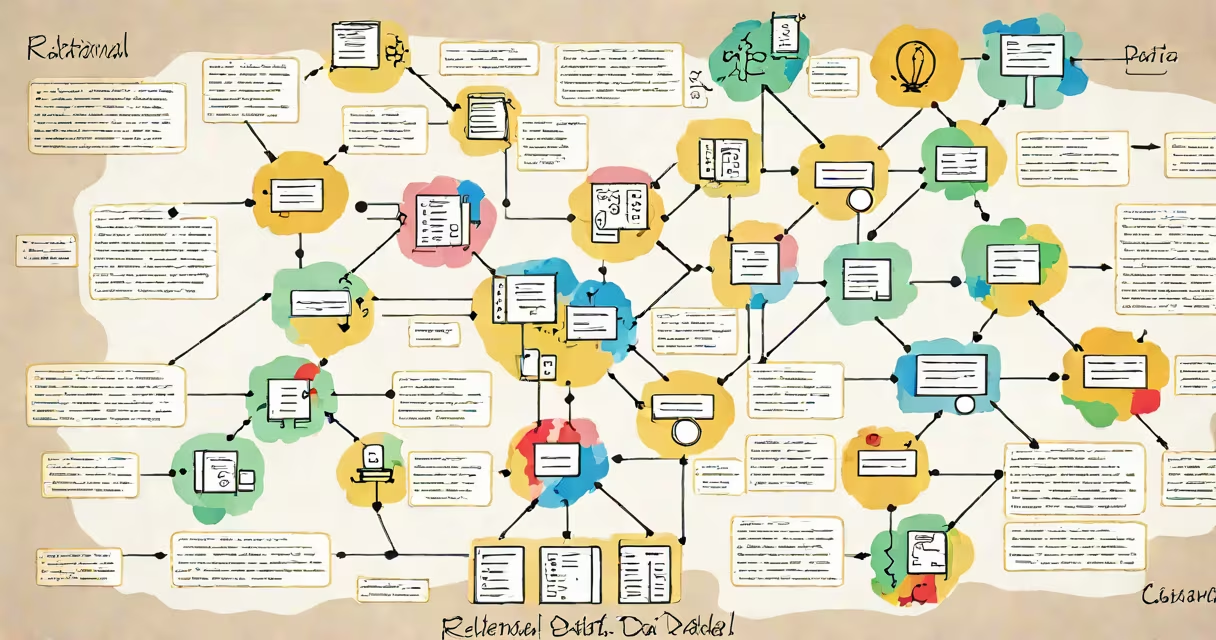
A relational data model structures data into tables composed of rows and columns, where relationships between tables are defined using keys. This system underpins most modern databases, including PostgreSQL, MySQL, and Oracle, enabling precise querying and consistent data management.
The model was formalized by Edgar F. Codd in 1970, who proposed that data should be stored in relations-mathematical sets-with no inherent order. This departure from hierarchical or network models allowed for greater flexibility and consistency. Today, it's the foundation of SQL-based systems used in banking, e-commerce, healthcare, and enterprise software.
Each table represents a specific entity-like customers, orders, or products-and contains attributes (columns) such as name, ID, or date. Rows correspond to individual records. For example, a customer table might have columns for customer_id, name, email, and address, with each row storing one customer's details.
Relationships between tables are established using primary and foreign keys. A primary key uniquely identifies each row in a table. A foreign key in another table references the primary key of a related table, creating a link. This allows complex queries across multiple tables without duplicating data.
For instance, an order table may contain a customer_id field that points to the customer_id in the customer table. When retrieving an order, the system joins these tables to display the customer's name alongside their purchase. This avoids storing the customer's name in every order row, reducing redundancy and improving accuracy.
SQL (Structured Query Language) is the standard interface for interacting with relational databases. Queries like SELECT * FROM orders WHERE customer_id = 123; retrieve data based on conditions and relationships. The relational model helps results are predictable and consistent across different operations.
Relational data models rely on several structural elements:
Normalization is a critical process within the model. It involves organizing data to reduce duplication and improve integrity. There are six normal forms, but most practical designs stop at Third Normal Form (3NF), which eliminates transitive dependencies. For example, if a table stores both employee name and department location, and the department changes, updating only the department table ensures consistency across all employees in that department.
Not all relational designs are equal. Some tables are optimized for read-heavy workloads (e.g., reporting), while others prioritize fast writes (e.g., transaction processing). This leads to variations in schema design, such as denormalization for performance in analytics systems.
| Normal Form | Requirement | Example |
|---|---|---|
| First (1NF) | No repeating groups; each cell holds a single value. | Split a list of phone numbers into separate rows. |
| Second (2NF) | Full functional dependency on the primary key. | Remove partial dependencies-e.g., move city from a customer-order table to a separate location table. |
| Third (3NF) | No transitive dependencies. | Move department manager info out of the employee table if it depends on department, not employee. |
People often confuse the relational data model with SQL itself. SQL is a language used to interact with relational databases, but the model exists independently. You can implement a relational model using other query languages or even custom APIs.
Another misconception is that relational databases are slow compared to NoSQL systems. While NoSQL databases excel in handling unstructured data and high-scale writes, relational databases offer stronger guarantees around consistency and correctness-critical for financial transactions or medical records.
Relational models differ from hierarchical or network models in how they represent relationships. Hierarchical models use parent-child trees (like file systems), while network models allow multiple parents. Relational models support many-to-many relationships through junction tables, making them far more flexible for complex data.
For example, a university course system might require students to enroll in multiple courses and courses to have many students. A direct link between student and course tables would create a many-to-many relationship. Instead, a junction table called enrollment tracks which student is registered in which course, with composite keys from both tables.
Consider an online store selling books. The database includes:
To find all books purchased by a customer named Alice, the system runs:
SELECT b.title, oi.quantity
FROM customers c
JOIN orders o ON c.customer_id = o.customer_id
JOIN order_items oi ON o.order_id = oi.order_id
JOIN books b ON oi.book_id = b.book_id
WHERE c.name = 'Alice';
This query traverses four tables using foreign keys. The relational model helps joins return accurate results because referential integrity is enforced-no order can reference a non-existent customer or book.
I built a similar system during a project at a startup. We used PostgreSQL and discovered that enforcing foreign key constraints caught 14 data entry errors in the first month-errors that would have gone unnoticed in a flat-file system.
Relational data models ensure ACID compliance-Atomicity, Consistency, Isolation, Durability-which protects data integrity during transactions. A bank transfer involving two accounts must succeed entirely or fail completely. The relational model supports this through transaction isolation levels and rollback mechanisms.
According to the PostgreSQL documentation, the system uses MVCC (Multi-Version Concurrency Control) to manage concurrent access without locking entire tables. This enables high throughput while preserving consistency-a feature rooted in relational theory.
Similarly, the MySQL manual emphasizes that InnoDB, the default storage engine, enforces foreign key constraints and supports transactions. These features are not optional-they're built into the relational model's architecture.
Despite advances in graph and document databases, the relational model remains dominant. A 2023 survey by DB-Engines ranked MySQL, PostgreSQL, and Oracle among the top five most popular databases globally-systems all based on relational principles.
Understanding the relational data model isn't just about knowing how tables connect. It's about grasping a structure for managing complexity with precision. scaling a global platform, the model provides a proven way to organize information reliably.
For deeper insight into how atomicity and consistency are implemented in practice, see 5 atomic model.