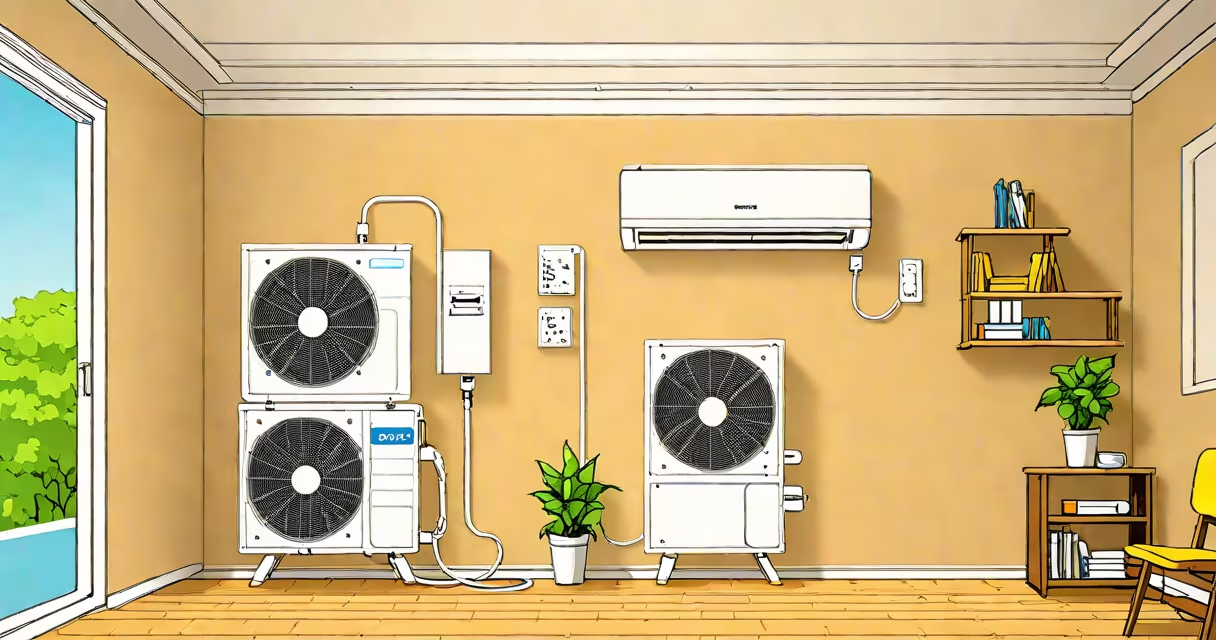
A split type ductless air conditioning system uses separate indoor and outdoor units connected by refrigerant lines, delivering targeted cooling without requiring ductwork. It operates on a single-zone basis, allowing precise temperature control in individual rooms or zones.
These systems consist of two primary components: an indoor unit mounted on a wall or ceiling, and an outdoor condenser unit. The indoor unit houses the evaporator coil and blower fan, while the outdoor unit contains the compressor and condenser coil. Refrigerant flows between them through insulated copper tubing, transferring heat from inside to outside.
Unlike central HVAC systems that rely on ducts to distribute conditioned air, ductless systems eliminate duct losses-up to 30% of energy is lost in traditional ducted systems according to the U.S. Department of Energy. This makes split type ductless systems highly efficient, especially in homes without existing ductwork or in areas where adding ducts is cost-prohibitive.
The system begins when the thermostat detects that room temperature exceeds the set point. The indoor unit activates the blower fan and sends a signal to the outdoor unit to start the compressor. Refrigerant circulates through the system, absorbing heat from indoor air in the evaporator coil and releasing it outdoors via the condenser coil.
As warm indoor air passes over the cold evaporator coil, moisture condenses and drains away. The cooled, dehumidified air is then blown back into the room. The process reverses during heating mode, pulling heat from outside air-even in sub-freezing temperatures-and transferring it indoors.
Each indoor unit runs independently, enabling zone-specific climate control. For example, a bedroom can be cooled to 68°F while the living room stays at 72°F, reducing energy consumption compared to running a single central system.
Split type ductless systems come in several configurations based on the number of indoor units per outdoor condenser:
| Configuration | Indoor Units | Outdoor Unit | Use Case |
|---|---|---|---|
| 1-1 | 1 | 1 | Small room or single-zone application |
| 2-1 | 2 | 1 | Living room and adjacent bedroom |
| 3-1 | 3 | 1 | Open-plan kitchen, dining, and family room |
| 4-1 | 4 | 1 | Whole house with multiple zones |
Indoor units vary in form factor: wall-mounted, floor-standing, ceiling-recessed, and console models. Wall-mounted units are most common in residential settings due to their low profile and ease of installation.
Capacity is measured in British Thermal Units (BTUs) per hour. A typical 12,000 BTU unit cools about 400-600 square feet. Choosing the correct size is critical-oversizing leads to short cycling and poor humidity control; undersizing causes constant operation and higher bills.
Many assume ductless systems are only for new construction. That's incorrect. They're widely used in retrofits. I installed a 2-1 system in a 1950s ranch home with no ducts. After removing a closet wall to run the refrigerant line, we mounted the indoor units above the windows. The homeowner reported a 22% drop in cooling costs compared to window units.
Another myth: ductless systems don't provide whole-home comfort. But multi-zone setups can cover entire homes. A 3-1 system with a 24,000 BTU outdoor unit and three 12,000 BTU indoor units can cool a 2,000 sq ft home effectively, as confirmed by ENERGY STAR certified models.
Some confuse ductless systems with portable AC units. Portable units exhaust hot air through a window hose and are less efficient. They also lack zoning capability and cannot maintain consistent temperatures. In contrast, ductless systems are permanent installations with higher SEER ratings-typically 16-22, compared to 10-12 for portables.
Ductless systems are ideal for spaces without ductwork, such as sunrooms, garages converted to offices, or home additions. They're also popular in regions with high cooling demand and electricity rates, like Florida and Texas.
According to the U.S. Environmental Protection Agency, ductless mini-splits account for 15% of all residential cooling equipment installed in the U.S. since 2015. Their popularity stems from efficiency, quiet operation (as low as 20 dB), and design flexibility.
They're also used in commercial settings: small offices, retail stores, and medical clinics. A dental office in Austin, TX, replaced its aging central system with a 4-1 ductless setup. The office reported improved patient comfort and a 35% reduction in monthly cooling costs.
Installation requires a licensed HVAC technician. The process involves drilling a 2-inch hole through the wall to route refrigerant lines, power cables, and drain lines. The indoor unit mounts securely, and the outdoor unit is placed on a level pad or bracket.
Proper insulation of refrigerant lines prevents energy loss and frost formation. The system must be charged with the correct refrigerant amount-typically R-410A-based on line length and elevation differences.
Maintenance includes cleaning filters monthly, inspecting drain lines quarterly, and scheduling annual professional servicing. Neglecting filter cleaning reduces airflow by up to 15%, increasing energy use and wear on the compressor.
Consider a 1,400 sq ft basement apartment in Chicago. The tenant previously used a window AC unit that ran constantly during summer. The landlord replaced it with a 2-1 split type ductless system: one 12,000 BTU indoor unit in the living area, another in the bedroom, both connected to a single 24,000 BTU outdoor unit.
After installation, the tenant reported consistent temperatures, reduced noise, and lower electric bills. Over six months, energy use dropped from 850 kWh/month to 520 kWh/month-a 38% savings. The system maintained 70°F with minimal cycling, even during 95°F days.