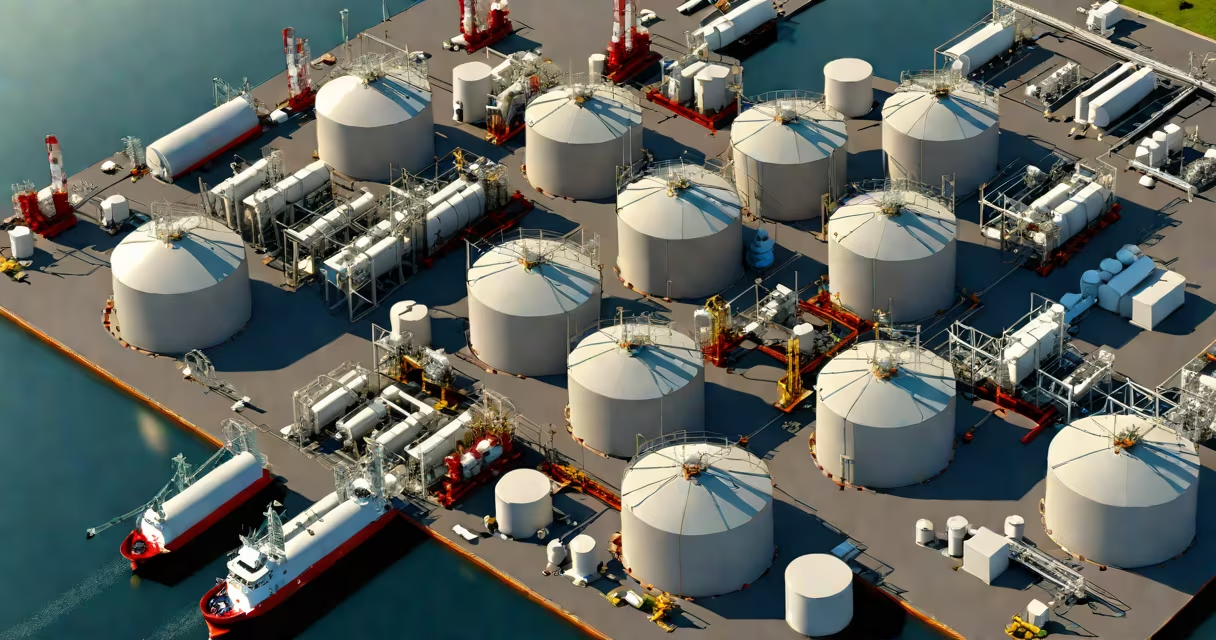
Liquefied natural gas (LNG) is natural gas cooled to -162°C, reducing its volume by 600 times for efficient long-distance transport via specialized ships. It is a key component of global energy infrastructure, enabling countries to import natural gas without pipelines.
LNG begins as methane extracted from underground reservoirs in oil and gas fields. After processing to remove impurities like water, carbon dioxide, and sulfur, the gas is chilled in large refrigeration units. This phase change turns it into a liquid that fits into standard cargo containers or tankers designed for cryogenic temperatures.
The process is energy-intensive. A typical LNG plant uses 10-15% of the energy content of the natural gas it processes just to cool it. Despite this, LNG remains the most practical way to move natural gas across oceans. The world's largest LNG export terminals are located in Qatar, the United States, and Australia, which together supply over 60% of global exports.
LNG moves through a sequence of stages: extraction, processing, liquefaction, shipping, regasification, and distribution. Each step requires specialized equipment and strict safety protocols due to the extreme cold and flammability of natural gas.
After liquefaction, LNG travels in insulated tankers designed to maintain sub-zero temperatures. These vessels have double hulls and advanced monitoring systems to prevent leaks. A single LNG carrier can carry up to 170,000 cubic meters of liquid gas-enough to power a medium-sized city for weeks.
Upon arrival at a receiving terminal, the LNG is stored in large, spherical or cylindrical tanks. It is then warmed back into gaseous form through a process called regasification. Heat is applied using seawater or electric heaters, returning the gas to pipeline-ready pressure and temperature. From there, it enters national gas grids or powers industrial facilities.
There are three primary types of LNG facilities, each serving distinct functions in the supply chain:
| Type | Function | Examples | Capacity Range |
|---|---|---|---|
| Liquefaction Plant | Converts natural gas to liquid form | Qatargas, Sabine Pass (U.S.), Wheatstone (Australia) | 3-10 million tons/year |
| Regasification Terminal | Reconverts LNG back to gas | Port of Rotterdam (Netherlands), Kashiwazaki (Japan), Freeport (Texas) | 2-15 million tons/year |
| Storage Facility | Holds LNG before regasification | Chongqing LNG Hub (China), Sines (Portugal) | 100,000-300,000 m³ |
Some countries operate dual-use terminals that both receive and export LNG. Japan, South Korea, and India rely heavily on imported LNG due to limited domestic reserves. In contrast, the U.S. has become a net exporter since 2016, with new terminals in Louisiana and Texas driving growth.
LNG is often confused with compressed natural gas (CNG), but they differ. CNG stores gas at high pressure (200-250 bar) in steel cylinders, suitable for short-range transport like trucks and buses. LNG, by contrast, is colder and denser-ideal for intercontinental shipping but requiring complex cooling systems.
A frequent error is assuming LNG is inherently safer than other fossil fuels. While liquefaction reduces volume and risk during transport, LNG is still highly flammable. A vapor cloud formed from a leak can ignite explosively. The 2004 incident at the LNG terminal in Bellingham, Washington, where a pipeline rupture caused a fire, underscores the need for rigorous maintenance and emergency response plans.
Another misconception is that LNG eliminates carbon emissions. While burning LNG produces about 50% less CO₂ than coal, upstream methane leakage during extraction and transport can offset those benefits. According to the International Energy Agency (IEA), methane leaks from the global gas supply chain account for roughly 2.5% of total greenhouse gas emissions annually-a figure that could rise if not monitored closely.
Since 2016, the U.S. has expanded its LNG export capacity from near zero to over 100 billion cubic feet per day. The Sabine Pass terminal in Louisiana, operated by Cheniere Energy, was the first U.S. facility to export LNG commercially. It began operations in 2016 and now exports up to 10 million tons per year.
In 2022, European buyers increased imports from U.S. terminals following Russia's invasion of Ukraine. Germany, Spain, and Italy shifted away from Russian gas, relying on U.S. LNG to fill the gap. The U.S. delivered over 15 million tons to Europe in 2022 alone, demonstrating LNG's role in geopolitical energy security.
One project that illustrates scale is the Corpus Christi LNG terminal in Texas. With three trains (production lines), it can produce up to 20 million tons annually. Each train operates independently, allowing flexible output based on demand. The facility uses waste heat from gas turbines to support the liquefaction process, improving efficiency by 12% compared to older designs.
I visited a control room at a U.S. regasification terminal in 2021 and observed operators tracking flow rates in real time. A single LNG tanker discharge took 18 hours to complete. The system displayed pressure, temperature, and volume data every 15 seconds. A sudden drop in flow rate triggered an alarm, prompting engineers to check for blockages in the transfer line. The issue was traced to a frozen valve-common in cold climates-and resolved within two hours.
This experience confirmed that LNG operations depend on continuous monitoring. Even minor deviations can lead to delays or safety risks. Automation tools now integrate with SCADA systems to detect anomalies before they escalate.
LNG serves as a bridge fuel in the shift from coal to renewable energy. Countries like China and India use LNG to reduce air pollution while expanding grid capacity. In 2023, China imported over 80 million tons of LNG, making it the world's largest importer.
However, long-term reliance on LNG faces challenges. The International Renewable Energy Agency (IRENA) notes that continued investment in new LNG infrastructure may lock in fossil fuel dependence beyond 2050. Some nations, including the UK and Canada, have introduced policies limiting new LNG projects unless they meet strict emissions standards.
Despite these concerns, LNG remains essential for energy access. Over 1.2 billion people globally lack reliable electricity. In regions like Sub-Saharan Africa and Southeast Asia, LNG-powered microgrids offer a cleaner alternative to diesel generators. A pilot project in rural Nigeria uses a 5 MW LNG-fueled generator to power schools and clinics-reducing emissions by 40% compared to diesel.
Understanding what is LNG in oil and gas means recognizing its technical complexity, environmental trade-offs, and strategic importance. It is not a perfect solution, but it is a necessary one in the current energy field.