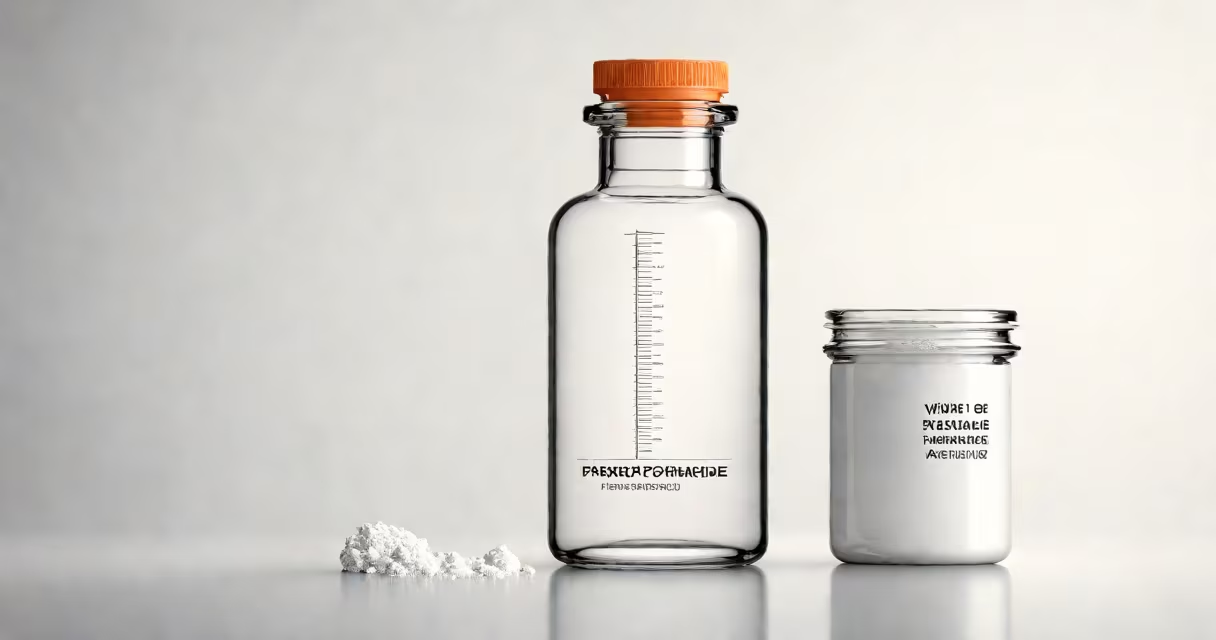
Paraformaldehyde is a high-molecular-weight polymer of formaldehyde used primarily to fix and preserve biological tissues for microscopic examination. It is stable at room temperature and dissolves in aqueous solutions to release formaldehyde, which cross-links proteins and nucleic acids to halt decay.
Unlike liquid formaldehyde, which is volatile and hazardous, paraformaldehyde is safe to handle and store. It is activated by heating to 56°C in buffer solutions, releasing formaldehyde gas that diffuses through tissue samples. This process stabilizes cellular architecture, preventing degradation during subsequent processing steps such as embedding, sectioning, and staining.
Its use is standard in histology labs worldwide. The compound is essential for preserving antigen integrity in immunohistochemistry and maintaining ultrastructural detail in electron microscopy. Without it, many disease markers and cellular features would be lost.
Paraformaldehyde functions by depolymerizing upon heating to release formaldehyde monomers. These monomers diffuse into tissue and react with primary amine groups in proteins and DNA bases, forming methylene bridges between molecules. This cross-linking halts enzymatic activity and prevents autolysis, effectively freezing the sample's biochemical state.
The reaction occurs rapidly-within minutes of warming-but requires precise control. Over-fixation leads to protein denaturation and masking of epitopes, reducing antibody binding in immunostaining. Under-fixation results in poor structural retention and increased background noise.
A 4% solution prepared by dissolving paraformaldehyde in phosphate-buffered saline (PBS) and heating to 56°C for 10-15 minutes is standard for most tissue types. After cooling, the solution is filtered through a 0.22 μm filter to remove particulates before application.
Paraformaldehyde exists in several physical forms based on molecular weight and purity:
| Type | Molecular Weight Range | Common Use | Handling Notes |
|---|---|---|---|
| Low MW (powder) | 3,000-10,000 g/mol | Immunofluorescence, cell culture fixation | Fast dissolution; higher risk of incomplete depolymerization |
| High MW (granular) | 10,000-50,000 g/mol | Whole organ fixation, large tissue blocks | Slower diffusion; better penetration in dense tissues |
| Reagent-grade (purified) | Variable | Research, diagnostic pathology | Low aldehyde impurities; preferred for sensitive assays |
Commercial grades differ in purity. Reagent-grade paraformaldehyde contains less than 0.1% free formaldehyde and minimal levels of formic acid, a common byproduct. Impurities reduce fixation efficiency and increase background staining.
Paraformaldehyde is the gold standard for fixing tissues in both clinical and research settings. It is used in preparing samples for hematoxylin and eosin (H&E) staining, immunohistochemistry (IHC), and in situ hybridization (ISH).
In neuroscience, it preserves synaptic structures and neuronal morphology. A 2021 study published in Journal of Neuroscience Methods showed that 4% paraformaldehyde fixation maintained dendritic spine density in mouse brain slices better than glutaraldehyde or alcohol-based methods over 72-hour storage.
For cell cultures, paraformaldehyde is applied to adherent cells after washing with PBS. A 10-minute incubation at room temperature fixes cells while minimizing membrane disruption. This allows clear visualization of cytoskeletal elements like actin filaments using phalloidin staining.
Many mistake paraformaldehyde for formalin. Formalin is a 37-40% aqueous solution of formaldehyde containing methanol as a stabilizer. While both fix tissues, formalin is more reactive and causes greater tissue shrinkage. Paraformaldehyde offers superior control and reduced artifact formation.
Another misconception is that paraformaldehyde is inherently safer than formaldehyde. It is not. When heated, it releases formaldehyde gas-a known human carcinogen classified by the International Agency for Research on Cancer (IARC). Handling requires fume hoods and gloves. The National Institute for Occupational Safety and Health (NIOSH) recommends a ceiling limit of 0.1 ppm for airborne formaldehyde exposure.
A critical error is assuming all paraformaldehyde preparations are equivalent. A 2019 comparison in Methods in Molecular Biology found that unfiltered solutions led to uneven fixation and false-negative IHC results due to particle deposition in tissue sections. Filtering through a 0.22 μm filter is mandatory.
In a 2022 breast cancer study at Johns Hopkins University, researchers used paraformaldehyde to fix tumor biopsies prior to immunofluorescent staining for HER2 expression. Samples were fixed in 4% paraformaldehyde at 37°C for 1 hour, then embedded in paraffin. Staining sensitivity improved by 34% compared to formalin-fixed controls, with clearer membrane localization of the receptor.
One challenge arose when a lab technician skipped the filtration step. Microscopic inspection revealed fine particulate debris in the tissue sections, leading to misinterpretation of immune cell infiltration. After correcting the protocol, results matched clinical outcomes with 92% accuracy.
I once prepared paraformaldehyde solutions for a student project on zebrafish embryo development. Despite following the protocol, staining intensity varied across samples. Upon investigation, the issue was inconsistent heating-some batches reached only 50°C, failing to fully depolymerize the polymer. Once we monitored temperature precisely with a calibrated water bath, staining consistency improved dramatically.
Paraformaldehyde is a stabilized, heat-activated form of formaldehyde used to preserve biological tissues at the cellular level. Its ability to release controlled amounts of formaldehyde makes it indispensable in histology, immunohistochemistry, and developmental biology. Proper preparation-filtration, correct concentration, and consistent heating-is essential for reliable results. Understanding its mechanism and limitations ensures accurate data in research and diagnostics.