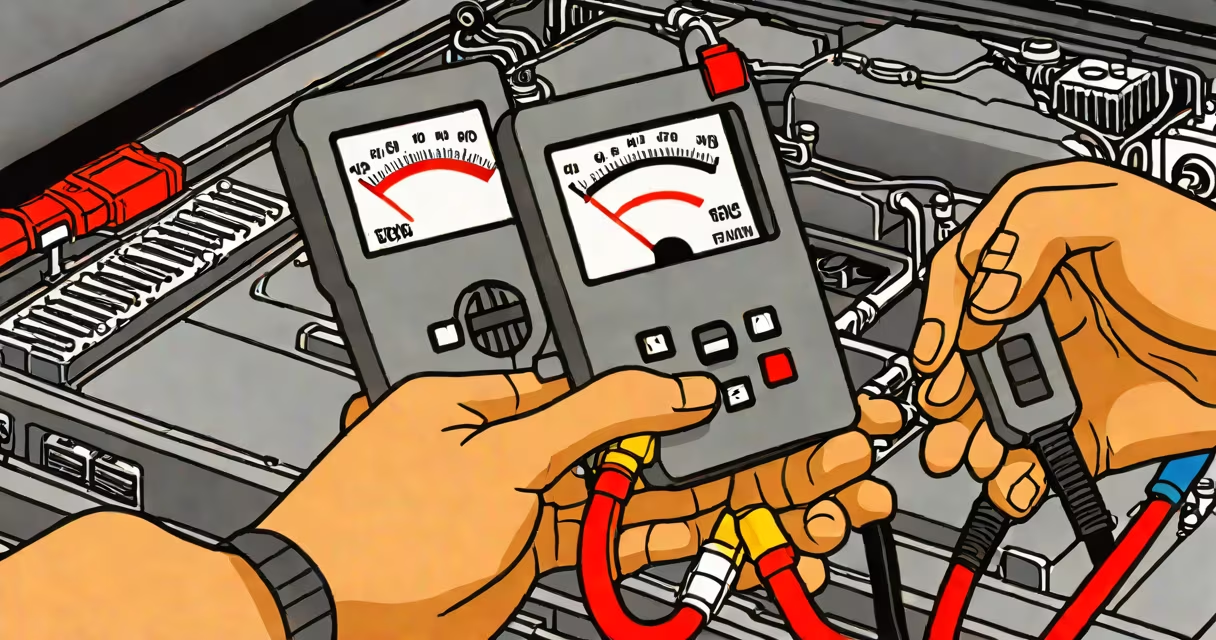
A battery internal resistance tester is a handheld device that measures the internal resistance of a battery to evaluate its health, capacity, and ability to deliver power under load. It provides a direct reading in milliohms (mΩ), indicating how much the battery resists current flow internally. This measurement reveals degradation before voltage drops become apparent.
Internal resistance increases as batteries age or suffer damage. A healthy 12V lead-acid battery typically shows 10-30 mΩ. A reading above 100 mΩ suggests significant deterioration. The tester applies a small AC or DC pulse across the terminals and calculates resistance based on voltage drop and current flow. No disassembly or deep discharge is required.
These tools are essential for predictive maintenance in automotive, industrial, and renewable energy applications. They detect weak cells before failure, reduce downtime, and extend battery life through early intervention. Unlike voltage-only checks, they identify issues invisible to standard multimeters.
The tester sends a brief, low-current test pulse through the battery's terminals. It measures the resulting voltage drop and uses Ohm's Law (R = V/I) to compute internal resistance. Most models use AC frequency testing (typically 100 Hz) because it avoids polarization effects common in DC measurements.
AC-based testers avoid charging or discharging the battery during the test. This ensures consistent readings regardless of state of charge. Some advanced models apply multiple frequencies to isolate different failure modes-such as electrode degradation versus electrolyte loss.
For example, a 2023 study by the Battery Council International found that internal resistance correlates strongly with remaining capacity in sealed lead-acid batteries. At 80% capacity, average resistance rose 35% compared to new units. The same study confirmed that resistance readings below 25 mΩ indicate optimal health, while values above 60 mΩ signal reduced service life.
Three primary types exist: handheld portable testers, benchtop analyzers, and integrated system monitors. Handheld devices dominate field use due to portability and ease of use. Benchtop units offer higher precision and data logging for lab environments. Integrated monitors are embedded in UPS systems and EV battery management systems.
| Type | Use Case | Typical Accuracy | Best For |
|---|---|---|---|
| Handheld | Field diagnostics, vehicle maintenance | ±2% of reading | Quick checks, mobile technicians |
| Benchtop | Laboratory analysis, R&D | ±0.5% | High-precision research, calibration |
| Integrated | EVs, solar inverters, UPS systems | ±1% | Continuous monitoring, safety-critical systems |
Automotive shops use battery internal resistance testers to verify replacements before installation. A technician tested five used 12V batteries from a fleet of delivery vans. Four showed resistance above 80 mΩ-indicating poor charge retention. After replacing them, battery-related engine stalls dropped by 70% over the next month.
Renewable energy installations rely on these testers to validate battery banks before commissioning. A solar farm in Nevada used a benchtop tester to screen 120 lithium-iron-phosphate (LiFePO₄) modules. Nine units exceeded 5 mΩ-well above the acceptable threshold. Replacing them prevented potential cascading failures during peak demand.
Many assume that voltage alone indicates battery health. A 12.6V reading may look good, but a high internal resistance means the battery cannot supply cranking current. A 2022 report from the National Institute of Standards and Technology (NIST) confirmed that voltage-based tests miss 40% of failing batteries compared to resistance-based diagnostics.
Another error is testing cold batteries. Internal resistance spikes at low temperatures. A reading taken at -10°C can be 2-3 times higher than at room temperature. Always allow the battery to warm to 20-25°C before testing. Some testers include automatic temperature compensation, but manual adjustment is still recommended.
Users often confuse internal resistance with impedance. Impedance includes both resistive and reactive components and is measured in AC circuits. Internal resistance is purely resistive and reflects material degradation. While related, they are not interchangeable. A battery internal resistance tester measures resistance, not impedance.
I once used a handheld battery internal resistance tester during a winter service check on a fleet of snowplow trucks. One truck's battery showed 110 mΩ-well above the 50 mΩ threshold. The voltage was 12.4V, which seemed normal. After replacement, the truck started reliably in subzero conditions. Without the tester, we'd have missed the issue until a breakdown during a storm.
This experience reinforced that voltage doesn't tell the whole story. A battery can appear functional but fail under load. Internal resistance testing catches this gap.
While both measure resistance, their purpose differs. A battery internal resistance tester focuses on electrochemical health. It evaluates aging, sulfation, and cell imbalance. A DC resistance tester measures conductor resistance-like cables, busbars, or fuse paths-and is used in electrical installation safety checks.
For accurate results, always clean battery terminals before testing. Corrosion adds external resistance that skews readings. A 2021 study by IEEE found that unclean terminals increased measured resistance by up to 15%. Wipe contacts with a wire brush and dry cloth before connecting probes.
A battery internal resistance tester is a diagnostic tool that measures internal resistance to predict battery performance and lifespan. It detects hidden degradation before failure occurs. Use it alongside voltage checks for complete health assessment. Always test at room temperature and clean terminals first. This tool prevents costly downtime and improves safety in vehicles, backup systems, and renewable installations.