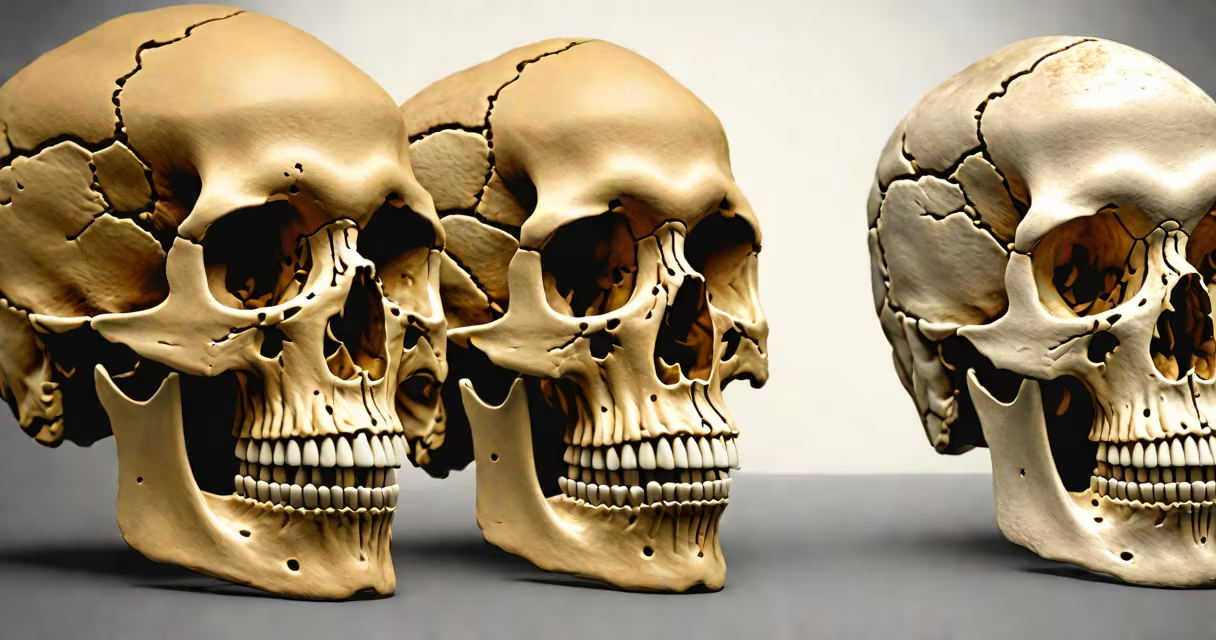
Homo sapiens and Neanderthals were distinct human species that coexisted in Europe and western Asia between about 40,000 and 30,000 years ago. While both walked upright and used tools, Homo sapiens had larger brains with different organization, developed symbolic culture, and outlived Neanderthals after interbreeding occurred.
Neanderthals lived primarily in cold environments across Europe and parts of western Asia. They adapted physically to harsh climates-shorter limbs, broad chests, and large nasal passages helped conserve heat. Their average cranial capacity was slightly larger than modern humans'-about 1,500 cm³ compared to 1,350 cm³-but their brain structure differed. The parietal lobes, involved in spatial reasoning and integration of sensory input, were less developed in Neanderthals.
Modern humans evolved in Africa around 300,000 years ago. By 70,000 years ago, they began migrating out of Africa, eventually reaching Europe and displacing Neanderthals. Genetic evidence shows that 1-4% of non-African modern human DNA comes from Neanderthal interbreeding, indicating successful reproduction between the species.
Brain size alone doesn't determine cognitive ability. Neanderthals had brains that were proportionally larger in certain regions-especially the visual cortex-but smaller in areas linked to social cognition and planning. A 2018 study published in Nature Communications analyzed fossilized endocasts and found that Neanderthal brains were elongated rather than globular, affecting neural connectivity patterns.
Modern human brains develop a globular shape during childhood, allowing for greater integration between brain regions. This may have supported advanced language processing, theory of mind, and long-term planning. Neanderthal remains show no consistent evidence of symbolic behavior such as cave paintings, jewelry, or burials with grave goods-though some recent findings challenge this view.
A 2021 analysis of Neanderthal remains from the site of La Chapelle-aux-Saints revealed intentional burial practices, including placement of the body in a flexed position and use of red ochre. However, these instances remain rare and lack the ritual consistency seen in early Homo sapiens sites like Skhul Cave in Israel, where bodies were buried with shells and pigments.
Both species used Mousterian-style stone tools-flakes struck from prepared cores. But Homo sapiens created more diverse toolkits, including bone needles, scrapers, and projectile points. Evidence from Blombos Cave in South Africa shows Homo sapiens making shell beads and engraved ochre pieces dating back 75,000 years-tools associated with symbolic expression.
Neanderthals used tools effectively but showed limited variation over time. A 2016 study in Science Advances found that Neanderthal tool production remained stable across 100,000 years, suggesting low innovation rates. In contrast, Homo sapiens toolkits changed rapidly in response to environmental shifts.
One example: at the site of Pech-de-l'Azé in France, Neanderthals crafted specialized scrapers for working hides. These tools were effective but lacked the variety seen in Upper Paleolithic sites occupied by Homo sapiens. There, researchers found over 20 different tool types, including harpoons and carved figurines.
| Feature | Neanderthal | Homo sapiens |
|---|---|---|
| Brain volume (avg.) | 1,500 cm³ | 1,350 cm³ |
| Tool tradition | Mousterian (stable) | Upper Paleolithic (rapidly changing) |
| Symbolic artifacts | Rare; occasional ochre use | Common; beads, carvings, cave art |
| Migration pattern | Restricted to Eurasia | Global spread by 40,000 years ago |
Neanderthals disappeared around 40,000 years ago, coinciding with the arrival of Homo sapiens in Western Europe. Climate shifts during the last Ice Age likely stressed Neanderthal populations, reducing food availability and increasing isolation. Their small group sizes-estimated at 10-30 individuals per band-limited genetic diversity and resilience.
Modern humans had larger social networks and greater population density. A 2020 study in PNAS modeled resource competition and found that Homo sapiens could exploit a wider range of food sources, including marine resources and plant-based diets, giving them an edge in uncertain environments.
I once visited the Neanderthal Museum in Mettmann, Germany, where a reconstructed campsite shows how Neanderthals lived. The exhibit includes replicas of wooden shelters and hearths. What stood out was the absence of personal adornment-no necklaces, no painted bones. In contrast, nearby displays of early Homo sapiens sites feature hundreds of pierced shells and engraved stones. That gap in material culture speaks volumes about cognitive divergence.
Many assume Neanderthals were primitive or brutish. This stems from early 20th-century reconstructions showing stooped figures with heavy brows. Modern research shows they were agile, skilled hunters, and capable of complex social cooperation. They used fire, built shelters, and cared for injured members.
Another myth is that Homo sapiens replaced Neanderthals through superior intelligence. But evidence suggests competition, climate stress, and demographic factors played bigger roles. A 2022 paper in Quaternary Science Reviews concluded that Neanderthal extinction resulted from multiple overlapping pressures-not a single cause.
Some confuse Neanderthals with Denisovans, another archaic human lineage. While both interbred with Homo sapiens, Denisovans lived primarily in Siberia and Southeast Asia. Their genome contributed to modern human immunity and high-altitude adaptation in Tibetans.
The difference between Homo sapiens and Neanderthal is not just biological-it's cultural, behavioral, and evolutionary. Homo sapiens developed cumulative culture, passed innovations across generations, and expanded globally. Neanderthals were highly adapted to their environment but did not evolve the same capacity for rapid cultural change.