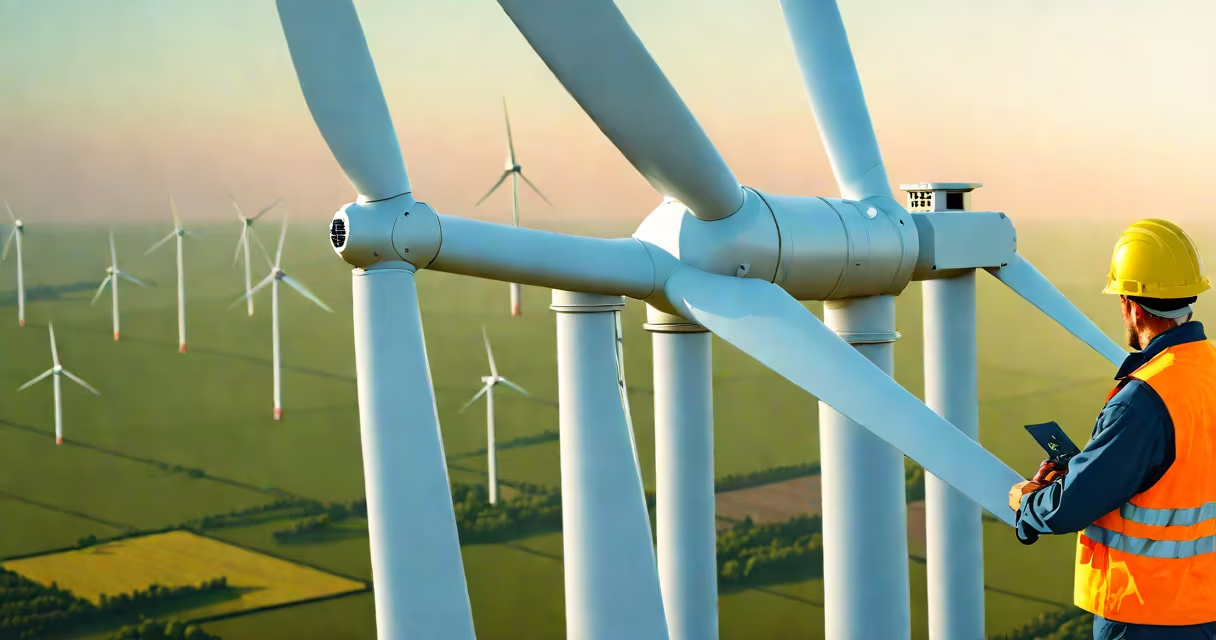
A wind turbine technician earns a median annual salary of $64,000 in the United States, according to the U.S. Bureau of Labor Statistics (BLS), with top earners surpassing $90,000. Pay varies by region, employer, and level of certification.
Wind turbine technicians maintain and repair large wind turbines, often working at heights of 300 feet or more. Their duties include inspecting blades, replacing faulty components, troubleshooting electrical systems, and ensuring turbines operate safely and efficiently. Technicians typically work outdoors in remote locations, sometimes in harsh weather conditions.
The role requires technical training, often completed through a community college program or apprenticeship. Most employers require at least an associate degree or certificate in wind energy technology. Safety certifications such as OSHA 10-hour and first aid are standard prerequisites.
Base pay for wind turbine technicians is influenced by geographic location, years of experience, and the size of the wind farm operator. Technicians in states with high wind energy deployment-such as Texas, Iowa, and California-earn above-average wages due to higher demand and cost of living.
Entry-level technicians earn between $45,000 and $55,000 annually. After two to three years of field experience, salaries typically rise to $65,000-$75,000. Senior technicians or those specializing in blade repair or control system diagnostics may exceed $90,000, especially with overtime and shift differentials.
For example, a technician in Lubbock, Texas, with three years' experience and a Level 1 certification from the National Renewable Energy Laboratory (NREL) earned $78,000 in 2023, including $4,500 in overtime and $3,000 in hazard pay for night shifts.
Many wind energy companies offer performance-based bonuses, shift premiums, and relocation assistance. Technicians working on offshore wind projects in the Atlantic Coast region may receive additional compensation due to the increased risk and travel demands.
Health insurance, retirement plans, paid time off, and tuition reimbursement are common benefits. Some companies provide housing during extended on-site assignments, particularly in rural areas where local accommodations are limited.
| Experience Level | Median Annual Pay (U.S.) | Top 10% Earners |
|---|---|---|
| Entry-level (0-2 years) | $48,000 | $65,000+ |
| Mid-level (3-5 years) | $64,000 | $85,000+ |
| Senior/Lead (6+ years) | $75,000 | $95,000+ |
Technicians with advanced credentials-such as NREL's Advanced Wind Turbine Systems Certification or a commercial pilot license for drone-assisted inspections-command higher rates. These skills are increasingly valued as wind farms adopt predictive maintenance tools and automated inspection systems.
Salaries are highest in regions with dense wind infrastructure and high operational costs. The Midwest leads in total technician employment, with Iowa and Nebraska averaging $68,000 due to long-term contracts and stable operations. In contrast, technicians in emerging markets like North Carolina or Oregon may start lower but see faster growth due to expanding project pipelines.
Offshore wind projects, such as those in Block Island Sound and Vineyard Wind, pay more. A technician assigned to offshore maintenance in Massachusetts earned $92,000 in 2023, including $12,000 in hazard pay and $5,000 for extended sea deployments.
One non-obvious factor: union membership. Technicians employed by utility-scale wind developers under collective bargaining agreements-like those represented by the International Brotherhood of Electrical Workers (IBEW)-often receive higher base pay and better benefits than those hired directly by independent operators.
Many assume wind turbine technician roles are low-skill or temporary. This is incorrect. The BLS classifies the job as a skilled trade requiring mechanical aptitude, electrical knowledge, and physical endurance. Over 80% of technicians hold formal credentials, and many spend 100+ hours in hands-on training before their first assignment.
Another misconception is that pay drops after initial project completion. In reality, maintenance contracts last 20 years, and technicians are retained for ongoing operations. Long-term stability is a key feature of the career path.
I once observed a team of five technicians from a national wind provider perform a full diagnostic on a 2.5 MW turbine in Minnesota during a winter storm. They worked 12-hour shifts for four days to replace a failed pitch control motor. Despite the extreme cold, they were paid $1,200 in emergency overtime and received a $500 safety bonus for completing the task without incident.
To increase income, technicians should pursue specialized training in control systems, hydraulics, or drone-based inspection. Certifications from organizations like the American Wind Energy Association (AWEA) or the National Center for Construction Education and Research (NCCER) improve job prospects and salary offers.
Relocating to high-demand states or joining offshore projects can boost earnings by 20-30%. Technicians who develop expertise in predictive analytics using vibration sensors or thermal imaging software are increasingly sought after by major operators.
For context, a technician in Texas with five years' experience and a NREL Advanced Certification earned $81,000 in 2023, compared to $67,000 for a similarly experienced peer without advanced credentials.
Understanding what a wind turbine technician makes involves more than just numbers-it reflects demand, skill, and industry evolution. As wind energy expands globally, so do opportunities for well-compensated technical roles.