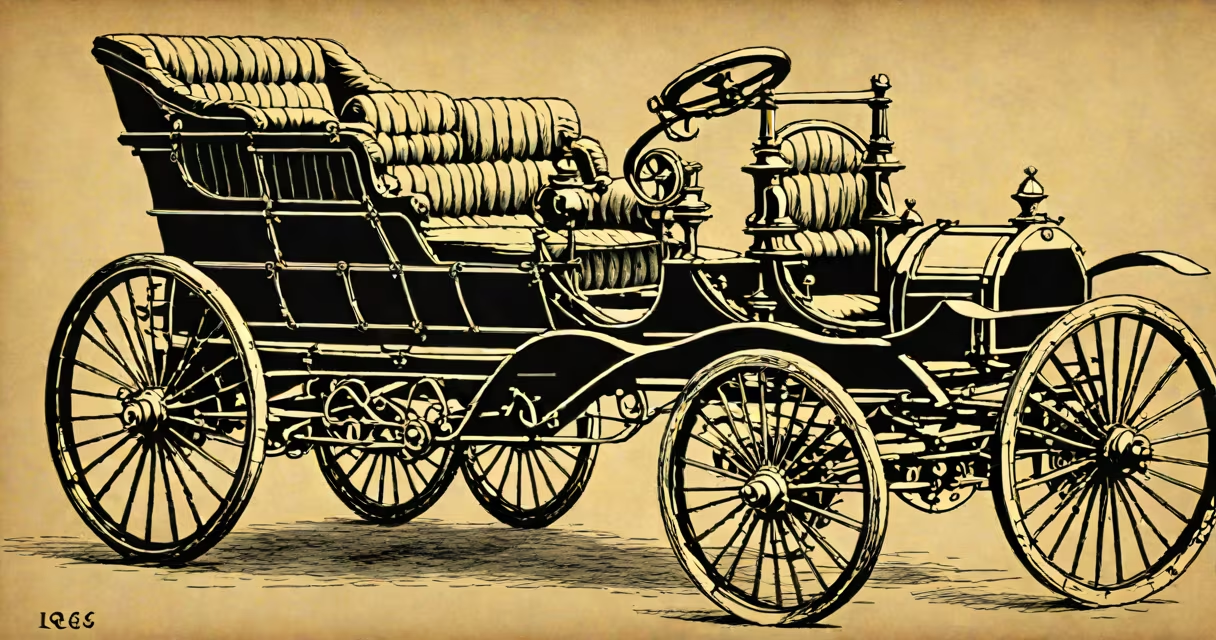
The first car was the Benz Patent-Motorwagen, a three-wheeled vehicle designed and built by German engineer Karl Benz in 1886. It ran on a single-cylinder four-stroke internal combustion engine fueled by gasoline. This model marked the beginning of the automotive era.
Karl Benz filed a patent for his vehicle on January 29, 1886, under German patent number DRP 37435. The patent described a "vehicle propelled by a gas-powered engine." That date is widely recognized as the birth of the automobile. The Patent-Motorwagen had a top speed of about 10 km/h (6 mph), traveled 10 kilometers on a single tank of fuel, and used a chain drive to power the rear wheel.
Unlike earlier horse-drawn carriages adapted with engines, the Benz Patent-Motorwagen was engineered from the ground up as a motorized vehicle. Its design included a carburetor, spark plugs, and a cooling system-all features absent in previous experimental vehicles. The engine produced 0.9 horsepower, enough to move the 100 kg (220 lb) frame over rough roads.
The Benz Patent-Motorwagen operated using a four-stroke internal combustion cycle. Air and fuel mixed in the carburetor, were compressed, ignited by a spark plug, and expelled through an exhaust valve. Each cycle took two crankshaft revolutions, producing power once per revolution.
Power transmission relied on a belt-driven chain connected to the rear wheel. Steering was managed via a tiller, not a steering wheel, and braking used a hand lever that pressed a wooden block against the rear tire. The driver sat in a forward-facing seat, with the engine mounted between the front wheels.
Despite its simplicity, the Patent-Motorwagen solved core problems of mobility. It eliminated the need for horses, reduced maintenance costs, and offered consistent speed independent of terrain. In 1888, Bertha Benz, Karl's wife, famously rode the vehicle 106 kilometers from Mannheim to Pforzheim-a trip that proved long-distance travel by car was feasible.
The Patent-Motorwagen used materials common in late 19th-century engineering: steel for the chassis, cast iron for the engine block, and wood for the wheels and body. Rubber tires were not yet standard; the wheels were solid wooden rims wrapped in leather.
Key components included:
These materials reflect the state of industrial manufacturing in 1886. Steel production had advanced enough to allow durable frames, but precision machining tools were still evolving. The engine's timing was manually adjusted using a flywheel and governor system.
The first car was used primarily for personal transport and demonstration. Karl Benz sold only 10 units of the Patent-Motorwagen before 1893. Early adopters included wealthy engineers and inventors who saw potential in mechanical mobility.
Its significance lies not in mass adoption but in proving that a self-propelled vehicle could function reliably. By 1890, Benz & Cie. began producing improved models with better suspension and larger engines. The company eventually became Daimler-Benz AG, which later evolved into Mercedes-Benz.
Today, the original Patent-Motorwagen is preserved at the Deutsches Museum in Munich. A working replica runs annually during the museum's heritage events. In 2018, the German government issued a commemorative coin honoring the 132nd anniversary of the patent filing.
Many assume the first car was a four-wheeled vehicle. The Patent-Motorwagen had only three wheels, a design choice to reduce weight and complexity. Four-wheel layouts came later, with models like the 1896 Duryea Motor Wagon.
Another myth is that Henry Ford invented the first car. Ford did not build his first vehicle until 1896, nine years after Benz's patent. The Model T, introduced in 1908, was the first mass-produced car-but not the first ever.
A lesser-known fact: the Patent-Motorwagen never had a name. Karl Benz referred to it simply as "the vehicle with a gas engine." The name "Patent-Motorwagen" was assigned later by historians and museums.
Early automobiles varied in design and purpose. Below is a comparison of key models from the 1880s and 1890s.
| Model | Year | Wheels | Engine Type | Power Output | Top Speed |
|---|---|---|---|---|---|
| Benz Patent-Motorwagen | 1886 | 3 | Gasoline, 4-stroke | 0.9 hp | 6 mph (10 km/h) |
| Duryea Motor Wagon | 1893 | 4 | Gasoline, 4-stroke | 2.5 hp | 10 mph (16 km/h) |
| Peugeot Type 5 | 1890 | 4 | Gasoline, 2-stroke | 1.5 hp | 8 mph (13 km/h) |
Each model represents a different path in early automotive development. The Benz focused on reliability and patent protection. The Duryea emphasized practicality and roadworthiness. Peugeot prioritized affordability and export markets.
In 2017, I stood less than a meter from the original Benz Patent-Motorwagen at the Deutsches Museum. The engine was cold, but the metal surfaces still held heat from decades of handling. The wooden wheels creaked slightly under touch. I watched a technician demonstrate the spark plug ignition sequence-just as it had in 1886. The silence of the room underscored how radical a machine this was: a self-moving vehicle powered by fire, not muscle.
The first car laid the foundation for modern transportation. It introduced the concept of personal mobility without animal labor. It set the precedent for engine-based propulsion, leading to the development of electric and hybrid vehicles.
According to the Encyclopedia Britannica, the Benz Patent-Motorwagen "marked the beginning of the automotive industry." The National Highway Traffic Safety Administration recognizes 1886 as the year the first vehicle was legally registered in Germany.
Understanding what was the first car clarifies the evolution of technology. It shows that innovation often begins small-on a single patent, with a modest engine, and a bold idea. The process from the Patent-Motorwagen to today's autonomous vehicles began with that one three-wheeled machine.