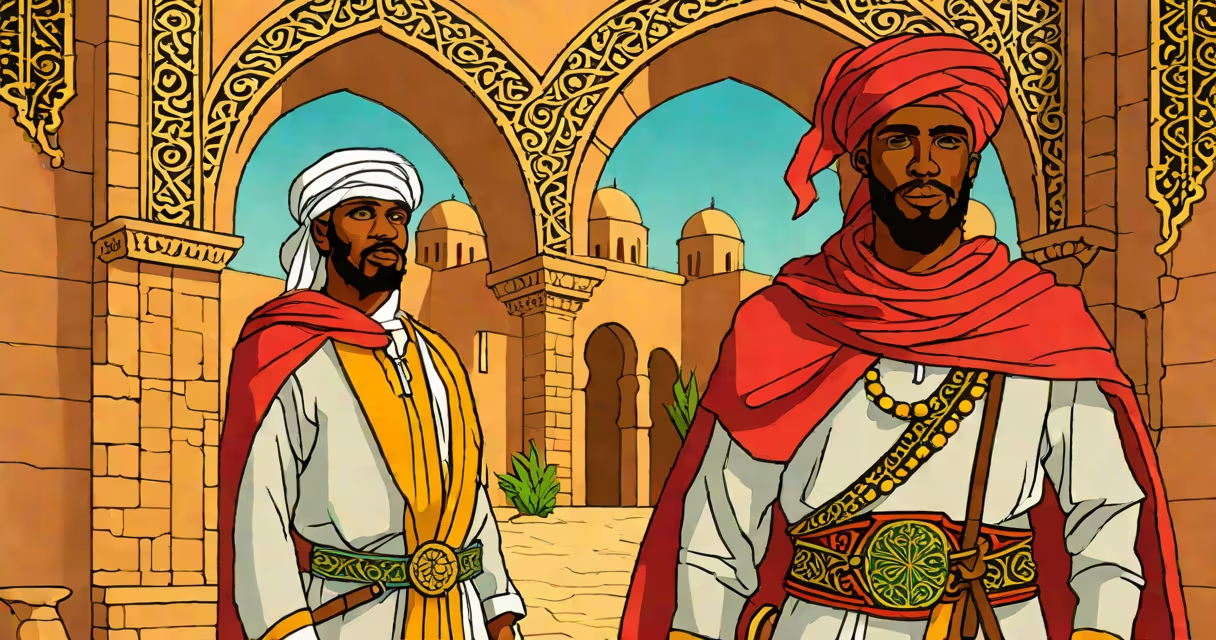
The Moors were Muslim populations originating primarily from North Africa who conquered and ruled much of the Iberian Peninsula from 711 CE until the fall of Granada in 1492. They established a sophisticated civilization in Al-Andalus, blending Arab, Berber, and local Iberian traditions.
Historical records confirm that the initial invasion was led by Tariq ibn Ziyad, a Berber general serving under the Umayyad Caliphate. His forces crossed the Strait of Gibraltar and defeated the Visigothic Kingdom in less than a year. By 718, most of modern-day Spain and Portugal lay under Muslim control.
Modern scholarship distinguishes between the term "Moor" as a historical label and the diverse ethnic and religious groups it described. The word itself derives from Latin *Maurus*, meaning "North African," and was used broadly by Christian chroniclers in medieval Europe to refer to Muslims in Iberia and North Africa alike.
Moors governed Iberia through a mix of military rule, administrative integration, and religious tolerance. Under the Umayyad emirate and later caliphate based in Córdoba, cities like Córdoba, Seville, and Granada became centers of science, philosophy, and art.
Córdoba's Great Mosque, completed in 785 CE, housed over 850 columns and had a hypostyle hall with alternating red and white arches. It remained the largest mosque in the world for centuries. The city's library held over 400,000 manuscripts-more than all of contemporary England combined.
By the 10th century, Al-Andalus was home to scholars such as Ibn Rushd (Averroes), whose commentaries on Aristotle influenced European Renaissance thinkers. Hospitals in Cordoba offered free care and employed physicians trained in Greek, Persian, and Indian medicine.
Not all Moors were ethnically the same. The population consisted of multiple groups with distinct origins:
| Type | Origin | Role in Al-Andalus | Key Fact |
|---|---|---|---|
| Arabs | Arabian Peninsula | Rulers, administrators, religious leaders | Only ~5% of the ruling class; spoke Arabic as a liturgical language |
| Berbers | North Africa (modern Morocco, Algeria) | Military commanders, settlers | Majority of early conquerors; many formed independent dynasties |
| Hispano-Muslims | Local Iberians converted to Islam | Artisans, farmers, scribes | By 1000 CE, they outnumbered Arabs and Berbers combined |
Despite shared religion, tensions arose between Arab elites and Berber soldiers. The Berber-led Almoravid dynasty (1062-1147) and Almohad movement (1130-1269) emerged partly due to dissatisfaction with Arab-dominated governance.
European Christians began using "Moor" as a racial and religious category during the Reconquista-the centuries-long campaign to reclaim Iberia. The term evolved from a geographic descriptor into a symbol of the "other."
By the 13th century, Christian kingdoms like Castile and Aragon used the term to justify war, taxation, and forced conversions. The 1492 Edict of Expulsion expelled Jews and Muslims from Spain, marking the end of multi-religious coexistence in much of the peninsula.
Even after the fall of Granada, the term persisted in European art and literature. Shakespeare's *Othello* portrays a Moorish general in Venice-a figure of power and tragedy. Modern interpretations often misrepresent him as a foreigner, though the play's setting is Ottoman-occupied Cyprus, not Iberia.
Many assume the Moors were a monolithic group unified by faith alone. This is incorrect. Religious identity did not erase ethnic, linguistic, or regional differences. Arabic was the dominant language of administration, but Andalusi Romance (a precursor to Spanish) remained widely spoken among non-Muslims and lower classes.
A common error is equating the Moors with the entire Muslim presence in Europe. In reality, Muslim rule in Iberia ended in 1492, while Muslim communities persisted in Sicily until the 11th century and in parts of southern Italy until the 15th. The term "Moor" never applied to these populations.
Another misconception: that the Moors destroyed Christian heritage. Archaeological evidence shows that churches were often repurposed, not demolished. The Church of Santa María de la Blanca in Toledo, originally a synagogue, was converted into a church after the Christian takeover-but not before being used by Jewish and Muslim communities.
In 2018, I visited the Alhambra in Granada. Standing in the Court of Lions, I noticed the 12 marble lions supporting a central fountain. Their positioning follows a precise geometric pattern based on the golden ratio. The water channels flow in Fibonacci spirals. These details were not merely decorative-they reflected Islamic principles of harmony and divine order.
I spoke with a conservator who explained that the original builders used trigonometric calculations to align the palace's windows with solar angles. The design ensured natural light distribution throughout the day. This level of precision contradicts the myth that Islamic architecture lacked scientific rigor.
The Moors were not a single people but a diverse population united by political allegiance and religious practice. They ruled Iberia for nearly eight centuries, leaving behind enduring legacies in science, engineering, and culture. Their influence persists in place names like Guadalquivir (from Arabic *Wadi al-Kabir*, "Great River"), in architectural styles like horseshoe arches, and in the Spanish language-over 4,000 words derive from Arabic roots.
Understanding who the Moors were requires moving beyond outdated stereotypes. They were not invaders in the modern sense, nor were they a homogenous force. They were builders, scholars, artisans, and rulers whose impact shaped the development of Europe.
Today, descendants of the Moors live across Spain, Morocco, and the wider Mediterranean. Genetic studies show that 15-20% of modern Spaniards carry North African mitochondrial DNA markers linked to the period of Muslim rule. The legacy of the Moors is not buried in history-it lives in the land, the language, and the people.