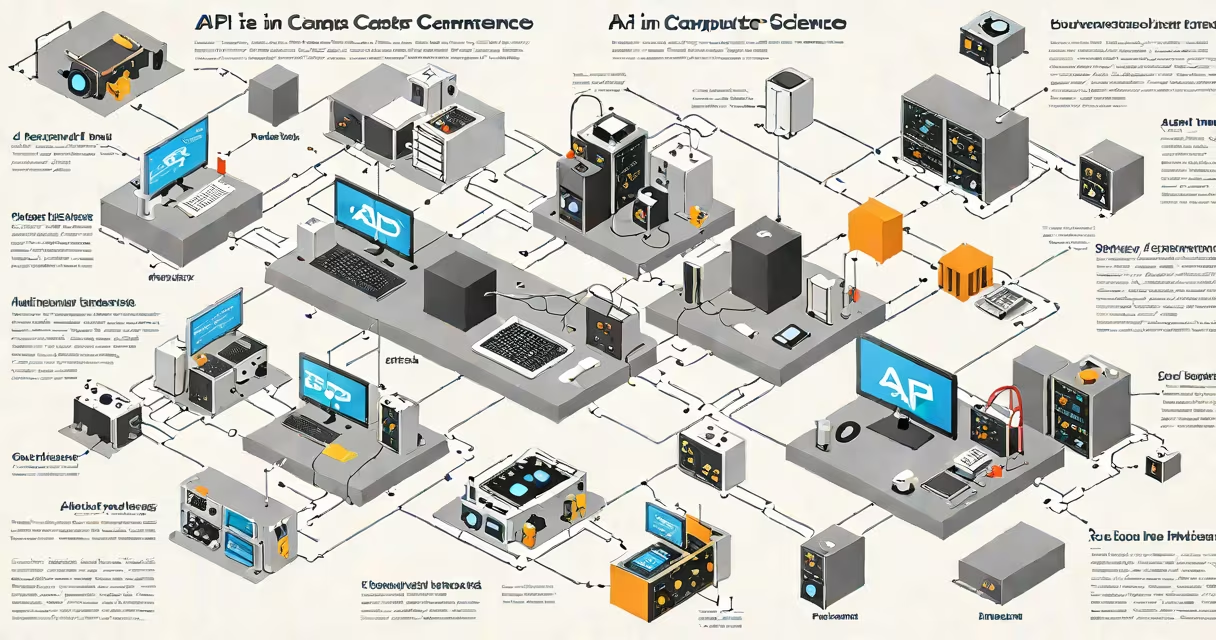
An API (Application Programming Interface) in computer science is a defined set of protocols, routines, and tools that allow different software applications to communicate and exchange data. It acts as a contract specifying how one program can request services from another, enabling modular development and interoperability across systems.
APIs are not visible components-they exist as specifications. When a web browser requests a weather forecast from a server, it uses an API to send a structured request and receive a standardized response. This interaction happens without the user seeing the underlying code or infrastructure.
For example, when a mobile app displays traffic conditions, it doesn't calculate routes itself. Instead, it sends a request to a navigation service's API using a predefined format. The API processes the request, retrieves real-time traffic data, and returns it in a consistent structure like JSON. The app then displays the result. This separation allows developers to build features quickly without reinventing core functionality.
APIs operate through well-defined endpoints-specific URLs that accept certain types of HTTP requests such as GET, POST, PUT, or DELETE. Each endpoint corresponds to a function: retrieving data, updating records, or triggering actions.
A typical API call follows a sequence: the client (e.g., a smartphone app) sends a request to the server hosting the API. The request includes authentication tokens, parameters, and headers. The server validates the request, processes it against its internal logic, and returns a response in a structured format like JSON or XML.
Consider the Google Maps API. A travel booking site integrates it by sending a request like:
GET https://maps.googleapis.com/maps/api/geocode/json?address=1600+Amphitheatre+Parkway,+Mountain+View,+CA&key=YOUR_API_KEYThe server responds with a JSON object containing the precise coordinates and address details. The site uses this data to display accurate locations on a map. The entire process takes less than a second and requires no direct access to Google's internal databases.
APIs fall into several categories based on access level, architecture, and intended audience. The most common types are public, private, partner, and composite APIs.
| Type | Access Level | Use Case Example | Security Requirements |
|---|---|---|---|
| Public | Open to all developers | Twitter's REST API for fetching tweets | API key required; rate limiting applied |
| Private | Internal use only | Banking system connecting loan processing to customer database | Authentication via OAuth 2.0; encrypted transport |
| Partner | Restricted to approved external organizations | Amazon's Seller Central API for third-party retailers | Client certificates; whitelisted IP addresses |
| Composite | Aggregates multiple backend services | Travel site combining flight, hotel, and car rental APIs | Centralized authorization layer; caching for performance |
REST (Representational State Transfer) and SOAP (Simple Object Access Protocol) are two dominant architectural styles. REST APIs use standard HTTP methods and return lightweight data formats like JSON. They're widely adopted due to simplicity and scalability. SOAP APIs rely on XML and are often used in enterprise environments requiring strict security and transaction handling.
According to the W3C's REST guidelines, stateless interactions and uniform interfaces are foundational principles. This helps each request contains all necessary context, making systems easier to debug and scale.
Many assume APIs are only for web services. In reality, they exist at every level of software architecture-from operating system calls (like Linux's syscalls) to low-level hardware drivers. Even desktop applications use APIs to interact with printers, cameras, or file systems.
Another frequent error is equating APIs with webhooks. While both enable automation, webhooks are event-driven notifications sent automatically when a condition occurs. An API is a request-response mechanism. For instance, a payment processor may use an API to authorize a transaction and a webhook to notify a merchant when funds clear.
A lesser-known fact: APIs are not inherently secure. A poorly designed API can expose sensitive data or allow unauthorized access. In 2021, researchers at Center for Internet Security (CIS) found that 76% of tested APIs had at least one critical vulnerability, including insecure endpoints and missing input validation.
Using JavaScript, I parsed the response and dynamically generated a timeline view. The system updated instantly when new courses were added. Without the API, I'd have needed to scrape web pages, which would break with design changes and violate the site's terms of service.
APIs also enable rapid prototyping. Tools like Postman allow developers to test API endpoints in isolation. You can simulate responses, check status codes, and validate payloads-all without writing a single line of production code.
APIs are not optional tools-they are fundamental structures in computer science. They define how software components relate, scale, and evolve. Mastering them means mastering the art of system design.