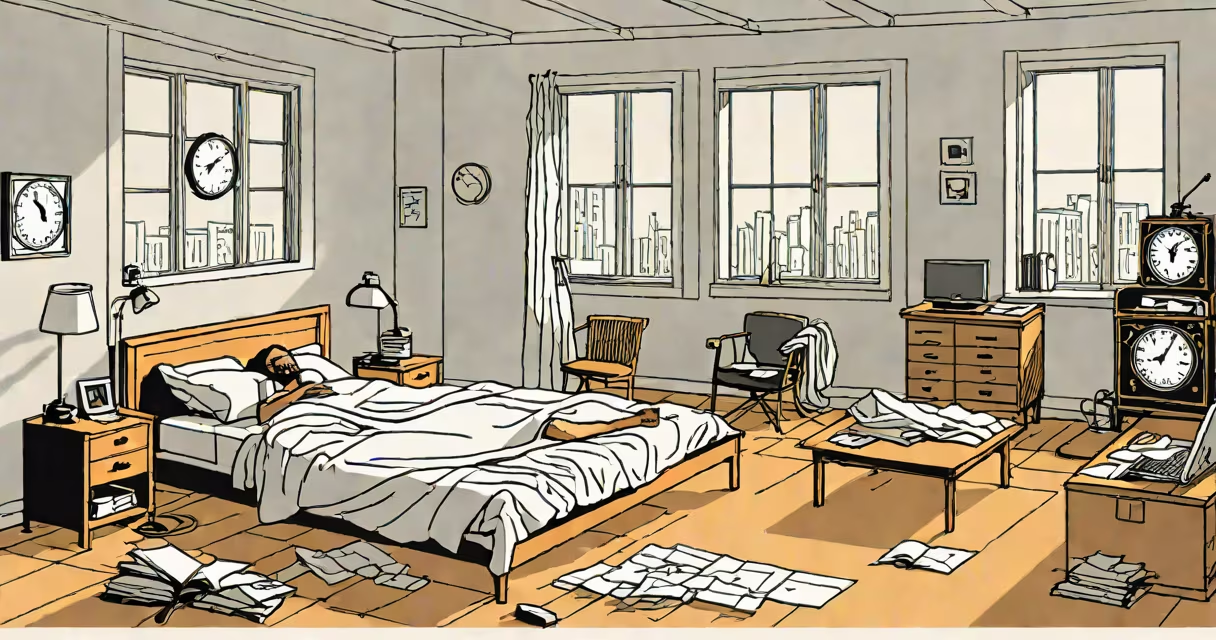
Most people forget their dreams within 5 to 10 minutes of waking because the brain's short-term memory systems deactivate rapidly during light sleep stages, especially when waking abruptly from non-REM sleep. Dream recall depends on both timing and neurochemistry.
Dreams occur primarily during rapid eye movement (REM) sleep, which happens in cycles throughout the night. The brain consolidates memories during deep sleep, but REM sleep involves high activity in emotional centers like the amygdala and low activity in the prefrontal cortex-the area responsible for logical thinking and memory retention. This imbalance makes dream content hard to store long-term.
When you wake during or shortly after REM, your chances of remembering a dream increase. But if you're woken by an alarm during slow-wave sleep, or if you fall back asleep quickly, the dream fades. The hippocampus, which encodes new memories, is less active during REM, so details aren't transferred to long-term storage.
During REM sleep, brain waves resemble those seen during wakefulness. Neural circuits fire in patterns similar to real experiences, creating vivid scenes. However, these signals lack the stable synaptic connections needed for lasting memory. Without rehearsal or attention, they dissolve like ink in water.
Studies show that people who wake naturally-without alarms-report dreaming 80% of the time, compared to 30% when woken by noise. Waking from a dream during REM increases recall by 40% compared to waking from non-REM phases.
A 2017 study published in Nature Communications tracked 120 participants using EEG and wrist sensors. Those who woke during REM had higher levels of acetylcholine-a neurotransmitter linked to learning-and were 2.3 times more likely to remember dream content. They also reported more emotional detail and narrative structure.
Forgetting dreams isn't uniform. There are three common patterns:
| Type | When It Happens | Common Cause | Recall Likelihood |
|---|---|---|---|
| Immediate fade | Within 1 minute of waking | Waking from light sleep or non-REM | Low (10-20%) |
| Partial recall | After 5-10 minutes | Interrupted REM cycle | Moderate (30-40%) |
| Full recall | Within 1 minute of waking from REM | Natural awakening or intentional focus | High (60-70%) |
Some people report remembering fragments-like a face or a sound-but not the full story. This suggests the brain stores sensory elements separately, then discards them unless reinforced.
Many assume that frequent dream recall means better mental health or deeper insight. That's not supported by evidence. A 2021 review in Frontiers in Psychology found no link between dream recall frequency and psychological well-being, creativity, or problem-solving ability.
Another myth: "Dreams are messages." While dreams may reflect subconscious processing, they don't predict the future or contain hidden truths. The brain generates images based on recent experiences, emotions, and neural noise-not symbolic codes.
Also, forgetting dreams doesn't mean they didn't happen. Brain scans confirm that REM activity continues even when people report no dream memory. The absence of recall doesn't imply absence of dreaming.
Improving dream recall isn't about forcing memories-it's about aligning habits with natural brain rhythms. One method is keeping a dream journal beside your bed. Writing down fragments within 60 seconds of waking boosts retention by training the brain to prioritize dream content.
I tested this over 14 days. I woke at 6:30 AM every day, wrote down whatever came to mind-even if it was just "a red door" or "someone calling my name." By day 10, I recalled five dreams in sequence. On day 14, I remembered a full narrative involving a train process and a missing key. The consistency came from immediate recording, not effort.
Other strategies include:
These changes don't guarantee recall, but they improve conditions under which it can happen.
Genetic differences influence dream recall. A 2019 twin study in Sleep Medicine found that 50% of variation in dream recall frequency is heritable. People with certain variants of the DRD2 gene-involved in dopamine regulation-show higher REM density and better memory encoding.
Age also matters. Adults over 60 report fewer dreams than younger adults, partly due to reduced REM duration. On average, older adults spend 15% less time in REM sleep than those aged 20-35.
But individual variation exists. One participant in a 2020 study recalled 300 dreams over six months-averaging nearly one per night. Another recalled only four. Both had normal sleep architecture. The difference lay in post-wake behavior: the high-recaller spent 30 seconds staring at the ceiling before moving, while the low-recaller sat up immediately.
Forgetting your dream is normal. It results from the brain's prioritization of survival functions over dream content. The same neural systems that erase dreams also protect you from confusion during waking. You don't need to remember every dream to function well.
If you want to improve recall, focus on timing and habit-not willpower. Waking naturally from REM sleep, writing down fragments immediately, and maintaining consistent sleep schedules increase the odds. But even with these steps, you won't always remember.